
Evidence-first supplement
guidance for families.
Structured, research-informed articles designed to help families evaluate supplement claims, understand product tradeoffs, and make calmer, more consistent decisions.
 Structured evaluation over simplified claims.
Not sure where to begin?
These three articles offer the clearest entry point depending on what you are trying to understand.
All Articles
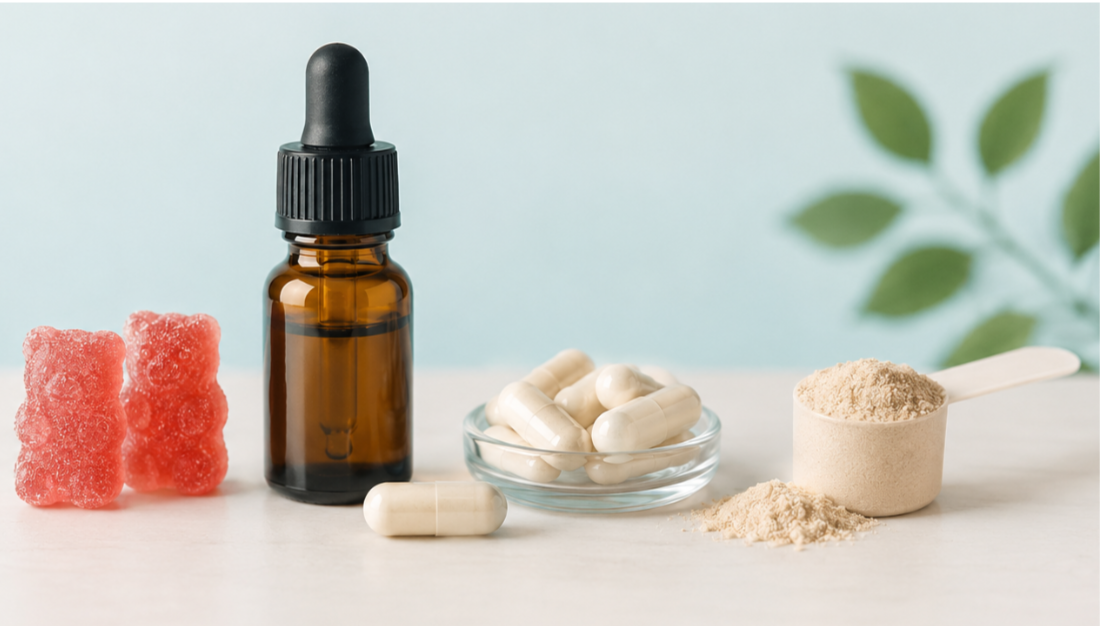
Gummy, Liquid, Capsule or Powder: Does the Form of a Supplement Matter?
The format a supplement comes in shapes more than just convenience — it affects dose accuracy, ingredient stability, and how well it actually works. A tradeoffs-focused breakdown for families.
How the form a supplement comes in affects what it does and whether it works.
You are holding two versions of the same supplement, one in gummies and one in capsules, and you have no idea whether the difference is meaningful or just a packaging decision.
It seems like it should not matter. It matters more than the label makes obvious.
Marketing often frames certain formats as automatically better absorbed, cleaner, or more effective. In reality, delivery form can matter, but usually in more practical and specific ways than the claims on the front of the bottle suggest.
This is a guide to those tradeoffs. Not a verdict on which format wins, but a clearer way to think about what each one actually changes.
Why This Question Comes Up So Often
Should a supplement be taken as a gummy, a liquid, a capsule, or a powder? These are not just preference questions — each format reflects different formulation priorities and introduces different practical tradeoffs.
Understanding what those tradeoffs actually are helps prevent marketing language from being mistaken for universal superiority.
How This Fits Within an Evidence-First Framework
Across this site, supplements are evaluated using a structured framework that considers evidence quality, dose alignment, formulation design, manufacturing quality, and practical tradeoffs. Delivery form is part of formulation design.
Different formats may influence dosing flexibility, shelf stability, ingredient limitations, ease of administration, and long-term consistency of use. Understanding these tradeoffs helps prevent delivery-form marketing from being treated as a quality signal.
A broader discussion of how supplements can be evaluated through evidence, formulation, and practical tradeoffs appears in How to Decide Whether a Supplement Is Worth Trying at All.
Delivery form is a formulation decision, not just a preference.
The format can affect what fits into the product, how stable it remains, how precisely it can be dosed, and whether it is realistic to use consistently.
Why Delivery Form Can Matter
Different supplement formats are designed to solve different practical problems. Gummies may improve acceptance for children; liquids may allow more flexible dosing; capsules may improve ingredient stability; powders may accommodate higher doses more easily.
No format is automatically ideal in every situation. The most appropriate option often depends on age, dosing needs, taste tolerance, convenience, ingredient type, and consistency of use. This is why delivery form should be evaluated as part of the broader formulation — not as a standalone quality signal.
Delivery Format Tradeoffs: Gummies, Liquids, Capsules, and Powders
| Format | Often Helpful For | Common Tradeoffs | Best Fit |
|---|---|---|---|
| Gummies | Acceptance, routine consistency, children who resist pills or powders | Lower nutrient capacity, sweeteners, stability challenges, fewer dosing options | When consistency and willingness to take the supplement are the main barriers |
| Liquids | Infants, young children, swallowing difficulties, smaller dose adjustments | Measuring inconsistency, taste challenges, shorter shelf stability, refrigeration or storage needs | When flexible dosing or swallowing difficulty matters most |
| Capsules | Ingredient stability, standardized dosing, higher ingredient amounts, fewer flavoring agents | Swallowing challenges, larger pill size, less practical for young children | When stability, precision, or ingredient density matter more than palatability |
| Powders | Larger doses, flexible serving adjustments, mixing into foods or beverages | Taste, texture, portability, measuring accuracy, ingredient settling or separation | When customization or higher ingredient amounts are useful and the user tolerates mixing |
No format is universally best. The right choice depends on the ingredient, dose, user, routine, and tradeoffs that matter most.
Gummies: Convenience and Acceptance
Gummies are popular because they are easy to take and often highly acceptable for children. In some situations, improved acceptance may support better consistency of use, which can matter practically.
At the same time, gummies introduce formulation tradeoffs including lower nutrient capacity, added sugars or sweeteners, stability challenges for certain nutrients, fewer dosing options, and difficulty accommodating larger ingredient amounts. Some gummies are thoughtfully formulated; others prioritize taste and marketing appeal over formulation precision.
A related discussion appears in Are Gummy Vitamins Worth It? An Evidence-Informed Look at Tradeoffs.
Gummies can improve acceptance, but they also narrow formulation flexibility.
A gummy format may support consistency, especially for children, but taste, texture, sweeteners, stability, and nutrient capacity still need to be evaluated.
Liquids: Flexibility and Dosing Precision
Liquid supplements can be useful when flexible dosing is important. They may be easier for infants, young children, or individuals with swallowing difficulties, and can allow smaller dose adjustments that are harder to achieve with fixed capsule or gummy formats.
However, liquid formulations may introduce other considerations including shorter shelf stability, refrigeration requirements, flavoring needs, measuring inconsistency, and ingredient degradation over time. In some cases, taste becomes a major factor influencing whether consistent use is realistic.
Liquid formats can improve flexibility, but measuring and stability still matter.
A liquid may allow smaller dose adjustments, but taste, storage, ingredient degradation, and consistency of measurement can affect real-world use.
Capsules: Stability and Simplicity
Capsules are often used when formulation stability and ingredient precision are priorities. Compared to gummies or liquids, capsules may accommodate higher ingredient amounts, reduce added sweeteners or flavoring agents, improve stability for certain nutrients, and allow more standardized dosing.
Capsules are also commonly used in research studies, meaning evidence may align more directly with capsule-based formulations. At the same time, capsules may be difficult for young children, individuals with swallowing challenges, or people sensitive to larger pill sizes. Practical usability still matters.
Capsules often support stability and precision, but only if the format is usable.
A capsule-based formulation may align well with research or ingredient stability, but it is not helpful if swallowing difficulty prevents consistent use.
Powders: Flexibility With Tradeoffs
Powder formulations can work well for nutrients requiring larger doses or customizable intake. They may allow easier mixing into foods or beverages, flexible serving adjustments, and higher ingredient capacity than gummies.
Powders are common in areas such as protein supplementation, fiber, magnesium, and electrolyte products. However, powders may also introduce challenges related to taste, mixing consistency, portability, dosing accuracy, and ingredient settling or separation. Convenience varies considerably depending on the situation.
Powders can support customization, but consistency depends on use.
Powders may allow higher amounts or flexible serving adjustments, but taste, mixing, portability, measuring accuracy, and settling can influence whether the product is used reliably.

Absorption Claims Are Often Oversimplified
Some supplement marketing strongly emphasizes absorption differences between delivery forms. While formulation can influence absorption in certain situations, these claims are often simplified beyond what evidence clearly supports.
Factors such as nutrient form, dose, timing, individual physiology, and overall formulation may matter just as much — or more — than whether a supplement is a gummy, liquid, capsule, or powder.
Understanding how marketing can overstate these distinctions is discussed further in How to Interpret Supplement Research Without Getting Misled.
Absorption is rarely just a format question.
Delivery form can matter, but nutrient form, dose, timing, formulation design, and individual context often matter just as much — and sometimes more.
Consistency Often Matters More Than Format Perfection
In real-world settings, the most practical supplement format is often the one that can be used consistently and appropriately over time. A theoretically ideal capsule may not work for a child who refuses it; a liquid may support accurate dosing but create taste-related adherence problems; a gummy may improve consistency despite formulation limitations.
This does not mean all formats are interchangeable. It means practical use matters alongside formulation theory.
Evaluating Delivery Form More Thoughtfully
Rather than assuming one format is universally superior, it can help to ask a consistent set of questions before choosing.
Before choosing a supplement format, ask:
Get the Supplement Decision Framework and the Evaluation Checklist — free, printable, and delivered straight to your inbox.
Get the Free Starter Kit →Why This Matters for Families
Families often look for supplement formats that feel easiest, safest, or most effective. But every delivery form introduces tradeoffs. Understanding those tradeoffs can reduce pressure to find a "perfect" format and instead support decisions that are more realistic, practical, and evidence-informed.
Because individual preferences, ages, and health situations vary, the most appropriate form may differ from one person or family to another.
Pulling It All Together
Gummies, liquids, capsules, and powders are not simply different packaging choices. Each delivery form affects formulation possibilities, dosing flexibility, stability, convenience, and consistency of use.
No single delivery form is universally best. An evidence-informed approach evaluates delivery forms within the broader context of evidence quality, dose appropriateness, practical tradeoffs, and real-world usability. That broader context matters far more than marketing claims alone.
Answer 6 questions and get a personalized starting point — not a product recommendation, a framework built around your family’s actual situation.
Take the Quiz →References and Further Reading
- National Institutes of Health Office of Dietary Supplements. Dietary Supplement Fact Sheets.
- U.S. Food & Drug Administration. Dietary Supplements: What You Need to Know.
- Harvard T.H. Chan School of Public Health. The Nutrition Source.
- National Center for Complementary and Integrative Health. Using Dietary Supplements Wisely.
- National Academies of Sciences, Engineering, and Medicine. Dietary Reference Intakes.
- Institute of Medicine. Dietary Reference Intakes: Applications in Dietary Assessment.
- World Health Organization. Good Manufacturing Practices (GMP) for Pharmaceutical Products.
- U.S. Pharmacopeia (USP). Quality Supplements and Verification Standards.
All sources are publicly accessible through NIH, FDA, Harvard, WHO, USP, or Google Scholar.
Transparency and Scope: Some links in this article may be affiliate links, which means Evidence First Wellness may earn a small commission if you choose to make a purchase — at no additional cost to you. Products are discussed based on formulation characteristics, not sponsorship, and affiliate relationships do not determine editorial conclusions.
This content is provided for educational purposes only and does not constitute medical advice. Individual health decisions should be made in consultation with qualified healthcare professionals.
The Evidence-Informed Family Supplement Guide covers this in depth — add your name to the waitlist ahead of launch.
Get evidence-first supplement guidance weekly — join the digest.


Are “Clean” and “Natural” Supplement Claims Meaningful — or Just Marketing?
"Clean" and "natural" appear on nearly every supplement shelf. This article examines what those terms are actually regulated to mean — and what they leave out.
What those terms actually mean on a supplement label, and why they are not enough.
Clean is not a regulated term. Natural is not a regulated term. Neither of them answers the questions that actually matter before you buy a supplement for your child.
I have worked in this industry for years and I genuinely cannot tell you what "clean" means on a supplement label. Not because I have not looked. Because there is no definition to find. Nobody is checking whether the claim is accurate because there is no standard against which to check it. "Clean" implies there is something dirty to compare it to. Nobody ever explains what that is.
The "natural" argument is its own kind of curious. Echinacea is a flower. Magnesium is a mineral. Vitamin C is an acid. At some point in the supply chain, every supplement ingredient has been extracted, concentrated, processed, or synthesized in some way. "Natural" describes where something started. It does not describe what it became.
The problem is that these words often sound more precise than they are. Unlike regulated drug claims, terms like "clean" and "natural" do not have universally standardized definitions within the supplement industry.¹ As a result, they can create the impression of safety, quality, or effectiveness before those things have been evaluated at all.
These claims may reflect real formulation choices. Some products labeled natural or clean do reflect priorities that matter to families. The issue is that the terms are broad enough to describe very different products, and they do not answer the questions that guide a good supplement decision: what is in the product, why is it included, at what dose, and what evidence supports the intended use.
What "Natural" Usually Means on Supplement Labels
In supplements, "natural" can refer to several different things: the original ingredient source, the way an ingredient was processed, the absence of artificial colors or flavors, or the overall branding style of the product. These meanings are not always consistent, and they are not interchangeable.²
A vitamin may originate from a plant source while still undergoing substantial processing before reaching the finished supplement. A synthetic ingredient may be chemically identical to a naturally occurring version. Natural may describe where an ingredient started. It does not necessarily describe what the finished ingredient does in the body, how it was controlled, or whether the dose fits the intended use.
Natural alone does not reliably predict effectiveness, absorption, safety, manufacturing quality, or suitability for children. A deeper discussion of these distinctions appears in Natural vs. Synthetic Vitamins: What the Evidence Actually Shows.
"Natural" describes a possible origin, not a final quality judgment.
A natural-source ingredient may still be processed, purified, standardized, or combined with other ingredients before it becomes part of the finished supplement.

What "Clean" Usually Signals
"Clean" is even less standardized. In practice, clean-label supplements often emphasize shorter ingredient lists, fewer dyes or flavors, fewer sweeteners or preservatives, and simplified packaging. Some families genuinely prefer these approaches, and in certain situations reducing unnecessary additives or simplifying formulas may improve tolerability.
But when you try to pin down what "clean" actually means, every interpretation falls apart quickly. If it means no additives, that is not possible, because every capsule needs a binder, and the binder is usually something like cornstarch, which is itself natural. If it means allergen-free, that is a medical consideration, not a cleanliness one, and framing allergens as "dirty" confuses two completely different things. If it means no artificial colors, that actually holds up and means something specific. If it means no sugar, sugar is a carbohydrate that exists throughout the natural world, and calling it dirty is a marketing position, not a chemistry one. The definition shifts depending on what the brand is trying to sell.
Silicon dioxide is a useful illustration. It is a mineral compound found in sand, quartz, and most rocks on earth. It is used in supplements as an anti-caking agent to keep powders from clumping. Some clean-label brands flag it as an ingredient to avoid and use rice hull powder instead. Rice hull is the outer shell of rice grain, removed during milling, then collected, dried, and processed into a fine powder before it goes into the capsule. It is doing the same job as silicon dioxide. It went through its own industrial process to get there. The only meaningful difference is that one sounds like a mineral and one sounds like a food. The marketing is built entirely on that association.
Following this logic all the way to its conclusion, the truly clean vitamin C would require someone to stand at a lemon farm and watch the manufacturer squeeze citrus by hand. In reality, the ascorbic acid in a "whole food" vitamin C supplement has been extracted, processed, concentrated, and standardized before it reaches the capsule, regardless of what the front label says. The lemon was involved at some point. The lemon was not squeezed in a clean room.
"Clean" can easily become a broad emotional signal rather than a clearly defined quality standard. Two products may both market themselves as clean while differing substantially in ingredient quality, manufacturing controls, dose alignment, stability testing, and evidence supporting use. A cleaner-looking formula may be preferable in some situations. "Clean" does not tell you whether the product is well designed, well tested, or appropriate for the person taking it.
Why These Claims Feel So Convincing
Terms like "clean" and "natural" work because they connect to something real. Parents want fewer unnecessary ingredients, simpler products, safer-feeling options, and products that appear less heavily processed. Those instincts are understandable, especially when the product is for a child.
Marketing language builds on those instincts by framing products as more pure, more trustworthy, or more aligned with wellness. The problem is not the instinct. The problem is when the label turns that instinct into a conclusion before the product has been evaluated. A product can look clean and still provide unrealistic doses, lack meaningful evidence, or rely heavily on marketing associations. A product without clean-label branding can still have strong manufacturing controls, transparent labeling, and appropriate dosing.
This is one reason evidence-informed evaluation requires looking beyond branding language.
What Matters More Than "Clean" or "Natural"
For families evaluating supplements, several factors are more decision-ready than broad front-label claims. These are the details that reveal whether a product is actually worth considering, regardless of how it is positioned.
What Matters More Than "Clean" or "Natural"
| Evaluation Factor | What to Look For | Why It Matters |
|---|---|---|
| Ingredient transparency | Clear ingredient identity, nutrient form, active amounts, and standardized extracts where relevant | A product is easier to evaluate when the label shows what is included and how much is provided |
| Dose alignment | Amounts that match the age, intended use, and available evidence | A clean-looking label does not tell you whether the dose is appropriate |
| Formulation design | Delivery format, stability, ingredient interactions, tolerability, and practical use | The finished formula matters more than the front-label claim |
| Quality signals | Testing information, manufacturing controls, supplier oversight, and clear quality claims | Important quality factors are often not visible from "clean" or "natural" language alone |
| Evidence supporting use | Research that matches the ingredient, dose, population, and intended outcome | A thoughtful-looking product still needs evidence that supports the specific use |
"Clean" and "natural" can describe preferences or formulation choices. They do not replace the need to evaluate dose, form, transparency, quality signals, and evidence.
Get the Supplement Decision Framework and the Evaluation Checklist — free, printable, and delivered straight to your inbox.
Get the Free Starter Kit →A Practical Way to Think About "Clean" and "Natural" Claims
Rather than treating these labels as proof of quality, or dismissing them entirely, it helps to treat them as starting points rather than conclusions. Ask what the claim is referring to: is it describing the ingredient source, the absence of certain additives, the processing approach, or primarily the brand positioning? Then ask whether that distinction changes the product's function, tolerability, or fit for the intended use.
Some products marketed as clean or natural do reflect formulation priorities that are worth considering. Others rely on those terms because they create strong associations around safety and wellness without adding specific information. The label can be a useful first signal. It is not a substitute for evaluating dose, evidence, quality controls, and product fit.
Why This Matters for Families
Parents are often trying to make careful choices in an environment filled with strong opinions and confident label language. "Clean" and "natural" can quickly become shorthand for safer, healthier, more responsible, or better for children. That association is understandable, especially when the goal is to avoid unnecessary ingredients and choose thoughtfully.
The issue is not the preference. The issue is when the label language creates a sense of confidence that the product has not yet earned. Supplement decisions are usually more specific than broad categories like "clean" or "natural" allow. A product that fits a family's preferences still needs to be evaluated for dose, evidence, quality controls, and intended use.
Pulling It All Together
"Clean" and "natural" are not meaningless terms, but they are often less precise than they appear. Some products using these claims reflect formulation priorities that families may reasonably care about. Others rely on the terms to create broad impressions of safety or quality without providing enough detail to evaluate the product.
The most useful question is not whether the label sounds clean enough. It is whether the product gives enough information to understand what it contains, why it is included, and whether it fits the intended use. A product can align with a family's preferences and still need to be evaluated for dose, evidence, quality controls, and product fit. Starting with the label is reasonable. Stopping there is not.
Answer 6 questions and get a personalized starting point — not a product recommendation, a framework built around your family’s actual situation.
Take the Quiz →References and Further Reading
- National Institutes of Health, Office of Dietary Supplements. Dietary Supplement Fact Sheets.
- U.S. Food & Drug Administration. Dietary Supplements: What You Need to Know.
- Harvard T.H. Chan School of Public Health. The Nutrition Source: Vitamins and Minerals.
- National Center for Complementary and Integrative Health. Using Dietary Supplements Wisely.
- National Academies of Sciences, Engineering, and Medicine. Dietary Reference Intakes: Applications in Dietary Assessment.
All sources are freely accessible or summarized via NIH, FDA, Harvard, or Google Scholar.
Content on this site is provided for educational purposes only and does not constitute medical advice. Individual health decisions should be made in consultation with qualified healthcare professionals.
The Evidence-Informed Family Supplement Guide covers this in depth — add your name to the waitlist ahead of launch.
Get evidence-first supplement guidance weekly — join the digest.

How to Decide Whether a Supplement is Worth Trying At All
A practical framework for deciding whether a supplement is worth trying — built around the questions that matter before you reach for your wallet.
A practical, evidence-informed framework for deciding whether a supplement is worth considering before comparing products, ingredients, or brands.
A parent may start looking for a supplement because a child keeps getting sick, eating feels inconsistent, sleep feels difficult, energy seems off, or someone in a parenting group recommended something that sounded reasonable. In that moment, it is easy for the question to become "Which one should I buy?" But often, the more useful question comes one step earlier: "Is this worth trying at all?"
Parents reaching for supplement information are usually trying to respond thoughtfully, not chase trends. A plausible benefit can feel like a good reason to act, especially when a child is involved. The difficulty is that a claim sounding reasonable is not the same as supplementation being the right fit for the specific concern.
This article walks through a structured way to think about supplement decisions before comparing brands, ingredient lists, or marketing claims. The goal is not to discourage supplementation. It is to help families make calmer, more proportional decisions.
Step One: Clarify the Actual Goal
Many supplement decisions begin with a vague objective: "support immunity," "improve wellness," "help with focus," "fill nutritional gaps." These goals can sound reasonable, but they are difficult to evaluate without more specificity. A goal like "support immunity" is understandable, but it does not answer the question of what would need to change, or how a family would know whether the supplement helped.
A more useful starting point is asking: What problem are we trying to address? Is there a defined concern or risk factor? Is the goal preventive, supportive, or something else? Are the expectations realistic?
Clarifying the reason helps determine whether supplementation meaningfully fits the current need, or whether another approach may be more appropriate first.
Step Two: Consider Whether a Defined Need Exists
Not all supplement decisions begin with a deficiency or elevated risk. At the same time, not every supplement marketed for general wellness addresses a clearly identified need. Situations where supplementation may be more commonly considered include picky or restrictive eating patterns, pregnancy or specific life stages, medically identified nutrient deficiencies, limited dietary intake of particular nutrients, and clinician-guided recommendations.⁴
This does not mean supplementation is automatically necessary in these situations. It means there may be a clearer reason to consider it. A broader discussion appears in Do Children Actually Need Supplements?
Step Three: Evaluate the Strength of the Evidence
Once a reason has been clarified, the next question is whether meaningful evidence supports the intended use. A claim becomes more useful when the evidence matches the person, dose, form, and outcome being considered. Important questions to ask: Was the supplement studied in the relevant population? Were meaningful outcomes measured, or primarily biomarkers? Was the dose similar to what is being considered? Are findings consistent across studies?
Randomized controlled trials are often considered the strongest form of evidence, but evidence quality varies widely depending on study design, population, duration, and outcomes.⁶ Some supplement claims are supported primarily by biological plausibility rather than demonstrated clinical outcomes. Plausibility can make a claim worth studying. It does not make the claim proven.
Understanding this distinction is discussed further in How to Interpret Supplement Research Without Getting Misled.
Step Four: Consider Potential Tradeoffs
Even when evidence suggests a supplement may be reasonable to consider, tradeoffs still matter. These may include cost, taste or ease of administration, gastrointestinal tolerance, interactions with medications or other supplements, and complexity added to daily routines.
For children especially, practicality often determines whether a supplement can be used consistently and appropriately. Tradeoffs are not proof that a supplement is a bad idea. They are part of deciding whether the expected benefit is worth the added step, cost, exposure, or routine burden.
Step Five: Avoid Treating "More" as Automatically Better
One of the most common patterns in supplement decision-making is assuming that a higher dose, more ingredients, or greater potency necessarily improves outcomes. In reality, many nutrients follow a plateau pattern: once physiological needs are met, additional intake may provide little additional benefit and can sometimes narrow safety margins.¹ The strongest option is not automatically the best-matched one.
Dose alignment matters more than potency alone. A deeper discussion appears in When "More Is Better" Becomes Risky in Supplement Use.
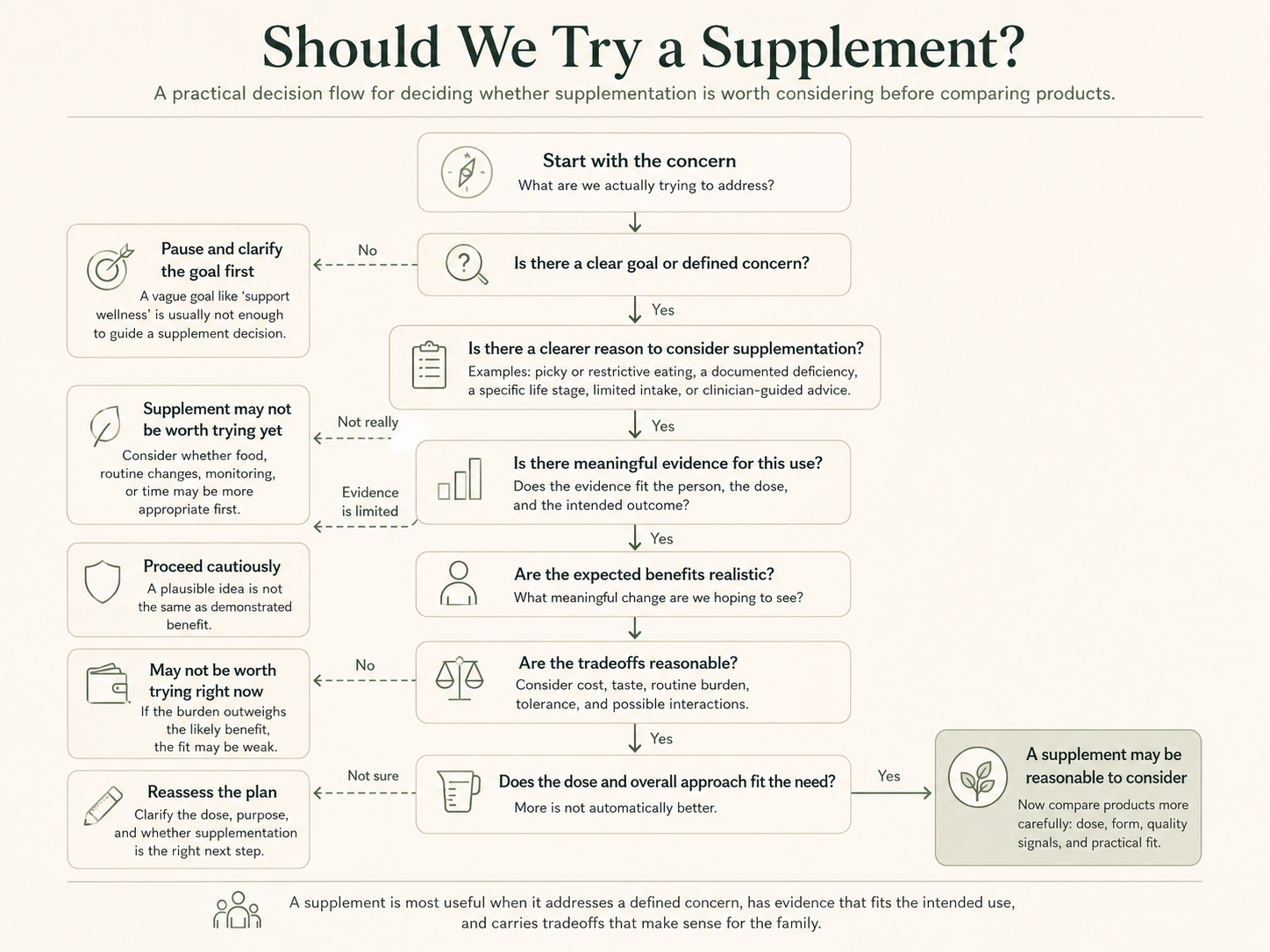
A Simple Decision Framework
Working through a few direct questions before trying a supplement helps shift the decision away from marketing pressure and toward structured evaluation.
Before trying a supplement, ask:
Evaluating Products Comes Later
If supplementation still seems reasonable after working through the broader decision process, product comparison becomes useful. That is when form, dose, quality signals, ingredient transparency, and formulation design matter. Jumping to product evaluation before this earlier step can make a decision feel more productive than it is.
The Evidence-Informed Supplement Evaluation Checklist is designed for that next step, once the reason for supplementation has been established.
How This Fits Within an Evidence-First Approach
Across Evidence First Wellness, supplements are evaluated through evidence quality, dose alignment, formulation design, quality signals, and practical tradeoffs. But those tools work best after the first question is answered: does supplementation fit the situation at all?
This article applies the same evidence-first lens used throughout this site, focusing on defined need, proportionality, and realistic expectations rather than defaulting to supplementation. For a broader explanation of how supplements are evaluated here, see How I Evaluate Supplements as a Biomedical Engineer and Quality Professional.
Use the checklist to review ingredient purpose, dose, form, quality signals, and tradeoffs once supplementation appears reasonable to consider.
View the Checklist →Use the decision flow to work through need, evidence, tradeoffs, safety, and whether supplementation fits the current situation before comparing products.
Use the Supplement Decision Flow →Why This Matters for Families
Parents often reach for supplement information during moments that already feel loaded: a child is sick again, meals feel limited, sleep is hard, school germs keep coming home, or a recommendation sounds like an easy next step. In those moments, doing something can feel more responsible than pausing.
A structured decision process helps families pause without feeling passive. It gives them a way to clarify the goal, weigh the evidence, consider tradeoffs, and decide whether supplementation fits the actual concern. Rather than assuming every concern requires supplementation, families can work through the decision more proportionally.
Because individual health situations vary, supplement decisions, especially for children or individuals with medical conditions, should ideally be made in consultation with a qualified healthcare professional.
Pulling It All Together
A supplement is most useful when it addresses a defined concern, has evidence that fits the intended use, and carries tradeoffs that make sense for the family. When those pieces are not yet clear, comparing products can make the decision feel more productive than it is.
Deciding whether a supplement is worth trying involves more than choosing a product with an impressive label. It starts earlier, by asking whether supplementation fits the actual concern: clarify the goal, evaluate the evidence, consider the tradeoffs, keep expectations realistic, and let product evaluation follow from there rather than lead it.
Get Evidence First Wellness articles and practical evaluation frameworks delivered once per week. The digest focuses on helping families better interpret supplement claims, research findings, and formulation tradeoffs.
Subscribe to the Digest →References and Further Reading
- National Institutes of Health, Office of Dietary Supplements. Dietary Supplement Fact Sheets.
- U.S. Food & Drug Administration. Dietary Supplements: What You Need to Know.
- Harvard T.H. Chan School of Public Health. The Nutrition Source: Vitamins and Minerals.
- American Academy of Pediatrics. Where We Stand: Vitamin Supplements for Children.
- National Academies of Sciences, Engineering, and Medicine. Dietary Reference Intakes: Applications in Dietary Assessment.
- Ioannidis JPA. Why Most Published Research Findings Are False. PLOS Medicine.
All sources are freely accessible or summarized via NIH, FDA, Harvard, or Google Scholar.
Transparency and Scope: Some content may include affiliate links to products that meet Evidence First Wellness evaluation criteria. If you choose to purchase through those links, Evidence First Wellness may earn a commission at no additional cost to you. Affiliate relationships do not determine editorial conclusions.
This content is provided for educational purposes only and does not constitute medical advice. Individual health decisions should be made in consultation with qualified healthcare professionals.