How I Actually Evaluate Supplements — and Why I Do It This Way
What I actually look for when evaluating a supplement, and why the front of the bottle is the last place I start.
Nobody hands you an evaluation rubric when you become a parent. You figure out car seats and sleep schedules and pediatrician wait times. Supplements just show up eventually, usually during a picky eating stretch or a string of back-to-back colds, and there is no equivalent of a consumer guide for a gummy vitamin.
I know that feeling. I also know what is on the other side of the label.
My background is in biomedical engineering, and I work as a Director of Quality in OTC and consumer health manufacturing. I spend my professional life thinking about how these products are made, evaluated, and controlled before they ever reach a shelf. That inside view changed how I look at supplement decisions entirely, and I started Evidence First Wellness because I thought it was worth sharing with families who are trying to make careful choices without a science degree or a manufacturing badge.
I am also a parent. Which means I have stood in that same aisle, held the same bottle, and felt the same pull toward whatever looked most reassuring. The difference is that I know what I am looking at when I flip it over. This site exists because I think every parent should.
Here is the honest truth: the supplement industry is not inherently bad. But it is structured around broad, reassuring language that is specific enough to feel meaningful and vague enough to apply to almost anyone, at almost any phase, on almost any given day. Immune support. Brain development. Overall wellness. These are not lies. They are just not the whole story either.
What most families are missing is not more information. It is a better set of questions. This article is where those questions come from.
What "Evidence-Based" Actually Means, and What It Does Not
"Evidence-based" is one of the most overused phrases in the wellness space. It gets used the way "natural" does: as a signal, not a standard.
When I use the term evidence-based, I do not mean that a product has glowing reviews, that an ingredient has been trending for two years, or that a study exists somewhere with the right words in the title. I mean that there is biological plausibility, a meaningful dose, an appropriate form, and evidence that is actually relevant to the person using it.
I also mean being comfortable with uncertainty, which is harder than it sounds. Not every supplement has strong data behind it, and that does not automatically make it useless. But it does change how cautiously it should be approached, and how much confidence should be placed in the claim on the front of the bottle.
Signals Worth Questioning vs. Questions Worth Asking
Why Supplement Claims Require a Different Kind of Scrutiny
A lot of parents assume that if a supplement is being sold legally, its claims have been evaluated the same way a medication would be. That is not quite how it works, and understanding this gap matters more than almost anything else.
In the United States, dietary supplements are regulated by the FDA. Manufacturing practices, ingredient safety, and labeling requirements all fall under that umbrella. But unlike prescription drugs or over-the-counter medications, supplement claims are not reviewed or approved by the FDA before products go to market, as long as those claims do not cross into diagnosing, treating, preventing, or curing disease.
So a label can say it supports immune health, normal development, or overall wellness without undergoing the kind of pre-market scrutiny a drug claim would require. That is legal. It is also worth knowing when you are standing in the aisle trying to figure out what is actually worth your money.
This is not an argument against supplements. It is an argument for understanding what the regulatory landscape actually looks like before deciding how much weight to put on any given claim. A claim can be legal, compliant, and still incomplete for decision-making.
The Lens I Use When Evaluating Supplements
Because of how I think professionally, I tend to approach supplements the way I approach most things in quality systems: as a set of inputs, controls, and processes that either hold up under scrutiny or do not.
That means I do not start with the brand. I do not start with the marketing language. I start with the mechanism, the formulation, and the context in which the product is likely to be used. And then I ask whether all three of those things actually connect.
What I have found, after years of doing this, is that the gap between what a supplement promises and what it can reasonably deliver is almost always a formulation problem. The ingredient is real. The research is real. But the dose is too low, or the form does not absorb well, or the product relies on adult clinical data applied to a child. Details that sound small but actually carry a lot of weight.
The goal is not skepticism for its own sake. It is better fit and better reasoning. A supplement should be evaluated by how well its evidence, formulation, dose, and context align with the person and purpose it is meant to support.
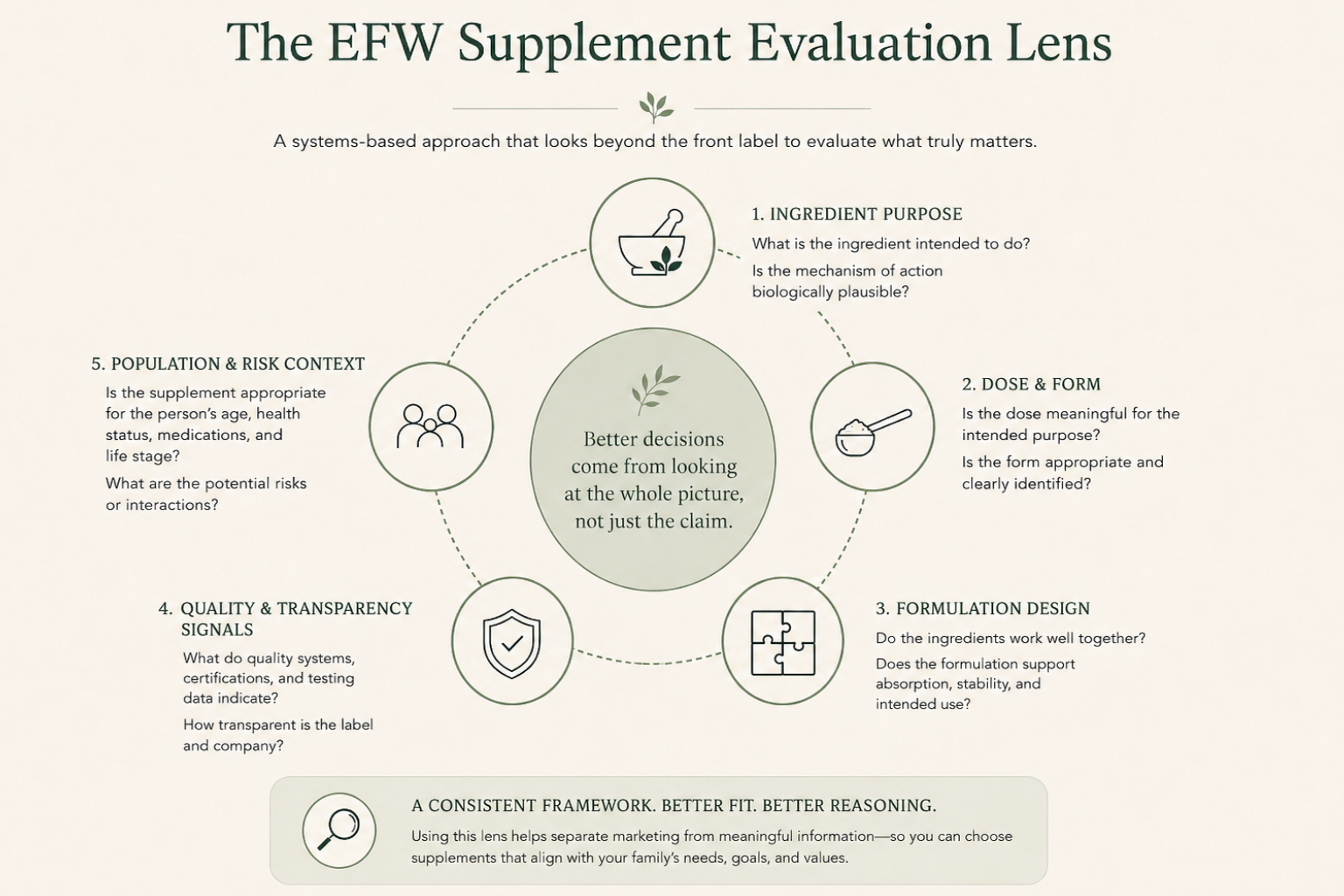
The Five Things I Look at When Evaluating a Supplement
1. Ingredient Identity and Purpose
The first question is simple: why is this ingredient here?
Many supplements contain ingredients that are included for marketing appeal, present at doses too low to do much of anything, or poorly matched to the stated purpose. I look for a clear connection between the ingredient, its known biological roles, and the claim being made. If that connection is not obvious, or requires a lot of creative interpretation to get there, that is a signal worth paying attention to.
2. Dosage and Form Matter More Than Most People Realize
Knowing the name of an ingredient is not the same as knowing whether the product contains enough of it to matter.
Dosage matters. Form matters. A supplement can include a well-studied ingredient and still be unlikely to do much if the dose is too low, the form is poorly absorbed, or it competes with other ingredients in the formulation. This gap between ingredient recognition and real-world effectiveness is one of the most common sources of confusion in supplements, and it almost never appears on the front label.
3. Formulation Quality Is Often Overlooked
Supplements are not just collections of ingredients thrown together. They are formulations, and how ingredients interact, how stable they are over time, and how they are delivered all affect whether a product performs the way it is supposed to.
A formulation can look good on paper and still fall short if it was not designed thoughtfully as a system. This is the part that is hardest to evaluate from a label alone, but transparency around it, or the lack of it, tells you a lot.
4. Label Transparency Tells You a Lot
A label cannot tell you everything. But it tells you more than many people realize, and what is missing is often as useful as what is there.
I pay attention to whether ingredients are clearly identified, whether doses are disclosed, whether claims are specific or vague, and what information has been left out. Proprietary blends, excessive buzzwords, and ambiguous language often signal that marketing considerations outweighed clarity in the design of the product. Transparency does not guarantee quality. But lack of it should raise questions.
5. Risk and Population Context Are Non-Negotiable
A supplement that makes sense for a healthy adult is not automatically appropriate for a child, someone who is pregnant, or someone taking medications.
I always consider who a supplement is intended for, who it may not be appropriate for, and what the margin for error looks like. For families especially, this context matters. Children are not small adults, and the research base for pediatric supplementation is different in ways that affect how claims should be interpreted.
What is the ingredient supposed to do? Is the dose meaningful for that purpose? Is the form appropriate and clearly identified? Does the formulation make sense as a system? Is this product appropriate for the person who will actually use it?
What I Do Not Start With, On Purpose
There are several things I deliberately set aside when evaluating a supplement: brand popularity, influencer recommendations, trend status, and "clean" or "natural" labels without a clear definition attached.
These signals are not worthless. But they are not substitutes for understanding how a product actually works, or whether it makes sense for the person considering it. They come later, if at all.
What I Set Aside vs. What I Look at First
Get the Supplement Decision Framework and the Evaluation Checklist — free, printable, and delivered straight to your inbox.
Get the Free Starter Kit →Why This Matters for Families
When you are making decisions for yourself, uncertainty feels manageable. When you are making decisions for a child, it feels different. The stakes feel higher. The pressure to do the right thing is louder.
Parents are not failing when they feel confused in the supplement aisle. The confusion is built into the design of these products. Labels are written to land in exactly the moment when you are tired, a little worried, and looking for something that sounds like a solution.
Better supplement decisions do not require perfect certainty. They require a better set of questions. The goal is not to eliminate every uncertainty. It is to stop relying on marketing shortcuts when evidence, dose, formulation, and context provide a clearer way to think. That is what this site is for. And it is what this framework is built around.
How to Use This Going Forward
You do not need a science background to use this framework. You need to know what to look for, and the willingness to slow down before the decision gets made on autopilot.
As you read content on this site, you will see these same questions applied repeatedly across specific supplements, ingredient categories, and real-world decisions. The Frameworks and Decision Tools hub applies this same lens in a more structured, interactive format.
Over time, it becomes more intuitive. And supplement decisions start to feel a lot less like decoding a marketing experiment.
Answer 6 questions and get a personalized starting point — not a product recommendation, a framework built around your family’s actual situation.
Take the Quiz →Content on this site is provided for educational purposes only and does not constitute medical advice. Individual health decisions should be made in consultation with qualified healthcare professionals.
The Evidence-Informed Family Supplement Guide covers this in depth — add your name to the waitlist ahead of launch.
Get evidence-first supplement guidance weekly — join the digest.