
Evidence-first supplement
guidance for families.
Structured, research-informed articles designed to help families evaluate supplement claims, understand product tradeoffs, and make calmer, more consistent decisions.
 Structured evaluation over simplified claims.
Not sure where to begin?
These three articles offer the clearest entry point depending on what you are trying to understand.
All Articles

Third-Party Testing Explained: What Certification Does and Doesn’t Mean
Third-party certification can verify identity, purity, and manufacturing quality — but it doesn't answer every supplement decision question. Here's what the logos actually mean.
What third-party certification seals actually verify, and what they do not.
The seal in the corner is there for a reason. Whether the reason is the one you think it is takes a bit more context.
Third-party certification can tell you something real. It just cannot tell you everything. The seal answers quality questions, not clinical ones. It does not say whether a supplement is necessary, or well-dosed, or backed by meaningful research for your child's specific situation. That part still has to come from you.
This article is about what the seal can and cannot do, and how to use it as one part of a more complete evaluation.
How This Fits Within an Evidence-First Approach
When evaluating any supplement, quality is one piece of the picture. Third-party testing is the part that helps answer whether a product contains what the label says, avoids contamination, and was made under appropriate standards. It does not weigh in on whether the supplement is needed, effective, or the right dose for your child.
For more on how those factors fit together, see How I Evaluate Supplements.
Certification is a quality signal, not a clinical conclusion.
Third-party testing can support confidence in identity, purity, potency, and manufacturing practices, but it does not determine whether a supplement is needed, effective, or appropriately dosed.
What Third-Party Testing Means
Third-party testing refers to independent evaluation conducted by organizations separate from the supplement manufacturer.² These programs typically assess whether a product contains the ingredients listed on the label, avoids unacceptable contamination, meets certain manufacturing standards, and maintains appropriate potency within defined limits.
Independent verification can improve transparency and accountability within the supplement market.³ Third-party testing helps answer quality questions. It does not answer every decision question.
Common Certification Programs Families May See
Several organizations provide supplement verification programs. Each has specific criteria and testing protocols.
USP (United States Pharmacopeia)
USP's verification program evaluates ingredient identity, purity, potency, and manufacturing quality.⁴ A deeper look at what USP standards and monographs specifically involve is covered in a separate article in this series.
NSF International
NSF certification programs evaluate manufacturing standards and product testing.⁵ NSF also operates athlete-focused programs that screen for banned substances, which reflects a broader testing scope depending on the product category.
Other testing organizations and quality seals may appear on labels depending on the product category. The presence of any certification logo should prompt the question of what, specifically, that program evaluates.
What Certification Programs Typically Evaluate
While requirements vary across programs, third-party testing commonly focuses on ingredient identity, confirming that what is listed on the label is present in the product; purity and contaminant screening, including potential heavy metals, microbial contamination, or adulterants; potency verification, checking whether the amount of a nutrient aligns with the labeled dose within an acceptable range; and manufacturing quality, including facility inspections and quality system review.⁶
These steps help verify that products meet defined quality expectations before or after reaching the market.
What Certification Can Tell You, and What It Cannot
| Evaluation Question | What Certification Can Help Address | What Still Needs Separate Evaluation |
|---|---|---|
| Is the ingredient what the label says it is? | Ingredient identity testing and label accuracy | Whether that ingredient is useful for the intended purpose |
| Is the product within potency expectations? | Whether labeled amounts are present within defined limits | Whether the dose is appropriate for the person and goal |
| Is the product screened for certain contaminants? | Purity testing and contaminant screening, depending on the program | Whether the supplement is necessary or beneficial |
| Was manufacturing quality reviewed? | Manufacturing practices, facility review, and quality systems | Whether the formulation, evidence, and intended use make sense |
| Does the logo mean the supplement works? | Quality confidence around selected product attributes | Clinical effectiveness, necessity, safety for the individual, and product fit |
Certification can strengthen confidence in selected quality attributes. It does not replace evaluation of evidence, dose, intended use, or whether supplementation is appropriate.
What Certification Does Not Guarantee
Although certification can provide useful quality information, it does not answer several important questions families often care about. Certification does not determine whether a supplement is necessary, whether the dose is appropriate for a child, whether clinical outcomes are supported by research, or whether the formulation is a good fit for a specific person or family.⁷
A certified product can be well verified and still not be the right supplement, dose, or category for a particular child or family. These questions require evaluating evidence, intended use, dose, and individual need.
Deciding Whether a Supplement Is Worth Considering
Certification can help verify product quality, but it does not determine whether supplementation is necessary in the first place. Before comparing certified products, it can be helpful to step back and ask broader questions about purpose, evidence, and practical tradeoffs.
How Certification Logos Can Be Misinterpreted
Certification symbols create understandable reassurance. The logo may be interpreted more broadly than intended. A parent might assume that a certified supplement has been shown to improve health outcomes or is universally recommended for children. In practice, certification programs evaluate quality and manufacturing standards, not clinical effectiveness.⁸
The logo is not the problem. The problem is when the logo is asked to answer questions it was not designed to answer. A related discussion of how label elements can be overinterpreted appears in Red Flags on Supplement Labels That Should Give Parents Pause.
Why Quality Verification Still Matters
Despite these limitations, third-party testing can play a meaningful role. Independent verification helps reduce uncertainty around ingredient identity, contamination risk, and manufacturing quality.
In a market where supplement oversight differs from prescription pharmaceuticals, quality verification can provide helpful additional assurance.⁹ Useful but incomplete is still useful. Certification works best when combined with thoughtful evaluation of formulation, dose, and purpose.
Get the Supplement Decision Framework and the Evaluation Checklist — free, printable, and delivered straight to your inbox.
Get the Free Starter Kit →A Practical Way to Interpret Certification Logos
When you see a certification logo, curiosity is more useful than assumption. The questions below help translate a logo into the specific information it can and cannot provide.
When you see a certification logo, ask:
Transparency around evidence sources can help readers evaluate claims more confidently. You can review how research is selected and cited throughout this site in How We Cite Evidence.
Why This Matters for Families
Parents look for signals they can trust, especially when the decision involves a child. A certification logo is one. The problem is not that it is untrustworthy. It is that it answers a narrower set of questions than most people assume. It tells you about quality and manufacturing. It does not tell you whether the supplement belongs in your child's routine.
Use the seal for what it is. Then keep asking the rest of the questions.
Pulling It All Together
Third-party certification is a quality signal, not a clinical verdict. It tells you something worth knowing about what is in the bottle and how it was made. It does not tell you whether the supplement is necessary, whether the dose is right, or whether the evidence supports the claim on the front of the label.
Useful and incomplete can both be true at the same time. The seal earns its place in the evaluation. It just does not end it.
Answer 6 questions and get a personalized starting point — not a product recommendation, a framework built around your family’s actual situation.
Take the Quiz →References and Further Reading
- U.S. Food & Drug Administration. Dietary Supplements: What You Need to Know.
- U.S. Food & Drug Administration. Dietary Supplement Labeling Guide.
- U.S. Food & Drug Administration. Current Good Manufacturing Practice (CGMP) Regulations for Dietary Supplements.
- United States Pharmacopeia (USP). USP Verified Dietary Supplements Program.
- NSF International. NSF/ANSI 173 Dietary Supplements Certification Program.
- National Institutes of Health, Office of Dietary Supplements. Dietary Supplement Fact Sheets.
- U.S. Food & Drug Administration. Questions and Answers on Dietary Supplements.
- Federal Trade Commission. Dietary Supplements: Advertising Guidance for Industry.
- National Institutes of Health, Office of Dietary Supplements. Using Dietary Supplements Wisely.
All sources are freely accessible or summarized via NIH, FDA, FTC, Harvard, or Google Scholar.
Content on this site is provided for educational purposes only and does not constitute medical advice. Individual health decisions should be made in consultation with qualified healthcare professionals.
The Evidence-Informed Family Supplement Guide covers this in depth — add your name to the waitlist ahead of launch.
Get evidence-first supplement guidance weekly — join the digest.

Are “Clean” and “Natural” Supplement Claims Meaningful — or Just Marketing?
"Clean" and "natural" appear on nearly every supplement shelf. This article examines what those terms are actually regulated to mean — and what they leave out.
What those terms actually mean on a supplement label, and why they are not enough.
Clean is not a regulated term. Natural is not a regulated term. Neither of them answers the questions that actually matter before you buy a supplement for your child.
I have worked in this industry for years and I genuinely cannot tell you what "clean" means on a supplement label. Not because I have not looked. Because there is no definition to find. Nobody is checking whether the claim is accurate because there is no standard against which to check it. "Clean" implies there is something dirty to compare it to. Nobody ever explains what that is.
The "natural" argument is its own kind of curious. Echinacea is a flower. Magnesium is a mineral. Vitamin C is an acid. At some point in the supply chain, every supplement ingredient has been extracted, concentrated, processed, or synthesized in some way. "Natural" describes where something started. It does not describe what it became.
The problem is that these words often sound more precise than they are. Unlike regulated drug claims, terms like "clean" and "natural" do not have universally standardized definitions within the supplement industry.¹ As a result, they can create the impression of safety, quality, or effectiveness before those things have been evaluated at all.
These claims may reflect real formulation choices. Some products labeled natural or clean do reflect priorities that matter to families. The issue is that the terms are broad enough to describe very different products, and they do not answer the questions that guide a good supplement decision: what is in the product, why is it included, at what dose, and what evidence supports the intended use.
What "Natural" Usually Means on Supplement Labels
In supplements, "natural" can refer to several different things: the original ingredient source, the way an ingredient was processed, the absence of artificial colors or flavors, or the overall branding style of the product. These meanings are not always consistent, and they are not interchangeable.²
A vitamin may originate from a plant source while still undergoing substantial processing before reaching the finished supplement. A synthetic ingredient may be chemically identical to a naturally occurring version. Natural may describe where an ingredient started. It does not necessarily describe what the finished ingredient does in the body, how it was controlled, or whether the dose fits the intended use.
Natural alone does not reliably predict effectiveness, absorption, safety, manufacturing quality, or suitability for children. A deeper discussion of these distinctions appears in Natural vs. Synthetic Vitamins: What the Evidence Actually Shows.
"Natural" describes a possible origin, not a final quality judgment.
A natural-source ingredient may still be processed, purified, standardized, or combined with other ingredients before it becomes part of the finished supplement.

What "Clean" Usually Signals
"Clean" is even less standardized. In practice, clean-label supplements often emphasize shorter ingredient lists, fewer dyes or flavors, fewer sweeteners or preservatives, and simplified packaging. Some families genuinely prefer these approaches, and in certain situations reducing unnecessary additives or simplifying formulas may improve tolerability.
But when you try to pin down what "clean" actually means, every interpretation falls apart quickly. If it means no additives, that is not possible, because every capsule needs a binder, and the binder is usually something like cornstarch, which is itself natural. If it means allergen-free, that is a medical consideration, not a cleanliness one, and framing allergens as "dirty" confuses two completely different things. If it means no artificial colors, that actually holds up and means something specific. If it means no sugar, sugar is a carbohydrate that exists throughout the natural world, and calling it dirty is a marketing position, not a chemistry one. The definition shifts depending on what the brand is trying to sell.
Silicon dioxide is a useful illustration. It is a mineral compound found in sand, quartz, and most rocks on earth. It is used in supplements as an anti-caking agent to keep powders from clumping. Some clean-label brands flag it as an ingredient to avoid and use rice hull powder instead. Rice hull is the outer shell of rice grain, removed during milling, then collected, dried, and processed into a fine powder before it goes into the capsule. It is doing the same job as silicon dioxide. It went through its own industrial process to get there. The only meaningful difference is that one sounds like a mineral and one sounds like a food. The marketing is built entirely on that association.
Following this logic all the way to its conclusion, the truly clean vitamin C would require someone to stand at a lemon farm and watch the manufacturer squeeze citrus by hand. In reality, the ascorbic acid in a "whole food" vitamin C supplement has been extracted, processed, concentrated, and standardized before it reaches the capsule, regardless of what the front label says. The lemon was involved at some point. The lemon was not squeezed in a clean room.
"Clean" can easily become a broad emotional signal rather than a clearly defined quality standard. Two products may both market themselves as clean while differing substantially in ingredient quality, manufacturing controls, dose alignment, stability testing, and evidence supporting use. A cleaner-looking formula may be preferable in some situations. "Clean" does not tell you whether the product is well designed, well tested, or appropriate for the person taking it.
Why These Claims Feel So Convincing
Terms like "clean" and "natural" work because they connect to something real. Parents want fewer unnecessary ingredients, simpler products, safer-feeling options, and products that appear less heavily processed. Those instincts are understandable, especially when the product is for a child.
Marketing language builds on those instincts by framing products as more pure, more trustworthy, or more aligned with wellness. The problem is not the instinct. The problem is when the label turns that instinct into a conclusion before the product has been evaluated. A product can look clean and still provide unrealistic doses, lack meaningful evidence, or rely heavily on marketing associations. A product without clean-label branding can still have strong manufacturing controls, transparent labeling, and appropriate dosing.
This is one reason evidence-informed evaluation requires looking beyond branding language.
What Matters More Than "Clean" or "Natural"
For families evaluating supplements, several factors are more decision-ready than broad front-label claims. These are the details that reveal whether a product is actually worth considering, regardless of how it is positioned.
What Matters More Than "Clean" or "Natural"
| Evaluation Factor | What to Look For | Why It Matters |
|---|---|---|
| Ingredient transparency | Clear ingredient identity, nutrient form, active amounts, and standardized extracts where relevant | A product is easier to evaluate when the label shows what is included and how much is provided |
| Dose alignment | Amounts that match the age, intended use, and available evidence | A clean-looking label does not tell you whether the dose is appropriate |
| Formulation design | Delivery format, stability, ingredient interactions, tolerability, and practical use | The finished formula matters more than the front-label claim |
| Quality signals | Testing information, manufacturing controls, supplier oversight, and clear quality claims | Important quality factors are often not visible from "clean" or "natural" language alone |
| Evidence supporting use | Research that matches the ingredient, dose, population, and intended outcome | A thoughtful-looking product still needs evidence that supports the specific use |
"Clean" and "natural" can describe preferences or formulation choices. They do not replace the need to evaluate dose, form, transparency, quality signals, and evidence.
Get the Supplement Decision Framework and the Evaluation Checklist — free, printable, and delivered straight to your inbox.
Get the Free Starter Kit →A Practical Way to Think About "Clean" and "Natural" Claims
Rather than treating these labels as proof of quality, or dismissing them entirely, it helps to treat them as starting points rather than conclusions. Ask what the claim is referring to: is it describing the ingredient source, the absence of certain additives, the processing approach, or primarily the brand positioning? Then ask whether that distinction changes the product's function, tolerability, or fit for the intended use.
Some products marketed as clean or natural do reflect formulation priorities that are worth considering. Others rely on those terms because they create strong associations around safety and wellness without adding specific information. The label can be a useful first signal. It is not a substitute for evaluating dose, evidence, quality controls, and product fit.
Why This Matters for Families
Parents are often trying to make careful choices in an environment filled with strong opinions and confident label language. "Clean" and "natural" can quickly become shorthand for safer, healthier, more responsible, or better for children. That association is understandable, especially when the goal is to avoid unnecessary ingredients and choose thoughtfully.
The issue is not the preference. The issue is when the label language creates a sense of confidence that the product has not yet earned. Supplement decisions are usually more specific than broad categories like "clean" or "natural" allow. A product that fits a family's preferences still needs to be evaluated for dose, evidence, quality controls, and intended use.
Pulling It All Together
"Clean" and "natural" are not meaningless terms, but they are often less precise than they appear. Some products using these claims reflect formulation priorities that families may reasonably care about. Others rely on the terms to create broad impressions of safety or quality without providing enough detail to evaluate the product.
The most useful question is not whether the label sounds clean enough. It is whether the product gives enough information to understand what it contains, why it is included, and whether it fits the intended use. A product can align with a family's preferences and still need to be evaluated for dose, evidence, quality controls, and product fit. Starting with the label is reasonable. Stopping there is not.
Answer 6 questions and get a personalized starting point — not a product recommendation, a framework built around your family’s actual situation.
Take the Quiz →References and Further Reading
- National Institutes of Health, Office of Dietary Supplements. Dietary Supplement Fact Sheets.
- U.S. Food & Drug Administration. Dietary Supplements: What You Need to Know.
- Harvard T.H. Chan School of Public Health. The Nutrition Source: Vitamins and Minerals.
- National Center for Complementary and Integrative Health. Using Dietary Supplements Wisely.
- National Academies of Sciences, Engineering, and Medicine. Dietary Reference Intakes: Applications in Dietary Assessment.
All sources are freely accessible or summarized via NIH, FDA, Harvard, or Google Scholar.
Content on this site is provided for educational purposes only and does not constitute medical advice. Individual health decisions should be made in consultation with qualified healthcare professionals.
The Evidence-Informed Family Supplement Guide covers this in depth — add your name to the waitlist ahead of launch.
Get evidence-first supplement guidance weekly — join the digest.

How to Decide Whether a Supplement is Worth Trying At All
A practical framework for deciding whether a supplement is worth trying — built around the questions that matter before you reach for your wallet.
A practical, evidence-informed framework for deciding whether a supplement is worth considering before comparing products, ingredients, or brands.
A parent may start looking for a supplement because a child keeps getting sick, eating feels inconsistent, sleep feels difficult, energy seems off, or someone in a parenting group recommended something that sounded reasonable. In that moment, it is easy for the question to become "Which one should I buy?" But often, the more useful question comes one step earlier: "Is this worth trying at all?"
Parents reaching for supplement information are usually trying to respond thoughtfully, not chase trends. A plausible benefit can feel like a good reason to act, especially when a child is involved. The difficulty is that a claim sounding reasonable is not the same as supplementation being the right fit for the specific concern.
This article walks through a structured way to think about supplement decisions before comparing brands, ingredient lists, or marketing claims. The goal is not to discourage supplementation. It is to help families make calmer, more proportional decisions.
Step One: Clarify the Actual Goal
Many supplement decisions begin with a vague objective: "support immunity," "improve wellness," "help with focus," "fill nutritional gaps." These goals can sound reasonable, but they are difficult to evaluate without more specificity. A goal like "support immunity" is understandable, but it does not answer the question of what would need to change, or how a family would know whether the supplement helped.
A more useful starting point is asking: What problem are we trying to address? Is there a defined concern or risk factor? Is the goal preventive, supportive, or something else? Are the expectations realistic?
Clarifying the reason helps determine whether supplementation meaningfully fits the current need, or whether another approach may be more appropriate first.
Step Two: Consider Whether a Defined Need Exists
Not all supplement decisions begin with a deficiency or elevated risk. At the same time, not every supplement marketed for general wellness addresses a clearly identified need. Situations where supplementation may be more commonly considered include picky or restrictive eating patterns, pregnancy or specific life stages, medically identified nutrient deficiencies, limited dietary intake of particular nutrients, and clinician-guided recommendations.⁴
This does not mean supplementation is automatically necessary in these situations. It means there may be a clearer reason to consider it. A broader discussion appears in Do Children Actually Need Supplements?
Step Three: Evaluate the Strength of the Evidence
Once a reason has been clarified, the next question is whether meaningful evidence supports the intended use. A claim becomes more useful when the evidence matches the person, dose, form, and outcome being considered. Important questions to ask: Was the supplement studied in the relevant population? Were meaningful outcomes measured, or primarily biomarkers? Was the dose similar to what is being considered? Are findings consistent across studies?
Randomized controlled trials are often considered the strongest form of evidence, but evidence quality varies widely depending on study design, population, duration, and outcomes.⁶ Some supplement claims are supported primarily by biological plausibility rather than demonstrated clinical outcomes. Plausibility can make a claim worth studying. It does not make the claim proven.
Understanding this distinction is discussed further in How to Interpret Supplement Research Without Getting Misled.
Step Four: Consider Potential Tradeoffs
Even when evidence suggests a supplement may be reasonable to consider, tradeoffs still matter. These may include cost, taste or ease of administration, gastrointestinal tolerance, interactions with medications or other supplements, and complexity added to daily routines.
For children especially, practicality often determines whether a supplement can be used consistently and appropriately. Tradeoffs are not proof that a supplement is a bad idea. They are part of deciding whether the expected benefit is worth the added step, cost, exposure, or routine burden.
Step Five: Avoid Treating "More" as Automatically Better
One of the most common patterns in supplement decision-making is assuming that a higher dose, more ingredients, or greater potency necessarily improves outcomes. In reality, many nutrients follow a plateau pattern: once physiological needs are met, additional intake may provide little additional benefit and can sometimes narrow safety margins.¹ The strongest option is not automatically the best-matched one.
Dose alignment matters more than potency alone. A deeper discussion appears in When "More Is Better" Becomes Risky in Supplement Use.
A Simple Decision Framework
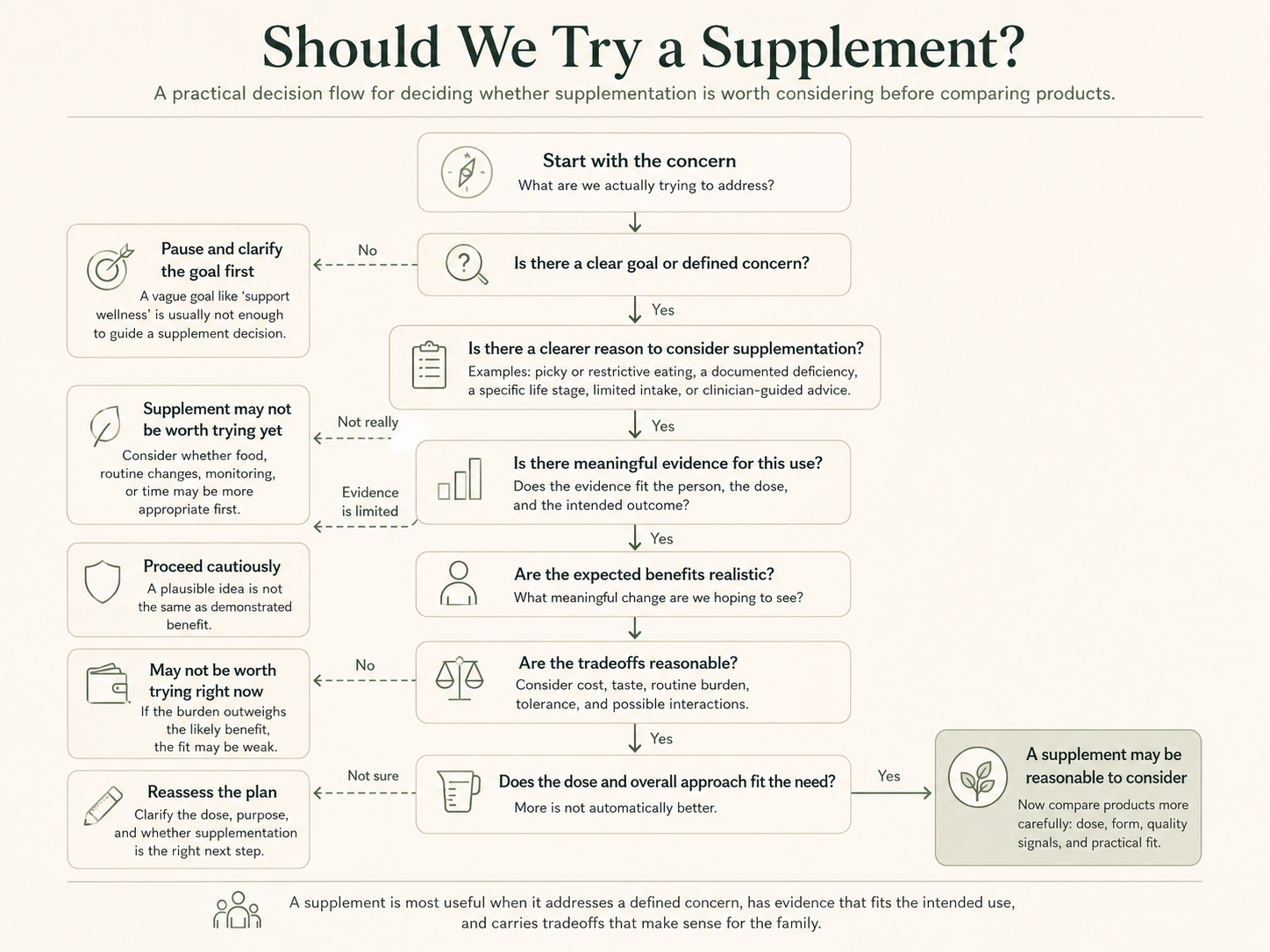
Working through a few direct questions before trying a supplement helps shift the decision away from marketing pressure and toward structured evaluation.
Before trying a supplement, ask:
Evaluating Products Comes Later
If supplementation still seems reasonable after working through the broader decision process, product comparison becomes useful. That is when form, dose, quality signals, ingredient transparency, and formulation design matter. Jumping to product evaluation before this earlier step can make a decision feel more productive than it is.
The Evidence-Informed Supplement Evaluation Checklist is designed for that next step, once the reason for supplementation has been established.
How This Fits Within an Evidence-First Approach
Across Evidence First Wellness, supplements are evaluated through evidence quality, dose alignment, formulation design, quality signals, and practical tradeoffs. But those tools work best after the first question is answered: does supplementation fit the situation at all?
This article applies the same evidence-first lens used throughout this site, focusing on defined need, proportionality, and realistic expectations rather than defaulting to supplementation. For a broader explanation of how supplements are evaluated here, see How I Evaluate Supplements as a Biomedical Engineer and Quality Professional.
Use the checklist to review ingredient purpose, dose, form, quality signals, and tradeoffs once supplementation appears reasonable to consider.
View the Checklist →Use the decision flow to work through need, evidence, tradeoffs, safety, and whether supplementation fits the current situation before comparing products.
Use the Supplement Decision Flow →Why This Matters for Families
Parents often reach for supplement information during moments that already feel loaded: a child is sick again, meals feel limited, sleep is hard, school germs keep coming home, or a recommendation sounds like an easy next step. In those moments, doing something can feel more responsible than pausing.
A structured decision process helps families pause without feeling passive. It gives them a way to clarify the goal, weigh the evidence, consider tradeoffs, and decide whether supplementation fits the actual concern. Rather than assuming every concern requires supplementation, families can work through the decision more proportionally.
Because individual health situations vary, supplement decisions, especially for children or individuals with medical conditions, should ideally be made in consultation with a qualified healthcare professional.
Pulling It All Together
A supplement is most useful when it addresses a defined concern, has evidence that fits the intended use, and carries tradeoffs that make sense for the family. When those pieces are not yet clear, comparing products can make the decision feel more productive than it is.
Deciding whether a supplement is worth trying involves more than choosing a product with an impressive label. It starts earlier, by asking whether supplementation fits the actual concern: clarify the goal, evaluate the evidence, consider the tradeoffs, keep expectations realistic, and let product evaluation follow from there rather than lead it.
Get Evidence First Wellness articles and practical evaluation frameworks delivered once per week. The digest focuses on helping families better interpret supplement claims, research findings, and formulation tradeoffs.
Subscribe to the Digest →References and Further Reading
- National Institutes of Health, Office of Dietary Supplements. Dietary Supplement Fact Sheets.
- U.S. Food & Drug Administration. Dietary Supplements: What You Need to Know.
- Harvard T.H. Chan School of Public Health. The Nutrition Source: Vitamins and Minerals.
- American Academy of Pediatrics. Where We Stand: Vitamin Supplements for Children.
- National Academies of Sciences, Engineering, and Medicine. Dietary Reference Intakes: Applications in Dietary Assessment.
- Ioannidis JPA. Why Most Published Research Findings Are False. PLOS Medicine.
All sources are freely accessible or summarized via NIH, FDA, Harvard, or Google Scholar.
Transparency and Scope: Some content may include affiliate links to products that meet Evidence First Wellness evaluation criteria. If you choose to purchase through those links, Evidence First Wellness may earn a commission at no additional cost to you. Affiliate relationships do not determine editorial conclusions.
This content is provided for educational purposes only and does not constitute medical advice. Individual health decisions should be made in consultation with qualified healthcare professionals.
Supplement Label Red Flags — and Why They Rarely Look Like Red Flags
Some supplement labels look reassuring at first glance — but small details can signal underlying concerns. This article explores common red flags and how to approach them with a more careful, evidence-informed lens.
The signals that deserve a second look, and why they rarely announce themselves.
Most parents who have ever bought a supplement that turned out to be not worth it were not fooled by a bad product. They were reassured by a convincing one.
The signals worth pausing on are rarely the obvious ones. Not the outright fabrications, which are comparatively rare and also illegal, but the patterns that are completely legal, technically accurate, and specifically designed to create confidence before you have looked closely enough to earn it.
This article is about those patterns. What to watch for, why they work, and how to slow down enough to notice them.
How This Fits Within an Evidence-First Framework
Across this site, supplements are evaluated using a structured, evidence-informed approach that prioritizes clarity, proportionality, and context over marketing language.
Label evaluation is one part of that framework. Understanding how claims are presented, how ingredients are disclosed, and how transparency is communicated helps families apply the same consistent standards across different products and categories.
For a broader explanation of how supplements are evaluated here — including how evidence, dose, and formulation tradeoffs are weighed — see How I Evaluate Supplements as a Biomedical Engineer and Quality Professional.
Why Labels Deserve Careful Attention
Supplement decisions are often made quickly: in a store aisle, during an online search, or after seeing a recommendation. Labels compress complex information into bold claims, ingredient lists, and certification logos. Without context, those elements can create a sense of reassurance that isn't always proportional to the evidence.
Learning to read labels carefully helps families slow down and evaluate claims more thoughtfully. How to Read a Supplement Label (Without Getting Misled) walks through the core elements of a supplement label and what they can — and cannot — tell you.
Supplement Label Red Flags: What to Pause On
| Label Signal | Why It Deserves Scrutiny | What Clearer Labeling Looks Like |
|---|---|---|
| Vague benefit claims | "Supports," "promotes," and "boosts" language is legally permissible but does not specify dose, population, or outcome | Claims tied to specific ingredients, amounts, and referenced evidence |
| "Clinically studied" without details | The phrase can apply to a single adult trial, a different dose, or a different form than what is in the product | Study population, form, and dose disclosed or referenced transparently |
| High potency framing | "Extra strength" and "maximum formula" imply greater benefit without clarifying whether higher dosing is necessary or appropriate | Dose presented in context of recommended intake levels for the intended user |
| Long ingredient lists | More ingredients can signal marketing intent rather than thoughtful formulation; individual doses may be too low to be meaningful | Purposeful ingredient selection with each amount clearly disclosed |
| Proprietary blends | Total blend amount is listed without individual ingredient doses, making evidence comparison difficult | Each ingredient listed with its own amount per serving |
| Fear-based marketing | Language that emphasizes universal deficiency, environmental risk, or developmental vulnerability may exaggerate need | Conservative claims that reflect population guidance, not worst-case framing |
| Certification logos without context | Third-party certification addresses quality and purity — not effectiveness, necessity, or appropriateness of dose | Certification explained clearly alongside what it does and does not verify |
Red flags do not mean automatic rejection. They signal where more context is needed.
1. Vague or Undefined Benefit Claims
Phrases such as "supports immune health," "promotes brain development," or "boosts wellness" can sound meaningful while remaining scientifically nonspecific. Support language is legally permissible for many supplements, but it does not indicate magnitude of effect, population studied, dose required, or duration evaluated.
When benefit claims lack context, it's worth asking what evidence actually supports them.¹ Understanding how research claims are framed is discussed further in How to Interpret Supplement Research Without Getting Misled.
2. "Clinically Studied" Without Details
"Clinically studied" is one of the most persuasive phrases used in supplement marketing. However, this phrase can mean a single small trial, a study in adults rather than children, research on a different form or dose, or research on an ingredient rather than the finished product. Without information about who was studied, how much was used, and what was measured, the phrase provides limited guidance.²
A deeper look at what this language does — and does not — mean appears in What "Clinically Studied" Really Means on a Supplement Label.
How label elements can combine to create unwarranted confidence.
Imagine a children's multivitamin labeled "clinically studied," displaying a certification logo, and highlighting "maximum strength" in bold. Closer evaluation might reveal that the clinical study involved adults, the dose differs from what is in the product, the certification applies to manufacturing quality only, and the higher potency exceeds typical pediatric recommendations. None of these details automatically disqualify the product — but they illustrate why label elements must be interpreted in context.
3. High Potency Framed as Automatically Better
Labels may emphasize "extra strength," "high potency," or "maximum formula." Higher numbers can feel protective, particularly when deficiency is a concern. But once adequacy is achieved, increasing intake does not necessarily improve outcomes.³
In some cases, higher doses may narrow safety margins — especially when combined with fortified foods or additional supplements.⁴ This is examined in detail in When "More Is Better" Becomes Risky in Supplement Use.
4. Long Ingredient Lists Used as a Signal of Value
Some products imply that more ingredients equal more benefit. Long lists may include multiple botanical extracts, added probiotics, enzymes, and specialty blends. Complexity can make evaluation harder, not easier.⁵
Understanding whether each ingredient is necessary — or whether the list is primarily marketing-driven — requires looking beyond count alone. Why formulation and dose often matter more than ingredient quantity is discussed in Why Dosage and Form Matter More Than Ingredient Lists.
5. Blended or Proprietary Formulas Without Transparency
Proprietary blends may list total amounts without specifying how much of each ingredient is included. Without that breakdown, it becomes difficult to assess whether dosing aligns with evidence, whether individual components are meaningfully included, or how the product compares to studied formulations. Transparency in labeling supports better decision-making.⁶
6. Marketing That Targets Fear Rather Than Need
Some labels emphasize modern diets as universally deficient, environmental exposure risks, or developmental vulnerability. While nutrient gaps can exist, fear-based framing may exaggerate risk to justify routine supplementation.
A risk-based approach asks whether a defined need exists — not whether risk can be implied.
7. Overreliance on Certification Logos Without Context
Third-party testing and certification can provide meaningful quality signals. Programs such as USP (United States Pharmacopeia), NSF International, and other independent verification bodies assess factors like ingredient identity, purity, and manufacturing practices.⁷
However, certification logos do not automatically indicate clinical effectiveness, necessity, or superiority over non-certified products. Certification typically addresses quality and labeling accuracy — not whether a supplement is needed, appropriately dosed, or supported by strong clinical outcomes. Understanding what certifications evaluate — and what they do not — prevents overinterpreting their presence.
Get the Supplement Decision Framework and the Evaluation Checklist — free, printable, and delivered straight to your inbox.
Get the Free Starter Kit →A Note on Evidence Transparency
When evaluating label claims, it can be helpful to ask: Are studies referenced clearly? Are citations accessible? Is the research population specified? Is the dose aligned with what is marketed?
On this site, transparency around sourcing and citation is intentional. You can review how research is selected and referenced in How We Cite Evidence.
A Practical Way to Use These Red Flags
Seeing one of these signals does not automatically mean a product is inappropriate. Instead, red flags are prompts to slow down, look for additional information, clarify context, and reassess necessity.
The goal is discernment — not dismissal.
A Guide to Common Supplement Misinterpretations
Many confusing supplement labels rely on subtle interpretation gaps — terms that sound meaningful but don't necessarily reflect evidence, safety, or effectiveness. For help interpreting research-based phrases like "clinically studied," "backed by science," or "shown to help," see the How to Interpret Supplement Research Without Getting Misled article and the related tools inside the Frameworks & Decision Tools Hub.
Why This Matters for Families
Parents often want reassurance that they are making the "right" choice. Labels are designed to provide that reassurance quickly.⁸ But thoughtful decisions benefit from context. Recognizing common red flags helps families differentiate between persuasive language and meaningful information.
Pulling It All Together
Supplement labels are not inherently misleading — but they are optimized for persuasion. Red flags do not demand rejection. They invite closer evaluation.
The most useful question is not "Does this label look impressive?" but: Does this product demonstrate clarity, proportionality, and transparency?
Answer 6 questions and get a personalized starting point — not a product recommendation, a framework built around your family’s actual situation.
Take the Quiz →References and Further Reading
- U.S. Food & Drug Administration. Dietary Supplements: What You Need to Know.
- U.S. Food & Drug Administration. Structure/Function Claims on Dietary Supplements.
- National Institutes of Health, Office of Dietary Supplements. Dietary Supplement Labels.
- National Academies of Sciences, Engineering, and Medicine. Dietary Reference Intakes: Tolerable Upper Intake Levels.
- National Institutes of Health, Office of Dietary Supplements. Multivitamin/Mineral Supplements Fact Sheet.
- U.S. Food & Drug Administration. Dietary Supplement Labeling Guide.
- United States Pharmacopeia (USP). USP Verified Dietary Supplements Program.
- Federal Trade Commission. Dietary Supplements: Advertising Guidance for Industry.
All sources are freely accessible or summarized via NIH, FDA, Harvard, or Google Scholar.
Transparency and Scope: Some links in this article may be affiliate links, which means Evidence First Wellness may earn a small commission if you choose to make a purchase — at no additional cost to you. Products are included as examples based on formulation characteristics, not sponsorship, and affiliate relationships do not determine editorial conclusions.
This content is provided for educational purposes only and does not constitute medical advice. Individual health decisions should be made in consultation with qualified healthcare professionals.
The Evidence-Informed Family Supplement Guide covers this in depth — Add your name to the waitlist ahead of launch.
Get evidence-first supplement guidance weekly — join the digest.

How to Actually Read Supplement Research and What to Do With What You Find
Most supplement research is harder to interpret than headlines suggest. This guide explains common study limitations, how findings get overstated, and how to read claims with more clarity.
A framework for reading supplement research without needing a methods course first.
There is a specific moment most parents have had, somewhere between clicking on a research link and closing the tab, where the evidence that was supposed to help them decide made them feel less certain than before.
Most people click through if there is a link, or search the ingredient name if there is not, and then face something they were not quite prepared for: a study abstract with a design they cannot assess, a conclusion that sounds promising but qualified, and no clear answer to whether any of it applies to their child at the dose in the bottle they are holding.
This is not a literacy problem. Most people have never been taught how to evaluate research. The supplement industry treats "backed by science" as a closed argument, when it is actually the beginning of a set of questions. This article is those questions.
Why Supplement Research Is So Easy to Misinterpret
Most supplement studies are conducted under specific and controlled conditions: defined populations, fixed doses, limited timeframes, and narrowly measured outcomes.¹ When those findings are translated into marketing language, much of that context is lost.
For example, a study conducted in healthy adults may be used to justify claims for children, or results tied to a single isolated compound may be generalized to an entire product category.² Understanding this translation gap is essential. Research findings do not become invalid when they are misused — but their relevance often changes.
How This Fits Within an Evidence-First Framework
Interpreting research responsibly requires the same structured thinking used throughout this site: separating what a study actually shows from what is implied or assumed.
This article applies the same evidence-first framework used across Evidence First Wellness to evaluate research claims carefully, without dismissing evidence or overstating its implications.
How evidence is selected, interpreted, and cited across this site is explained in How We Cite Evidence.
The framework below shows how to move through supplement research step by step — focusing on interpretation, not conclusions.

Step One: Identify What Was Actually Studied
Before interpreting a claim, it's important to clarify who was studied (age, health status, baseline nutrition), the specific compound or form tested, the dose and duration, and the outcome measured.
A study demonstrating an effect under controlled conditions does not automatically apply to different populations, formulations, or real-world use. Evidence is typically tied to specific compounds and contexts, not broad supplement categories.³
Step Two: Distinguish Outcomes From Implications
Many supplement studies measure intermediate outcomes, such as biomarker changes or short-term physiological shifts.⁴ These findings can be informative, but they do not always translate into meaningful health outcomes.
When a claim moves from "this marker changed" to "this supplement improves health," interpretation has already begun to stretch. Understanding what was measured — and what was not — helps keep conclusions proportional to the data.
Step Three: Consider Form, Dose, and Duration
Research findings are closely tied to how an ingredient was delivered and used. Differences in chemical form, dose level, frequency, and study duration⁵ can meaningfully change outcomes.
When evaluating research relevance, form and dose tend to matter more than ingredient names alone. This is explored in more depth in Why Dosage and Form Matter More Than Ingredient Lists.
Step Four: Recognize the Limits of Individual Studies
Single studies rarely provide definitive answers. Most evidence develops gradually through replication, consistency across different populations, and systematic reviews.⁶
Overreliance on one positive study — particularly if it is small or narrowly scoped — can lead to overstated conclusions. This is especially relevant in supplement research, where study design, funding sources, and publication bias can influence how results are presented.
Common Types of Supplement Studies (and What They Can — and Can't — Tell Us)
Not all research carries the same weight, and study type matters when interpreting supplement claims.⁷ Common types of studies referenced in supplement marketing include:
In vitro studies are conducted in cells or test tubes. These studies help explore biological mechanisms but do not show how a supplement behaves in the human body.
Animal studies are useful for generating hypotheses and understanding potential pathways, but results may not translate directly to humans.
Small human trials are often short-term and narrowly defined. These studies can suggest potential effects under controlled conditions but may not reflect real-world use.
Observational studies identify associations rather than causation. These findings are especially prone to overinterpretation.
Each study type contributes differently to the evidence base. Understanding these distinctions helps prevent treating early or limited findings as definitive conclusions.
Step Five: Separate Evidence from Plausibility
Some supplement claims are framed as "biologically plausible," meaning they align with known mechanisms. While plausibility can guide research, it is not the same as demonstrated benefit.⁸
Treating plausibility as proof can cause hypotheses to be mistaken for conclusions.
Common Ways Research Is Used (and Misused) in Marketing
Supplement marketing often relies on patterns that sound scientific but lack context, such as citing studies without specifying population or dose, referencing ingredient-level research for multi-ingredient products, and implying long-term benefits based on short-term findings.
Recognizing these patterns helps readers engage with research claims more critically — without dismissing research altogether. For a closer look at one of the most common examples, see What "Clinically Studied" Really Means on a Supplement Label.
Get the Supplement Decision Framework and the Evaluation Checklist — free, printable, and delivered straight to your inbox.
Get the Free Starter Kit →A Practical Test for Research Claims
When encountering a research-based claim, it can help to pause and apply a simple test. Does the claim clearly state who was studied? Does it specify what form and what dose were used? Is the outcome measured meaningful, or indirect? Is the conclusion proportional to the data — or extended beyond it?
If these questions can't be answered from the claim itself, the research may be functioning more as persuasion than as information. For a more structured way to work through these questions, the Frameworks & Decision Tools Hub and Supplement Decision Tool are designed to support exactly this kind of evaluation.
Why This Matters for Families
For families, supplement decisions are often made under time pressure or uncertainty. Research claims can feel reassuring — but only when interpreted correctly.
Understanding how to read research without overextending conclusions helps reduce anxiety, avoid unnecessary supplementation, and support more deliberate decision-making. For broader context on when supplementation may actually be worth considering, see How to Decide Whether a Supplement Is Worth Trying at All.
Pulling It All Together
Interpreting supplement research does not require advanced training, but it does require attention to context. The most useful questions to ask when encountering research claims are: Who was studied? What exactly was tested? At what dose and for how long? What outcome was measured? What assumptions are being made beyond the data?
Answering these questions keeps research in its proper role: informative, but not definitive.
If you're also thinking about how labels present this kind of information, How to Read a Supplement Label (Without Getting Misled) applies the same interpretive lens to what appears on the front and back of a product.
Answer 6 questions and get a personalized starting point — not a product recommendation, a framework built around your family’s actual situation.
Take the Quiz →References and Further Reading
- National Institutes of Health. Understanding Clinical Research.
- Ioannidis JPA. Why Most Published Research Findings Are False. PLOS Medicine.
- U.S. Food & Drug Administration. Dietary Supplement Labeling Guide.
- Fleming TR, DeMets DL. Surrogate End Points in Clinical Trials. New England Journal of Medicine.
- Heaney RP. Factors Influencing the Measurement of Bioavailability. American Journal of Clinical Nutrition.
- Ioannidis JPA. Why Most Clinical Research Is Not Useful. PLOS Medicine.
- Harvard T.H. Chan School of Public Health. Types of Nutrition Studies and Their Limitations.
- U.S. Food & Drug Administration. Dietary Supplement Claims and Consumer Understanding.
- National Institutes of Health. How to Read and Evaluate Health Research.
All sources are freely accessible via NIH, FDA, or Google Scholar.
Transparency and Scope: Some links in this article may be affiliate links, which means Evidence First Wellness may earn a small commission if you choose to make a purchase — at no additional cost to you. Products are discussed based on formulation characteristics, not sponsorship, and affiliate relationships do not determine editorial conclusions.
This content is provided for educational purposes only and does not constitute medical advice. Individual health decisions should be made in consultation with qualified healthcare professionals.
The Evidence-Informed Family Supplement Guide covers this in depth — add your name to the waitlist ahead of launch.
Get evidence-first supplement guidance weekly — join the digest.

Natural vs. Synthetic Vitamins: What the Evidence Actually Shows
When does the natural vs. synthetic distinction matter — and when is it just marketing? An evidence-informed look at what the research actually shows.
What the natural vs. synthetic distinction actually means, and when it matters.
At some point someone told you to avoid synthetic vitamins and you are not entirely sure where that idea came from, or whether it is a reason to pay twice as much for a different version of the same nutrient.
The natural vs. synthetic debate in supplements has gotten louder as social media turned it into a moral argument. Natural is framed as pure and safe. Synthetic is framed as dangerous and cheap. Neither framing reflects how nutrition actually works, and both of them get in the way of the question that actually matters: does this specific form, at this dose, make sense for this person.
Why This Question Comes Up So Often
Many supplement labels emphasize "natural" sourcing as a signal of quality, while others are described as "synthetic" or "lab-made" in ways that imply inferiority. These distinctions are rarely explained beyond the label itself.
For parents, the concern is usually not philosophical. It is practical: Is one safer than the other? Is one better absorbed? Does the source matter for children? Are there meaningful tradeoffs?
The answers to these questions depend on context, formulation, and dose, not simply on whether an ingredient is described as natural or synthetic.¹
What the Natural-vs-Synthetic Label Suggests, and What It Does Not Prove
How This Fits Within an Evidence-First Framework
"Natural" and "synthetic" are descriptors of origin. They are not conclusions about quality, safety, or effectiveness. The same evaluation questions apply regardless of which word appears on the label.
What "Natural" Actually Means, and What It Does Not
In supplements, "natural" typically refers to an ingredient that is extracted from plants, animals, or microorganisms, or derived from a naturally occurring source before processing.
What it does not automatically mean: gentler on the body, better absorbed, safer at higher doses, or free from processing or purification.
Many natural-source ingredients require significant processing to isolate the active compound. In some cases, the final ingredient is chemically identical to a version produced through synthesis.² How supplement labels describe sourcing and processing often influences perception more than how the ingredient is actually used by the body.
What "Natural" Can Mean, and What It Does Not Guarantee
What "Synthetic" Actually Means
"Synthetic" generally refers to ingredients that are produced through controlled chemical processes and designed to replicate a naturally occurring compound.
Importantly, many synthetic vitamins are chemically identical to those found in food. Synthesis allows for consistency, stability, and precise dosing. Safety depends on quality control and dose, not origin alone.
For some nutrients, synthetic forms are more extensively studied, easier to standardize, or more stable in supplement formulations.³
Origin is only one piece of the formulation story.
Whether a vitamin is natural or synthetic matters less than whether the specific form, dose, quality controls, and intended use make sense for the person taking it.
When Source Can Matter
There are situations where source or formulation differences are relevant, but the reasons are usually more specific than marketing language suggests.
Nutrients With Multiple Chemical Forms
Some vitamins exist in multiple forms that behave differently in the body. In these cases, the distinction is not "natural versus synthetic," but which form is used and how it is metabolized.
Whole-Food or Food-Based Blends
Some products use concentrated food extracts rather than isolated nutrients. These may include additional compounds from the source material, but they can also introduce variability in composition and dosing.
Sensitivity or Allergen Considerations
Certain natural sources, such as fish, yeast, or specific plant extracts, may be relevant for families managing sensitivities. These considerations are situational, not categorical.
In each case, source can matter, but not in a universal or predictable way.
When source is part of the decision, ask:
Bioavailability Is About Form, Not Philosophy
Bioavailability is often cited as a reason to favor natural vitamins. In practice, absorption and utilization depend on the specific chemical form, the dose provided, interactions with other nutrients, and individual digestive and metabolic differences.⁴
Whether a vitamin is labeled natural or synthetic does not, on its own, determine how well it is absorbed or used by the body.⁴ Some synthetic forms are well absorbed and extensively studied, while some natural-source formulations offer no clear advantage beyond perception.
This is why discussions of bioavailability need to focus on specific forms and contexts, rather than broad categories.
Bioavailability is a form-and-context question, not a natural-versus-synthetic shortcut.
A sourcing label does not tell you how well a nutrient will be absorbed or used. The specific chemical form, dose, formulation, and individual context matter more.
Where This Distinction Most Often Appears
Rather than evaluating individual brands, it is often more useful to understand where the natural-versus-synthetic question commonly arises.
Vitamins such as B vitamins, vitamin D, and vitamin C often exist in multiple forms with different metabolic pathways. Mineral supplements are inorganic by nature. Differences usually relate to the compound they are bound to, not whether they are "natural." Whole-food or food-based supplements emphasize sourcing but may trade precision for perception. Children's supplements frequently highlight natural flavors, colors, or sourcing, sometimes at the expense of formulation clarity.
These categories illustrate why source alone is an incomplete decision tool. This framing is particularly relevant in children's supplements, where simplified marketing language can obscure meaningful formulation differences.
Managing Expectations Around "Natural" Claims
"Natural" claims can create the impression that a product is inherently safer or more appropriate for long-term use.⁵ In reality, safety is determined by dose, duration, and individual factors, not by how an ingredient is labeled.
Assuming that natural products are risk-free can lead to unnecessary supplementation or complacency around dosing, particularly in children.
An evidence-first approach applies the same level of scrutiny to all supplements, regardless of origin.
A "natural" claim should not lower the standard of evaluation.
Families can evaluate natural and synthetic products using the same core questions: What is the ingredient, what form is used, how much is provided, and what tradeoffs are visible?
Get the Supplement Decision Framework and the Evaluation Checklist — free, printable, and delivered straight to your inbox.
Get the Free Starter Kit →Why This Matters for Families
I came across an Instagram ad recently calling synthetic vitamin A "dangerous and trashy" and promoting a whole-food alternative at three times the price. It was built on a legitimate concern, that vitamin A toxicity is real, and then pointed that concern at the wrong target. The safety issue with vitamin A is dose and accumulation, not synthesis route. A natural-source vitamin A at a high dose carries exactly the same risk as a synthetic one at the same dose. The danger is the amount, not the chemistry. Marketing that blames the origin instead of the quantity is doing a specific job, and it is not helping anyone make a better decision.
When natural and synthetic labels are treated as moral categories, families may avoid appropriate options, overpay for products with no meaningful advantage, or miss the actual formulation questions that determine whether a product is worth taking at all.
Pulling It All Together
Natural and synthetic vitamins are descriptors of origin, not guarantees of effectiveness or safety. The most meaningful differences between supplements are rarely captured by these labels alone.
For families evaluating supplements, the most useful questions remain: Is supplementation appropriate right now? Does the specific form make sense for the intended use? Is the dose conservative and appropriate? Are expectations realistic and evidence-informed?
Answering these questions keeps decisions grounded in clarity rather than marketing. The Starter Kit includes tools designed to work alongside this kind of article, bringing the same questions into a printable format.
Answer 6 questions and get a personalized starting point — not a product recommendation, a framework built around your family’s actual situation.
Take the Quiz →References and Further Reading
- National Institutes of Health Office of Dietary Supplements. Dietary Supplements: What You Need to Know About Ingredients and Labels.
- Harvard T.H. Chan School of Public Health. Vitamins and Supplements: Understanding Forms and Bioavailability.
- National Institutes of Health Office of Dietary Supplements. Vitamin and Mineral Fact Sheets (Chemical Forms and Stability).
- Institute of Medicine (National Academies). Dietary Reference Intakes: Applications in Dietary Assessment. (Form and dose principles; accessible summaries via NIH/Harvard.)
- U.S. Food & Drug Administration. Dietary Supplement Labeling Guide.
All sources are freely accessible or summarized via NIH, FDA, Harvard, or Google Scholar.
Content on this site is provided for educational purposes only and does not constitute medical advice. Individual health decisions should be made in consultation with qualified healthcare professionals.
The Evidence-Informed Family Supplement Guide covers this in depth — add your name to the waitlist ahead of launch.
Get evidence-first supplement guidance weekly — join the digest.

What “Clinically Studied” Actually Means — and What It Doesn’t
A structured look at what "clinically studied" actually means in the supplement context — and why the claim tells you less than it appears to.
What those two words can and cannot honestly mean on a supplement label.
There is a specific kind of reassurance that happens when you see "clinically studied" on a supplement label. Something settles. You feel like you can put it in the cart.
"Clinically studied" is doing a specific job when it appears on a supplement label. It is not summarizing the science. It is creating the feeling that the science has been done, reviewed, and found sufficient, so you do not have to look further.
That feeling can occasionally be accurate. Sometimes a clinical study claim does correspond to real, relevant, well-designed research that applies to the product you are holding. But the phrase itself does not tell you that. It can describe research conducted in adults when the product is marketed for children. It can describe a study on one isolated ingredient at a therapeutic dose, not the finished formula at the dose on the label. It can describe a single small trial that has never been replicated.
The phrase is not a lie. It is a summary that leaves out the details that determine whether it means anything for this product, for your family, right now.
Why the Phrase Sounds So Convincing
"Clinically studied" borrows credibility from clinical research, which most people associate with medicine, safety testing, and clear outcomes. The phrase suggests human data, controlled conditions, meaningful results, and scientific oversight and rigor.
Those associations are not unreasonable, but the wording itself does not guarantee any of them.
Unlike pharmaceutical claims, supplement claims are not required to meet a single standardized definition of "clinically studied."
What "Clinically Studied" Suggests, and What It Doesn't Guarantee
The phrase can be accurate and still leave the most important questions unanswered.
What "Clinically Studied" Can Mean
When a supplement uses this phrase, it may be referring to one of several things:
- An individual ingredient has been studied in humans
- A similar formulation has been studied, but not the exact product
- Research exists at doses different from what the product provides
- Studies were conducted on a different population
All of these scenarios can be technically true while still leaving important questions unanswered.
The phrase alone does not tell you what was studied, how it was studied, at what dose, or in whom. Those details matter more than the label claim itself.
The phrase matters less than the details behind it.
A "clinically studied" claim becomes useful only when you can connect it to the ingredient, dose, population, and conditions behind the research.
Ingredient Studies vs. Product Studies
This distinction is one of the most important, and most commonly misunderstood.
Many supplements rely on studies conducted on individual ingredients, not the finished product. That does not automatically make a product ineffective, but it does change how the evidence should be interpreted.
A product-level study evaluates the exact formulation, ingredient interactions, stability over time, and real-world dosing. An ingredient-level study may not account for those factors.
When a label says "clinically studied," it is worth asking whether the evidence applies to the ingredient, the dose, or the finished product.
Ingredient Evidence vs. Product Evidence
Why Dose and Form Still Matter
Even when clinical research exists, outcomes are often dependent on dose, chemical form, timing, and duration of use.
A supplement may reference a studied ingredient while providing it at a much lower dose, in a different chemical form, or combined with other ingredients that affect absorption.
In those cases, the presence of clinical research does not necessarily translate to the same real-world effect. This does not mean the product is misleading. It means the claim needs context.
A studied ingredient does not automatically create a studied product.
Dose, form, and formulation context determine whether the research being referenced can reasonably apply to the product in front of you.
Population Matters More Than the Claim
Clinical studies are conducted on specific populations: adults versus children, healthy individuals versus those with deficiencies, and short-term versus long-term use.
A study conducted in one group does not automatically apply to another. For families, especially when considering supplements for children, it is important to recognize that "clinically studied" does not always mean studied in a population like yours.
When a label says "clinically studied," ask:
Get the Supplement Decision Framework and the Evaluation Checklist — free, printable, and delivered straight to your inbox.
Get the Free Starter Kit →How to Read the Phrase Thoughtfully
Rather than treating "clinically studied" as a signal to stop asking questions, it is more helpful to treat it as an invitation to look a little closer.
Helpful follow-up questions include: Which ingredient was studied? At what dose? In what population? Does the product reflect those conditions?
You do not need all the answers immediately, but understanding what the phrase does and does not promise helps prevent over-interpretation.
"Clinically studied" should start the evaluation, not end it.
You do not need to reject every product that uses the phrase. The goal is to understand whether the evidence being referenced actually matches the ingredient, dose, form, population, and use case you care about.
Why This Matters for Families
I will be honest: I generally avoid supplements that lean heavily on "clinically studied" language. Not because clinical research is unimportant, but because I work in a regulated industry and I know what rigorous clinical evaluation actually looks like. When a medical device goes through PMA, the FDA reviews clinical data demonstrating safety and effectiveness before anything reaches the market. A 510(k) requires demonstrating substantial equivalence to something already evaluated. Supplements go through neither process.
So when I see "clinically studied" on a supplement label, my first question is always: studied how, by whom, at what dose, and compared to what? The phrase borrows the credibility of regulated medicine without any of the oversight that makes that credibility meaningful. That does not mean I dismiss research. It means I read it before I trust it.
One study, conducted once, on one ingredient, is not a body of evidence. In most regulated contexts it would be the beginning of a conversation. In the supplement industry it is often the end of one.
Answer 6 questions and get a personalized starting point — not a product recommendation, a framework built around your family’s actual situation.
Take the Quiz →Content on this site is provided for educational purposes only and does not constitute medical advice. Individual health decisions should be made in consultation with qualified healthcare professionals.
The Evidence-Informed Family Supplement Guide covers this in depth — add your name to the waitlist ahead of launch.
Get evidence-first supplement guidance weekly — join the digest.
How to Read a Supplement Label (Without Getting Misled)
A practical, structured guide to reading supplement labels — covering what each section tells you, what to look for, and what to be skeptical of.
What the back of the bottle is actually telling you, and what it quietly leaves out.
You pick it up, flip it over, and realize you are not sure what you are looking at.
Supplement labels are designed to look like they contain everything you need. They contain a lot. Whether any of it answers the question you actually came with is a different matter.
That gap between what a label discloses and what a parent actually needs to know is where most supplement confusion lives. The information is not hidden. The context that makes it useful is almost never there.
This is a guide to finding that context, not by becoming an expert, but by knowing which questions the label can answer and which ones it cannot.
What a Supplement Label Is (and What It Is Not)
It is:
- A legally required way to disclose ingredients
- A tool for communicating how a product is positioned
- A snapshot of what is included in the formula
It is not:
- A guarantee of effectiveness
- A summary of supporting evidence
- A substitute for understanding dose, form, or context
Reading a label well means understanding both what it discloses and what it cannot reasonably prove.
What a Supplement Label Can and Cannot Tell You
A supplement label provides useful information, but not the full picture.
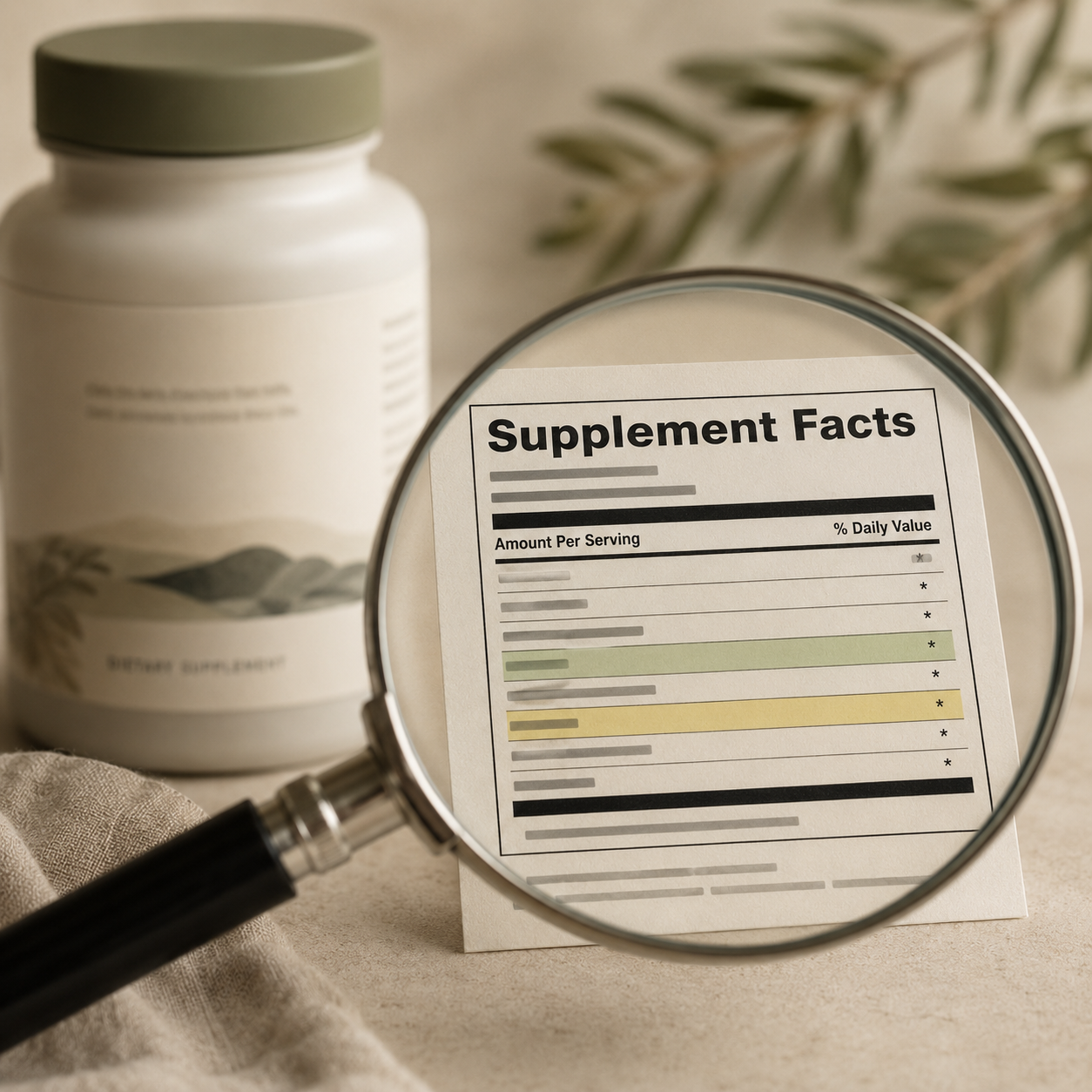
Starting With the Supplement Facts Panel
The Supplement Facts panel is often where people spend the least time, even though it contains the most actionable information on the label.
Serving Size
Serving size is easy to overlook. It is also the first thing worth checking before interpreting anything else on the label.
The amounts listed are only meaningful in relation to the serving size. A product may appear to contain a strong amount of an ingredient, but that amount may require two capsules, a full scoop, or multiple gummies per day to reach. What looks like a single clear number can reflect a serving that may not match how the product is likely to be used.
For families, that has practical implications. Will a child take the full serving consistently? With gummies especially, reaching the stated dose can mean consuming several pieces per day, which also adds to daily sugar intake. If the serving is not realistic, the amount on the label may not reflect actual use.
Start here. Then move to the rest of the panel.
Amount Per Serving
The amount per serving tells you how much of an ingredient you are getting based on the stated serving size, not just whether it is present.
This matters because many ingredients have dose-dependent effects. A small amount may look reassuring on the label while still being too low to matter for the intended purpose. More ingredients in a formula does not automatically mean a better product. It can mean lower individual doses spread across a longer list.
At this stage, you do not need to calculate ideal doses for every ingredient. The goal is to determine whether the amount listed seems relevant to the claim being made.
Daily Value (%DV): When It Helps and When It Does Not
The percent Daily Value (%DV) is a familiar reference point, but it is frequently misunderstood.
Daily Values are based on general population estimates. They are not tailored to individual needs, life stages, or specific health goals. For some nutrients, %DV provides a useful frame of reference. For others, it can be overly simplistic, particularly for children, where adult-based reference values may not apply.
Treat %DV as contextual information, not a quality score. It can tell you how a nutrient amount compares to a general reference point. It does not tell you whether that amount is appropriate for your child or relevant to your specific reason for considering the product.
The Supplement Facts panel is useful, but it only becomes meaningful when dose, serving size, and context are considered together.
A number on a label can look precise without answering whether that amount is relevant for the person using the product.
Ingredient Form: Where Labels Can Be Quietly Misleading
Two supplements can list the same ingredient and still perform very differently.
That difference often comes down to ingredient form.
Labels may list a mineral without specifying its salt form, a vitamin without indicating its bioavailable form, or a botanical without disclosing how it was processed. Those details affect how the ingredient behaves in the body.
Ingredient form influences absorption, tolerability, stability, and consistency of effect. It is one of the most common reasons supplements fail to perform as expected, and one of the least obvious things to a reader scanning the label quickly.
Proprietary Blends: What They Do and What They Hide
Proprietary blends group multiple ingredients under a single listed amount. They exist for legitimate reasons: to protect formulations, simplify labels, or allow flexibility in ingredient ratios.
The tradeoff here is transparency.
When ingredients are listed as part of a proprietary blend, the individual amounts within the blend are not disclosed. That makes it difficult to assess whether any specific ingredient is present at a dose likely to matter for the stated purpose. A blend can include ten ingredients while making it difficult to evaluate how much of each one is actually present.
A proprietary blend is not automatically a problem. But it limits what can reasonably be evaluated from the label alone.
The Other Ingredients Section: What Lives Below the Line
Every Supplement Facts panel has two parts. The top lists nutrients with doses and daily values. Below a dividing line sits the Other Ingredients section, a separate list of everything in the product that is not a nutrient. Most people never read it. That is where a significant amount of the information that actually matters for families is quietly stored.
These are excipients, the functional components that make the supplement possible to manufacture, store, and take. Binders hold tablets together. Fillers give capsules volume. Flow agents keep powders from clumping. Coatings make tablets easier to swallow. Flavors and sweeteners make gummies palatable. Colors make the product look appealing. None of these are inherently suspicious. Without them the supplement could not exist in its current form. But they are worth reading for a few specific reasons.
Allergens: By law, major allergens must be declared on supplement labels. What families sometimes miss is that the allergen can be present in an excipient rather than an active ingredient, such as a capsule shell made from shellfish-derived gelatin or a filler that contains soy. The declaration, required by the Food Allergen Labeling and Consumer Protection Act, typically appears as a "Contains:" statement near the Other Ingredients section rather than within the Supplement Facts panel itself. If allergen avoidance is a concern, reading below the nutrient table rather than relying solely on a front-label claim is worth the extra step.
Sugar alcohols: Sorbitol, xylitol, mannitol, and erythritol are common in sugar-free gummies and chewables. At the amounts used in supplements they are unlikely to cause problems for most children, but they can cause digestive discomfort in children who are sensitive to them.
Artificial colors: FD&C dyes appear by name in this section. If avoiding artificial colors is a priority for your family, this is where to check rather than trusting front-label claims.
Natural flavors: This is a catch-all term that does not require disclosure of source ingredients. It is not a red flag on its own, but it is not a fully transparent disclosure either.
The Other Ingredients section is also where most clean and natural marketing is making its real argument. When a brand says "clean," it usually means this list is short, avoids certain excipients, or substitutes alternatives that test better in market research. Whether those substitutions actually change anything about the product's safety or effectiveness is a separate question from whether they change the brand's positioning. Reading this section is one of the fastest ways to understand what a product is actually prioritizing.
Structure and Function Claims: How to Read the Language
Supplement labels often use phrases like "supports immune health," "promotes normal digestive regularity," or "helps maintain energy levels." These are known as structure/function claims, language designed to describe how a product relates to normal bodily processes without crossing into disease-related territory.
This wording is intentionally broad.
Structure/function claims tell you how a product is positioned, not how well it works. They do not tell you whether the product has been shown to meaningfully improve an outcome for a specific person, at a specific dose, in a specific context. Two products can make nearly identical claims while differing significantly in their formulas, doses, and evidence base. Understanding that distinction helps prevent over-interpreting what label language promises.
When you see a claim like "supports immune health" or "promotes digestive balance," ask:
What Labels Often Do Not Tell You
Even a well-designed label leaves out important information: bioavailability data, stability over time, population-specific considerations for children versus adults, and how ingredients interact within the entirety of the formulation.
The absence of this information does not automatically mean a product is of poor quality. It does mean that what the label shows is genuinely incomplete, and that assuming otherwise is a common source of misplaced confidence.
Labels are a starting point, not a conclusion.
Get the Supplement Decision Framework and the Evaluation Checklist — free, printable, and delivered straight to your inbox.
Get the Free Starter Kit →Using the Label as One Part of a Bigger Decision
Reading a supplement label well is not about finding a perfect product. It is about using the information available to ask better questions.
A thoughtful evaluation considers ingredient identity, dose, form, transparency, third-party certifications, context, and risk. The label supports that process. It does not replace it.
A label is not the decision. It is the first layer of the decision.
Use the label to identify what deserves a closer look: serving size, dose, ingredient form, transparency, and whether the claim matches the evidence available.
Why This Matters for Families
When you are making decisions for yourself, imperfect information can feel manageable. When you are making decisions for a child, uncertainty carries more weight.
Most parents are not reading supplement labels because they want to become experts in formulation science. They are reading them because they are trying to answer a specific set of questions: Is this necessary? Is it appropriate for my child? Is it likely to help with the reason I am considering it? Is it worth adding to our routine?
Those are the right questions. Learning to read a label more deliberately does not resolve every uncertainty, but it makes it clearer what the label can and cannot actually tell you. That's a better starting point than taking the claims at face value.
How This Fits With What Comes Next
In future articles, this label-reading framework gets applied to specific supplements commonly used by families, so the ingredient choices, formulation decisions, and claims involved can be evaluated in practical terms.
This approach is part of a broader evaluation framework described in more detail in How I Evaluate Supplements as a Biomedical Engineer and Quality Professional.
The label is where those conversations must start. Knowing what it can and cannot tell you makes every subsequent decision more grounded.
Answer 6 questions and get a personalized starting point — not a product recommendation, a framework built around your family’s actual situation.
Take the Quiz →Content on this site is provided for educational purposes only and does not constitute medical advice. Individual health decisions should be made in consultation with qualified healthcare professionals.
The Evidence-Informed Family Supplement Guide covers this in depth — Add your name to the waitlist ahead of launch.
Get evidence-first supplement guidance weekly — join the digest.

How I Actually Evaluate Supplements — and Why I Do It This Way
The framework behind every evaluation on this site — built from a background in biomedical engineering and OTC consumer health quality, not wellness trends.
What I actually look for when evaluating a supplement, and why the front of the bottle is the last place I start.
Nobody hands you an evaluation rubric when you become a parent. You figure out car seats and sleep schedules and pediatrician wait times. Supplements just show up eventually, usually during a picky eating stretch or a string of back-to-back colds, and there is no equivalent of a consumer guide for a gummy vitamin.
I know that feeling. I also know what is on the other side of the label.
My background is in biomedical engineering, and I work as a Director of Quality in OTC and consumer health manufacturing. I spend my professional life thinking about how these products are made, evaluated, and controlled before they ever reach a shelf. That inside view changed how I look at supplement decisions entirely, and I started Evidence First Wellness because I thought it was worth sharing with families who are trying to make careful choices without a science degree or a manufacturing badge.
I am also a parent. Which means I have stood in that same aisle, held the same bottle, and felt the same pull toward whatever looked most reassuring. The difference is that I know what I am looking at when I flip it over. This site exists because I think every parent should.
Here is the honest truth: the supplement industry is not inherently bad. But it is structured around broad, reassuring language that is specific enough to feel meaningful and vague enough to apply to almost anyone, at almost any phase, on almost any given day. Immune support. Brain development. Overall wellness. These are not lies. They are just not the whole story either.
What most families are missing is not more information. It is a better set of questions. This article is where those questions come from.
What "Evidence-Based" Actually Means, and What It Does Not
"Evidence-based" is one of the most overused phrases in the wellness space. It gets used the way "natural" does: as a signal, not a standard.
When I use the term evidence-based, I do not mean that a product has glowing reviews, that an ingredient has been trending for two years, or that a study exists somewhere with the right words in the title. I mean that there is biological plausibility, a meaningful dose, an appropriate form, and evidence that is actually relevant to the person using it.
I also mean being comfortable with uncertainty, which is harder than it sounds. Not every supplement has strong data behind it, and that does not automatically make it useless. But it does change how cautiously it should be approached, and how much confidence should be placed in the claim on the front of the bottle.
Signals Worth Questioning vs. Questions Worth Asking
Why Supplement Claims Require a Different Kind of Scrutiny
A lot of parents assume that if a supplement is being sold legally, its claims have been evaluated the same way a medication would be. That is not quite how it works, and understanding this gap matters more than almost anything else.
In the United States, dietary supplements are regulated by the FDA. Manufacturing practices, ingredient safety, and labeling requirements all fall under that umbrella. But unlike prescription drugs or over-the-counter medications, supplement claims are not reviewed or approved by the FDA before products go to market, as long as those claims do not cross into diagnosing, treating, preventing, or curing disease.
So a label can say it supports immune health, normal development, or overall wellness without undergoing the kind of pre-market scrutiny a drug claim would require. That is legal. It is also worth knowing when you are standing in the aisle trying to figure out what is actually worth your money.
This is not an argument against supplements. It is an argument for understanding what the regulatory landscape actually looks like before deciding how much weight to put on any given claim. A claim can be legal, compliant, and still incomplete for decision-making.
The Lens I Use When Evaluating Supplements
Because of how I think professionally, I tend to approach supplements the way I approach most things in quality systems: as a set of inputs, controls, and processes that either hold up under scrutiny or do not.
That means I do not start with the brand. I do not start with the marketing language. I start with the mechanism, the formulation, and the context in which the product is likely to be used. And then I ask whether all three of those things actually connect.
What I have found, after years of doing this, is that the gap between what a supplement promises and what it can reasonably deliver is almost always a formulation problem. The ingredient is real. The research is real. But the dose is too low, or the form does not absorb well, or the product relies on adult clinical data applied to a child. Details that sound small but actually carry a lot of weight.
The goal is not skepticism for its own sake. It is better fit and better reasoning. A supplement should be evaluated by how well its evidence, formulation, dose, and context align with the person and purpose it is meant to support.
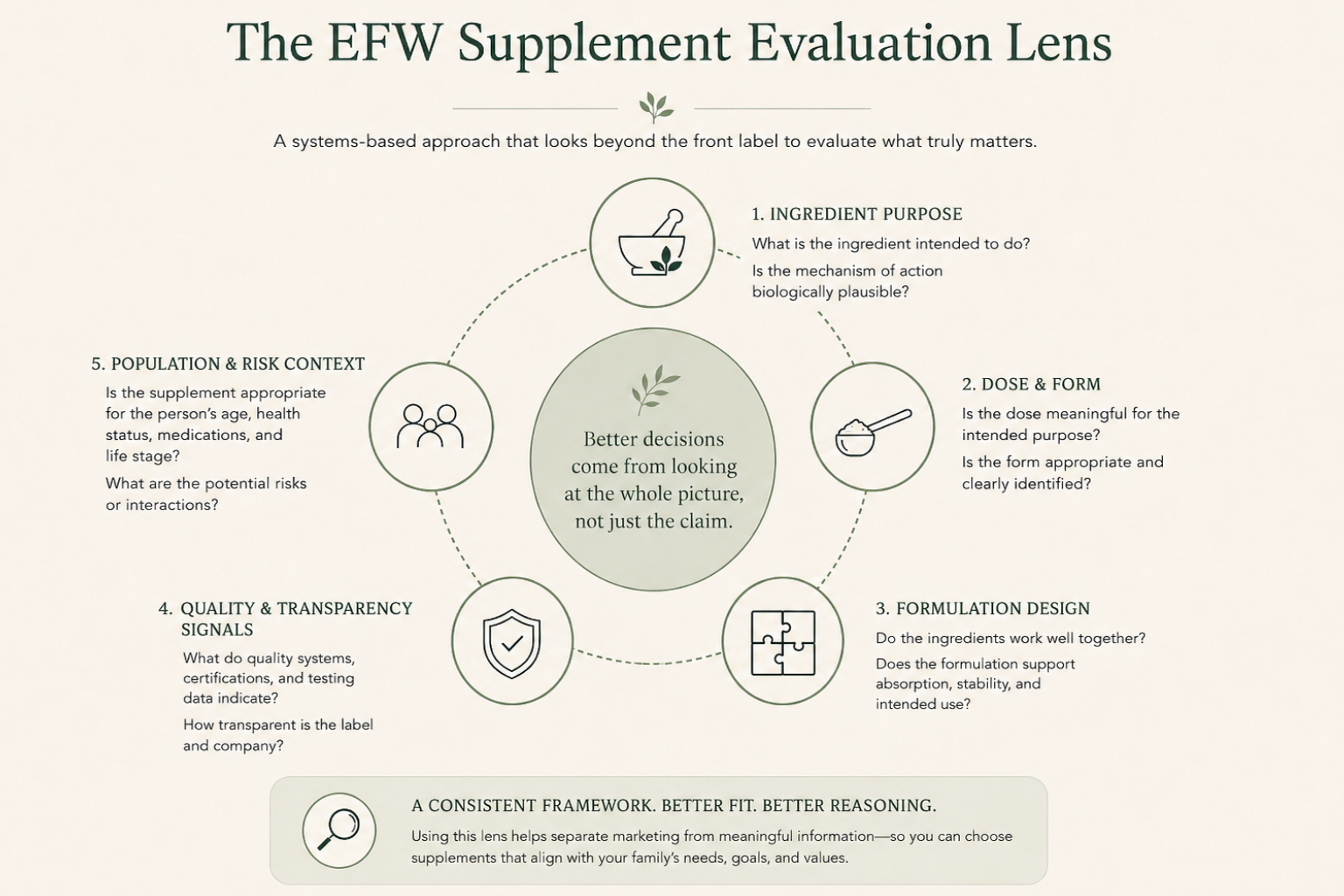
The Five Things I Look at When Evaluating a Supplement
1. Ingredient Identity and Purpose
The first question is simple: why is this ingredient here?
Many supplements contain ingredients that are included for marketing appeal, present at doses too low to do much of anything, or poorly matched to the stated purpose. I look for a clear connection between the ingredient, its known biological roles, and the claim being made. If that connection is not obvious, or requires a lot of creative interpretation to get there, that is a signal worth paying attention to.
2. Dosage and Form Matter More Than Most People Realize
Knowing the name of an ingredient is not the same as knowing whether the product contains enough of it to matter.
Dosage matters. Form matters. A supplement can include a well-studied ingredient and still be unlikely to do much if the dose is too low, the form is poorly absorbed, or it competes with other ingredients in the formulation. This gap between ingredient recognition and real-world effectiveness is one of the most common sources of confusion in supplements, and it almost never appears on the front label.
3. Formulation Quality Is Often Overlooked
Supplements are not just collections of ingredients thrown together. They are formulations, and how ingredients interact, how stable they are over time, and how they are delivered all affect whether a product performs the way it is supposed to.
A formulation can look good on paper and still fall short if it was not designed thoughtfully as a system. This is the part that is hardest to evaluate from a label alone, but transparency around it, or the lack of it, tells you a lot.
4. Label Transparency Tells You a Lot
A label cannot tell you everything. But it tells you more than many people realize, and what is missing is often as useful as what is there.
I pay attention to whether ingredients are clearly identified, whether doses are disclosed, whether claims are specific or vague, and what information has been left out. Proprietary blends, excessive buzzwords, and ambiguous language often signal that marketing considerations outweighed clarity in the design of the product. Transparency does not guarantee quality. But lack of it should raise questions.
5. Risk and Population Context Are Non-Negotiable
A supplement that makes sense for a healthy adult is not automatically appropriate for a child, someone who is pregnant, or someone taking medications.
I always consider who a supplement is intended for, who it may not be appropriate for, and what the margin for error looks like. For families especially, this context matters. Children are not small adults, and the research base for pediatric supplementation is different in ways that affect how claims should be interpreted.
What is the ingredient supposed to do? Is the dose meaningful for that purpose? Is the form appropriate and clearly identified? Does the formulation make sense as a system? Is this product appropriate for the person who will actually use it?
What I Do Not Start With, On Purpose
There are several things I deliberately set aside when evaluating a supplement: brand popularity, influencer recommendations, trend status, and "clean" or "natural" labels without a clear definition attached.
These signals are not worthless. But they are not substitutes for understanding how a product actually works, or whether it makes sense for the person considering it. They come later, if at all.
What I Set Aside vs. What I Look at First
Get the Supplement Decision Framework and the Evaluation Checklist — free, printable, and delivered straight to your inbox.
Get the Free Starter Kit →Why This Matters for Families
When you are making decisions for yourself, uncertainty feels manageable. When you are making decisions for a child, it feels different. The stakes feel higher. The pressure to do the right thing is louder.
Parents are not failing when they feel confused in the supplement aisle. The confusion is built into the design of these products. Labels are written to land in exactly the moment when you are tired, a little worried, and looking for something that sounds like a solution.
Better supplement decisions do not require perfect certainty. They require a better set of questions. The goal is not to eliminate every uncertainty. It is to stop relying on marketing shortcuts when evidence, dose, formulation, and context provide a clearer way to think. That is what this site is for. And it is what this framework is built around.
How to Use This Going Forward
You do not need a science background to use this framework. You need to know what to look for, and the willingness to slow down before the decision gets made on autopilot.
As you read content on this site, you will see these same questions applied repeatedly across specific supplements, ingredient categories, and real-world decisions. The Frameworks and Decision Tools hub applies this same lens in a more structured, interactive format.
Over time, it becomes more intuitive. And supplement decisions start to feel a lot less like decoding a marketing experiment.
Answer 6 questions and get a personalized starting point — not a product recommendation, a framework built around your family’s actual situation.
Take the Quiz →Content on this site is provided for educational purposes only and does not constitute medical advice. Individual health decisions should be made in consultation with qualified healthcare professionals.
The Evidence-Informed Family Supplement Guide covers this in depth — add your name to the waitlist ahead of launch.
Get evidence-first supplement guidance weekly — join the digest.