
Evidence-first supplement
guidance for families.
Structured, research-informed articles designed to help families evaluate supplement claims, understand product tradeoffs, and make calmer, more consistent decisions.
 Structured evaluation over simplified claims.
Not sure where to begin?
These three articles offer the clearest entry point depending on what you are trying to understand.
All Articles

How to Decide Whether a Supplement is Worth Trying At All
A practical framework for deciding whether a supplement is worth trying — built around the questions that matter before you reach for your wallet.
A practical, evidence-informed framework for deciding whether a supplement is worth considering before comparing products, ingredients, or brands.
A parent may start looking for a supplement because a child keeps getting sick, eating feels inconsistent, sleep feels difficult, energy seems off, or someone in a parenting group recommended something that sounded reasonable. In that moment, it is easy for the question to become "Which one should I buy?" But often, the more useful question comes one step earlier: "Is this worth trying at all?"
Parents reaching for supplement information are usually trying to respond thoughtfully, not chase trends. A plausible benefit can feel like a good reason to act, especially when a child is involved. The difficulty is that a claim sounding reasonable is not the same as supplementation being the right fit for the specific concern.
This article walks through a structured way to think about supplement decisions before comparing brands, ingredient lists, or marketing claims. The goal is not to discourage supplementation. It is to help families make calmer, more proportional decisions.
Step One: Clarify the Actual Goal
Many supplement decisions begin with a vague objective: "support immunity," "improve wellness," "help with focus," "fill nutritional gaps." These goals can sound reasonable, but they are difficult to evaluate without more specificity. A goal like "support immunity" is understandable, but it does not answer the question of what would need to change, or how a family would know whether the supplement helped.
A more useful starting point is asking: What problem are we trying to address? Is there a defined concern or risk factor? Is the goal preventive, supportive, or something else? Are the expectations realistic?
Clarifying the reason helps determine whether supplementation meaningfully fits the current need, or whether another approach may be more appropriate first.
Step Two: Consider Whether a Defined Need Exists
Not all supplement decisions begin with a deficiency or elevated risk. At the same time, not every supplement marketed for general wellness addresses a clearly identified need. Situations where supplementation may be more commonly considered include picky or restrictive eating patterns, pregnancy or specific life stages, medically identified nutrient deficiencies, limited dietary intake of particular nutrients, and clinician-guided recommendations.⁴
This does not mean supplementation is automatically necessary in these situations. It means there may be a clearer reason to consider it. A broader discussion appears in Do Children Actually Need Supplements?
Step Three: Evaluate the Strength of the Evidence
Once a reason has been clarified, the next question is whether meaningful evidence supports the intended use. A claim becomes more useful when the evidence matches the person, dose, form, and outcome being considered. Important questions to ask: Was the supplement studied in the relevant population? Were meaningful outcomes measured, or primarily biomarkers? Was the dose similar to what is being considered? Are findings consistent across studies?
Randomized controlled trials are often considered the strongest form of evidence, but evidence quality varies widely depending on study design, population, duration, and outcomes.⁶ Some supplement claims are supported primarily by biological plausibility rather than demonstrated clinical outcomes. Plausibility can make a claim worth studying. It does not make the claim proven.
Understanding this distinction is discussed further in How to Interpret Supplement Research Without Getting Misled.
Step Four: Consider Potential Tradeoffs
Even when evidence suggests a supplement may be reasonable to consider, tradeoffs still matter. These may include cost, taste or ease of administration, gastrointestinal tolerance, interactions with medications or other supplements, and complexity added to daily routines.
For children especially, practicality often determines whether a supplement can be used consistently and appropriately. Tradeoffs are not proof that a supplement is a bad idea. They are part of deciding whether the expected benefit is worth the added step, cost, exposure, or routine burden.
Step Five: Avoid Treating "More" as Automatically Better
One of the most common patterns in supplement decision-making is assuming that a higher dose, more ingredients, or greater potency necessarily improves outcomes. In reality, many nutrients follow a plateau pattern: once physiological needs are met, additional intake may provide little additional benefit and can sometimes narrow safety margins.¹ The strongest option is not automatically the best-matched one.
Dose alignment matters more than potency alone. A deeper discussion appears in When "More Is Better" Becomes Risky in Supplement Use.
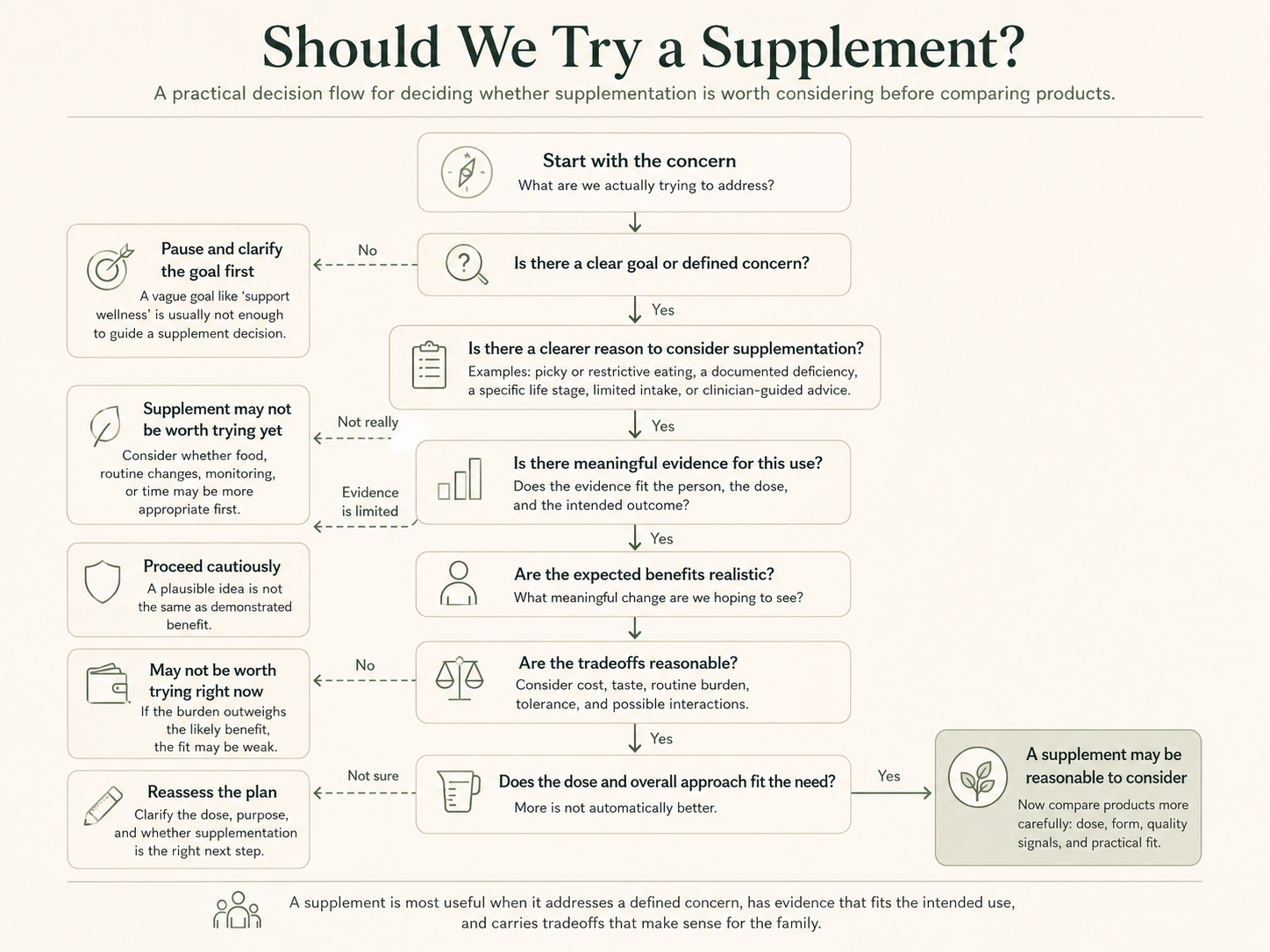
A Simple Decision Framework
Working through a few direct questions before trying a supplement helps shift the decision away from marketing pressure and toward structured evaluation.
Before trying a supplement, ask:
Evaluating Products Comes Later
If supplementation still seems reasonable after working through the broader decision process, product comparison becomes useful. That is when form, dose, quality signals, ingredient transparency, and formulation design matter. Jumping to product evaluation before this earlier step can make a decision feel more productive than it is.
The Evidence-Informed Supplement Evaluation Checklist is designed for that next step, once the reason for supplementation has been established.
How This Fits Within an Evidence-First Approach
Across Evidence First Wellness, supplements are evaluated through evidence quality, dose alignment, formulation design, quality signals, and practical tradeoffs. But those tools work best after the first question is answered: does supplementation fit the situation at all?
This article applies the same evidence-first lens used throughout this site, focusing on defined need, proportionality, and realistic expectations rather than defaulting to supplementation. For a broader explanation of how supplements are evaluated here, see How I Evaluate Supplements as a Biomedical Engineer and Quality Professional.
Use the checklist to review ingredient purpose, dose, form, quality signals, and tradeoffs once supplementation appears reasonable to consider.
View the Checklist →Use the decision flow to work through need, evidence, tradeoffs, safety, and whether supplementation fits the current situation before comparing products.
Use the Supplement Decision Flow →Why This Matters for Families
Parents often reach for supplement information during moments that already feel loaded: a child is sick again, meals feel limited, sleep is hard, school germs keep coming home, or a recommendation sounds like an easy next step. In those moments, doing something can feel more responsible than pausing.
A structured decision process helps families pause without feeling passive. It gives them a way to clarify the goal, weigh the evidence, consider tradeoffs, and decide whether supplementation fits the actual concern. Rather than assuming every concern requires supplementation, families can work through the decision more proportionally.
Because individual health situations vary, supplement decisions, especially for children or individuals with medical conditions, should ideally be made in consultation with a qualified healthcare professional.
Pulling It All Together
A supplement is most useful when it addresses a defined concern, has evidence that fits the intended use, and carries tradeoffs that make sense for the family. When those pieces are not yet clear, comparing products can make the decision feel more productive than it is.
Deciding whether a supplement is worth trying involves more than choosing a product with an impressive label. It starts earlier, by asking whether supplementation fits the actual concern: clarify the goal, evaluate the evidence, consider the tradeoffs, keep expectations realistic, and let product evaluation follow from there rather than lead it.
Get Evidence First Wellness articles and practical evaluation frameworks delivered once per week. The digest focuses on helping families better interpret supplement claims, research findings, and formulation tradeoffs.
Subscribe to the Digest →References and Further Reading
- National Institutes of Health, Office of Dietary Supplements. Dietary Supplement Fact Sheets.
- U.S. Food & Drug Administration. Dietary Supplements: What You Need to Know.
- Harvard T.H. Chan School of Public Health. The Nutrition Source: Vitamins and Minerals.
- American Academy of Pediatrics. Where We Stand: Vitamin Supplements for Children.
- National Academies of Sciences, Engineering, and Medicine. Dietary Reference Intakes: Applications in Dietary Assessment.
- Ioannidis JPA. Why Most Published Research Findings Are False. PLOS Medicine.
All sources are freely accessible or summarized via NIH, FDA, Harvard, or Google Scholar.
Transparency and Scope: Some content may include affiliate links to products that meet Evidence First Wellness evaluation criteria. If you choose to purchase through those links, Evidence First Wellness may earn a commission at no additional cost to you. Affiliate relationships do not determine editorial conclusions.
This content is provided for educational purposes only and does not constitute medical advice. Individual health decisions should be made in consultation with qualified healthcare professionals.


Are Gummy Vitamins Worth It?
Gummies are convenient and kids actually take them — but the format creates real tradeoffs in dosing, ingredient stability, and sugar load. An evidence-informed look at when they make sense.
A structured evaluation of gummy vitamins, focusing on tradeoffs in dosing, stability, and formulation quality.
Gummy vitamins are one of the most popular supplement formats for families. They're easy to take, widely available, and often framed as a practical solution for children who resist pills or powders.
At the same time, gummy formulations raise specific questions around dosing precision, formulation constraints, and long-term use — questions that are not always addressed clearly on labels.
This article examines gummy vitamins using an evidence-informed framework. Rather than asking whether gummies are "good" or "bad," it focuses on what actually changes when vitamins are delivered in gummy form, what tradeoffs are introduced, and when this format may — or may not — make sense for families.
Why Gummy Vitamins Became So Common
Gummy vitamins address a real problem: compliance.¹ For many children — and adults — swallowing capsules or tolerating powders is difficult. Gummies offer improved acceptance, simplified routines, and predictable daily habits.
These advantages explain their popularity, but they do not eliminate the need to evaluate what is gained and what is constrained by this format.
What Gummy Vitamins Can Help With — and What They Don't Solve
How This Fits Within an Evidence-First Framework
When evaluating supplements, delivery format is one variable among many — not a deciding factor on its own. The same questions apply regardless of whether a vitamin is delivered as a gummy, capsule, powder, or liquid.
This article applies the same evidence-first framework used throughout this site to evaluate supplement form, dose, and tradeoffs consistently.
What Changes When Vitamins Are Made Into Gummies
Gummy vitamins are not simply capsules in a different shape.² To function as a gummy, a product must account for texture and stability, moisture content, flavoring and sweeteners, and shelf-life constraints.
These requirements influence formulation decisions in ways that are often invisible to consumers.

Dosing Precision Is Often Reduced
Unlike capsules or tablets, gummies typically contain lower amounts of individual nutrients per unit.³ This can make precise dosing more difficult, especially when children fall between age-based dose ranges, only partial dosing is appropriate, or multiple nutrients are combined.³
When evaluating supplement formats, form and dose tend to matter more than convenience alone.
Convenience is useful only if the dose still fits the purpose.
A gummy format may make a supplement easier to take, but the amount per serving still needs to be meaningful, realistic, and appropriate for the person using it.
Sugar, Sweeteners, and Functional Tradeoffs
To be palatable, gummy vitamins require sweeteners.⁴ These may include sugars, sugar alcohols, or non-nutritive sweeteners, each with different implications for dental health, gastrointestinal tolerance, and daily exposure over time.
While the presence of sweeteners does not automatically disqualify a product, it represents a tradeoff that should be acknowledged — particularly for daily use.⁴
Before choosing a gummy vitamin for daily use, ask:
Answer 6 questions and get a personalized starting point — not a product recommendation, a framework built around your family’s actual situation.
Take the Quiz →Stability and Shelf-Life Considerations
Certain vitamins are more sensitive to heat, light, and moisture. Gummy formulations must balance vitamin stability, taste and texture, and packaging limitations.⁵
This can influence which forms of vitamins are used and how long potency is maintained. Evidence supporting supplement use is typically tied to specific compounds and formulations, not delivery formats alone.⁶
A gummy is not just a different shape. It is a different formulation environment.
Moisture, texture, sweeteners, and shelf-life constraints can influence which nutrients are included, which forms are used, and how much can realistically fit.
Where Gummy Vitamins Are Most Commonly Used
Gummy formats are most frequently encountered in children's multivitamins, basic vitamin D or vitamin C products, and general "daily" supplements.
In these categories, marketing often emphasizes natural flavors, colors, or sourcing — sometimes at the expense of clarity around formulation details.⁷
Gummies vs. Other Delivery Formats
Compared with capsules, powders, or liquids, gummy vitamins tend to prioritize ease of use over formulation flexibility. Other formats may offer more precise dosing, fewer formulation constraints, and broader options for sensitive nutrients.⁸
This does not make gummies inappropriate — but it does mean they should be evaluated with different expectations.
Gummy Vitamins Compared With Other Delivery Formats
| Format | Common Strengths | Common Tradeoffs | Best Fit |
|---|---|---|---|
| Gummies | Palatable; easy to build into routines; helpful for children who resist pills or powders | Lower dosing flexibility; sweeteners; stability constraints; limited formulation space | When acceptance and routine consistency are the main barriers |
| Capsules or tablets | More formulation flexibility; often easier to dose precisely; fewer taste constraints | Harder for some children or adults to swallow; less appealing for routine use | When dosing precision, ingredient density, or fewer sweeteners matter more |
| Powders | Flexible serving size; can allow higher amounts; easy to mix into foods or drinks | Taste, texture, measuring accuracy, and consistency can be issues | When flexible dosing is useful and the user tolerates mixing |
| Liquids | Adjustable dosing; easier for some children; useful when swallowing is difficult | Stability, taste, preservatives, and measuring accuracy may matter | When dose adjustment or swallowing difficulty is the primary concern |
Managing Expectations Around Gummy Vitamins
Gummy vitamins are often framed as an easy solution, but ease does not eliminate the need for thoughtful evaluation. Over time, daily exposure to sweetened supplements may introduce habits or assumptions that deserve reconsideration.⁹
An evidence-first approach treats gummies as one option among many — appropriate in some situations and less suitable in others.¹
A gummy vitamin is a format choice, not a quality guarantee.
For families, the goal is not to avoid or prefer gummies automatically. The goal is to understand whether the format supports the actual need without hiding important tradeoffs around dose, stability, sweeteners, or long-term use.
Why This Matters for Families
For families, gummy vitamins often feel like a compromise between practicality and precision. Understanding what is gained — and what is constrained — helps prevent decisions based solely on convenience or marketing.
Rather than asking whether gummies are "worth it," a more useful question is whether the format aligns with current needs, tolerance, and expectations.
Pulling It All Together
Gummy vitamins are not inherently inferior — or inherently superior — to other supplement formats. They represent a shift in priorities.
When vitamins are delivered as gummies, convenience and palatability are often optimized. In exchange, formulation flexibility, dosing precision, and ingredient simplicity may be constrained.
Understanding those tradeoffs allows families to make decisions based on context rather than format preference. In some situations, improved acceptance may outweigh formulation limitations. In others, precision or long-term stability may matter more.
An evidence-informed approach does not rank delivery forms. It asks whether the chosen format aligns with the intended purpose, dosing needs, and duration of use.
Get the Supplement Decision Framework and the Evaluation Checklist — free, printable, and delivered straight to your inbox.
Get the Free Starter Kit →References and Further Reading
- National Institutes of Health Office of Dietary Supplements. Consumer Guidance on Dietary Supplements.
- Harvard T.H. Chan School of Public Health. Vitamins and Supplements: Understanding Different Forms.
- National Institutes of Health Office of Dietary Supplements. Multivitamin/Mineral Supplements Fact Sheet.
- U.S. Food & Drug Administration. Dietary Supplements: What You Need to Know (Sweeteners & Labeling).
- National Institutes of Health Office of Dietary Supplements. Stability of Vitamins and Minerals in Supplements.
- Allen LV. Stability of oral formulations. International Journal of Pharmaceutical Compounding.
- U.S. Food & Drug Administration. Dietary Supplement Labeling Guide.
- American Dental Association. Sugar and Children's Oral Health.
- National Institutes of Health Office of Dietary Supplements. Dietary Supplement Fact Sheets (Formulation & Stability).
All sources are freely accessible or summarized via NIH, FDA, Harvard, or Google Scholar.
Transparency and Scope: Some links in this article may be affiliate links, which means Evidence First Wellness may earn a small commission if you choose to make a purchase — at no additional cost to you. Products are discussed based on formulation characteristics, not sponsorship, and affiliate relationships do not determine editorial conclusions.
This content is provided for educational purposes only and does not constitute medical advice. Individual health decisions should be made in consultation with qualified healthcare professionals.
The Evidence-Informed Family Supplement Guide covers this in depth — join the waitlist ahead of launch.
Get evidence-first supplement guidance weekly — join the digest.