
Evidence-first supplement
guidance for families.
Structured, research-informed articles designed to help families evaluate supplement claims, understand product tradeoffs, and make calmer, more consistent decisions.
 Structured evaluation over simplified claims.
Not sure where to begin?
These three articles offer the clearest entry point depending on what you are trying to understand.
All Articles

Why Children’s Supplements Aren’t Just Smaller Adult Supplements
Adult supplement guidance doesn't translate directly to children. This article explains where the evidence base, dosing context, and safety thresholds actually differ — and why that matters.
Why children's supplements are not just smaller adult supplements.
One of the most common questions about children's supplements is whether you can use an adult version at a lower dose. The answer is almost always no, and the reason is not obvious from the label.
Children are not simply smaller adults.¹ Their physiology, developmental stage, safety margins, and evidence base all influence how supplement decisions are made.
This article is about those differences specifically, because knowing they exist changes how you evaluate almost every supplement decision you make for a child.
Why This Distinction Matters
Many supplement practices originate in adult wellness culture: higher doses, optimization goals, performance framing, and routine long-term use. When these approaches are applied to children without adjustment, several problems can emerge: dosing misalignment, overestimation of need, inappropriate extrapolation of adult research, and unnecessary exposure.
Understanding how pediatric guidance differs helps prevent well-intentioned but mismatched decisions. For a broader look at when supplementation may or may not be appropriate for children, see Do Children Actually Need Supplements?
Children Are Not Smaller Adults
| Decision Area | Pediatric Guidance | Adult Guidance | Why It Matters |
|---|---|---|---|
| Dose | Age-stratified; conservative; calibrated to body mass and development | Often based on population averages; may emphasize higher potency | Pediatric doses do not scale linearly from adult doses |
| Safety margin | Narrower; precaution is emphasized; upper intake levels are age-specific | Wider in most cases; adults may accept voluntary tradeoffs at higher doses | Excess intake in children may reach concerning thresholds more quickly |
| Evidence base | Limited; often extrapolated cautiously from adult data | More extensive; longer-term and larger studies more common | Adult findings do not automatically translate to pediatric safety or efficacy |
| Duration | Typically short-term or purpose-driven; periodic reassessment encouraged | Long-term routines more common; continuation often assumed | Cumulative exposure in children warrants more active monitoring |
| Risk tolerance | Lower; threshold for justification is higher | Higher; adults may voluntarily accept greater uncertainty | Pediatric decisions operate under a different ethical framework |
| Marketing framing | Reassurance-based: immunity, growth, brain development | Enhancement-based: energy, performance, anti-aging | Marketing language in both categories often exceeds what evidence supports |
Pediatric supplementation follows different safety thresholds, evidence standards, and risk tolerance than adult guidance. The table above reflects principles, not absolute rules. Individual context always matters.
1. Differences in Physiological Scale and Metabolism
Children differ from adults in body mass, metabolic rate, organ maturity, and nutrient storage capacity. These differences influence how nutrients are absorbed, distributed, metabolized, and excreted.²
Higher doses that are tolerated in adults may not scale proportionally in children. Safety margins can narrow more quickly, especially with ongoing use. This is why pediatric dosing is typically conservative and age-stratified.
2. Differences in Developmental Sensitivity
Children undergo rapid growth and neurological development. Certain nutrients are critical during specific windows, but excess intake can also carry greater implications during development.³
This dual sensitivity, where adequacy matters but excess also matters, shapes pediatric guidance. Adult supplementation often prioritizes optimization or enhancement. Pediatric guidance prioritizes safety, sufficiency, and stability.
3. Differences in Evidence Base
A significant portion of supplement research is conducted in adults.⁴ Pediatric data is often limited in duration, narrower in scope, ethically constrained, and extrapolated cautiously. Adult findings do not automatically translate to children.⁵
The limits of extrapolating adult data are examined in more depth in How to Interpret Supplement Research Without Getting Misled.
4. Differences in Risk Tolerance
Adult supplementation decisions often involve voluntary tradeoffs. Adults may choose higher doses based on personal goals or risk tolerance. Pediatric decisions operate under a different ethical framework. Risk tolerance is typically lower, and precaution is emphasized.⁶
This does not mean pediatric supplementation is discouraged. It means the threshold for justification is higher.
Answer 6 questions and get a personalized starting point — not a product recommendation, a framework built around your family’s actual situation.
Take the Quiz →5. Differences in Duration Expectations
Adults may adopt long-term supplementation routines. In children, prolonged use is often approached more cautiously. Because duration influences cumulative exposure, pediatric supplementation decisions benefit from periodic reassessment, a principle explored further in What Safety Data Exists for Long-Term Supplement Use in Children?⁷
Duration is part of the safety equation, not an afterthought.
6. Differences in Dosing Philosophy
Adult supplements frequently emphasize potency and higher intake. Pediatric guidance typically emphasizes meeting established requirements, avoiding excessive intake, and minimizing unnecessary complexity.⁹
This difference reflects a shift from optimization thinking to adequacy thinking, recognizing that higher intake does not automatically improve outcomes, and may narrow safety margins over time. This is examined in detail in When "More Is Better" Becomes Risky in Supplement Use.⁸
7. Differences in Marketing Framing
Children's supplements are often marketed through reassurance: "immune support," "brain development," "growth support." Adult supplements are frequently marketed through enhancement: "energy," "performance," "anti-aging."
Understanding this distinction helps families identify when language is persuasive rather than informational.¹⁰ For a practical way to read label language more critically, see How to Read a Supplement Label (Without Getting Misled).
A Practical Way to Apply This Distinction
Rather than applying adult supplementation habits to children, families can ask: Is this practice based on pediatric guidance or adult wellness trends? Does the dose reflect age-specific recommendations? Is this short-term support or indefinite use? Is there a clear reason for supplementation?
Why This Matters for Families
The "it works for me, so why not for my child" logic is one of the most common ways families end up with dosing that was never designed for a child's body. I have heard this in almost every supplement conversation I have with other parents. Someone found a magnesium supplement that helps them sleep and wants to give their toddler a smaller amount for the same reason. Someone takes a high-dose vitamin D because they were told they were deficient and assumes their child probably is too. The instinct to share what works is a loving one.
The problem is that what works for an adult body, processed by adult organs at an adult dose, is a completely different equation than what is appropriate for a child who is still building those systems. Smaller person does not mean smaller version of the same thing. It means different thresholds, different evidence, different safety margins, and a completely different set of questions.
Pulling It All Together
Pediatric supplement guidance differs from adult recommendations in physiology, evidence base, safety thresholds, and risk tolerance. Children are not smaller versions of adult consumers. Their supplementation decisions require context, restraint, and periodic reassessment.
The most useful question is not "What do adults take?" but: What is appropriate for this child, at this stage, and for this reason?
Get the Supplement Decision Framework and the Evaluation Checklist — free, printable, and delivered straight to your inbox.
Get the Free Starter Kit →References and Further Reading
- American Academy of Pediatrics. Pediatric Nutrition Handbook.
- Kearns GL et al. Developmental Pharmacology: Drug Disposition, Action, and Therapy in Infants and Children. New England Journal of Medicine.
- Georgieff MK. Nutrition and the Developing Brain: Nutrient Priorities and Measurement. American Journal of Clinical Nutrition.
- U.S. Department of Health and Human Services. Ethical Considerations in Pediatric Clinical Research.
- Ioannidis JPA. Why Most Clinical Research Is Not Useful. PLOS Medicine.
- American Academy of Pediatrics Committee on Bioethics. Ethical Conduct of Clinical Research in Children.
- National Academies of Sciences, Engineering, and Medicine. Dietary Reference Intakes: Tolerable Upper Intake Levels.
- Institute of Medicine. Dietary Reference Intakes: Applications in Dietary Assessment.
- National Institutes of Health, Office of Dietary Supplements. Dietary Supplement Fact Sheets.
- U.S. Food & Drug Administration. Dietary Supplements: What You Need to Know.
All sources are freely accessible or summarized via NIH, FDA, Harvard, or Google Scholar.
Content on this site is provided for educational purposes only and does not constitute medical advice. Individual health decisions should be made in consultation with qualified healthcare professionals.
The Evidence-Informed Family Supplement Guide covers this in depth — add your name to the waitlist ahead of launch.
Get evidence-first supplement guidance weekly — join the digest.


Magnesium for Families: What to Know Before You Buy
An evidence-informed guide to evaluating magnesium for families, explaining how different forms, dosing ranges, and tradeoffs affect use and why simple ingredient lists rarely tell the full story.
What to know about magnesium for children before choosing a form or dose.
Magnesium became the supplement everyone is suddenly talking about. That does not make it wrong for your child. But it does mean the signal-to-noise ratio on the topic is not great right now.
It is often framed as a solution for sleep, stress, digestion, or general "calm." But magnesium decisions are shaped less by the mineral itself and more by the form, dose, tolerance, and what a child actually needs from it. The marketing is louder than the evidence, and the evidence is more conditional than the marketing suggests.
This article is about the form question specifically, because that is where most magnesium decisions get made or unmade.
If magnesium were as reliably calming as the marketing suggests, every pediatric sleep specialist would be recommending magnesium baths. They are not. The mineral is genuinely important and genuinely worth understanding. It is just not the miracle the wellness space has decided it is.
Why Magnesium Comes Up So Often
Magnesium plays a role in hundreds of biochemical processes, including neuromuscular signaling and energy metabolism and enzyme function.¹ Because of this broad involvement, magnesium is frequently mentioned in wellness conversations. That breadth also makes it easy to overgeneralize its benefits or assume supplementation is universally helpful.¹
For families, magnesium often enters the conversation when navigating selective eating, growth and development phases, digestive tolerance, and sleep routines or transitions.
Understanding how magnesium is delivered matters just as much as whether it's present at all.
How This Fits Within an Evidence-First Framework
Magnesium is evaluated the same way any supplement is: What form is being used? How much is provided? Who is it intended for? What are the tradeoffs? Those questions matter more for magnesium than for most minerals because the form differences are real and consequential, not just marketing variation.
Magnesium Is Not One Thing: Understanding Forms
Magnesium must be bound to another compound, and that binding affects absorption and tolerance.²

Magnesium Glycinate
Bound to the amino acid glycine, magnesium glycinate is generally well tolerated and less likely to cause digestive upset. It is often prioritized when gentler absorption is desired.
Magnesium Citrate
More readily absorbed, magnesium citrate draws water into the intestine. This can be useful in some contexts, but may cause loose stools at higher intakes.³
Magnesium Oxide
Magnesium oxide has high elemental magnesium content but lower absorption efficiency. It is common in lower-cost products, but less bioavailable than other forms.²
Other Forms (Malate, Threonate, etc.)
These appear in more specialized formulations with varying levels of evidence, and are often included at lower doses. They appear less frequently in family-focused products.
Why Form Matters for Families
For children, tolerance and consistency matter more than theoretical absorption. A form that causes digestive discomfort or is difficult to administer consistently may not be appropriate, even if it looks favorable on paper.
Magnesium should always be considered alongside delivery method, total daily intake, and dietary sources already present.
Magnesium Supplement Formats Families Commonly Encounter
Once form and dose are understood, magnesium supplements tend to fall into a few practical delivery categories. These categories, not specific brands, are the most useful way to compare options, particularly for children.
Importantly, not all formats are equally available or appropriate in pediatric products. The examples below reflect what families commonly encounter in the current supplement market.
1. Powdered Magnesium (Drink Mixes)
Powdered magnesium products are among the most common magnesium-forward options formulated for children. They are often prioritized for flexible dosing, older children or teens, and families avoiding chewables. Powders allow dose adjustments and make it easier to tailor intake based on tolerance. However, taste and texture can limit acceptance, and some forms, like magnesium citrate, may cause gastrointestinal discomfort at higher intakes.
One commonly encountered example is Natural Vitality Calm Kids Magnesium Powder.
2. Liquid Magnesium
Liquid magnesium products are sometimes discussed for children because they allow small, incremental dosing. However, magnesium-only formulations specifically labeled for pediatric use are uncommon. Families more often encounter magnesium in liquid products combined with other nutrients, such as calcium or vitamin D. These formulations require careful label review, as magnesium may not be the primary nutrient and total intake can be harder to track across multiple supplements.
As a result, liquid magnesium is best evaluated conceptually rather than assumed to be a straightforward option.
3. Chewable or Gummy Magnesium
Chewable and gummy magnesium products marketed for children are typically combination formulations, not magnesium-only supplements. They are often prioritized for taste acceptance, routine consistency, and compliance challenges. Because magnesium contributes bitterness and bulk, chewable products usually contain lower magnesium amounts alongside other nutrients or sweeteners. This makes evaluating total magnesium intake, especially when used alongside multivitamins or fortified foods, particularly important. One commonly encountered example is Olly Kids Chillax.
4. Combination Magnesium Products
Some children's supplements include magnesium incidentally as part of broader formulations, such as bone or growth-focused products that combine calcium, vitamin D, and magnesium. These products are often prioritized for convenience, but they introduce important tradeoffs: magnesium is not the primary focus, dosing flexibility is limited, and cumulative intake across supplements can be difficult to assess.
Combination products highlight why understanding context and stacking matters more than the presence of any single ingredient.
One commonly encountered example is ChildLife Essentials Liquid Calcium with Magnesium.
Examples in these categories may be referenced throughout this site. Any product mentions are selected based on formulation characteristics, not sponsorship, and are intended for educational comparison only.
Answer 6 questions and get a personalized starting point — not a product recommendation, a framework built around your family’s actual situation.
Take the Quiz →Dosing: More Is Not Better
Magnesium has established upper intake limits for supplemental forms. Excess intake, particularly from supplements, can lead to gastrointestinal upset and electrolyte imbalance.⁴
For families, this reinforces the importance of understanding magnesium from food and supplements combined, and avoiding overlap across multivitamins, gummies, and powders.⁴
Food First, Supplement Second
Many foods provide meaningful magnesium, including whole grains, legumes, nuts and seeds, and leafy greens. For children with varied diets, these sources may already contribute significantly to daily needs.
This aligns with professional guidance emphasizing food first, reserving supplementation for situations where intake, tolerance, or specific needs suggest it may be helpful.⁵
Why This Matters for Families
Magnesium gets added to family routines for a lot of reasons: a child who wakes up in the night, a child who seems anxious, a recommendation from another parent, a general sense that it might help. Those reasons are understandable. The form and dose questions matter more than any of the product promises, and they are worth asking before the first dose rather than after three months of routine use.
Pulling It All Together
Magnesium decisions are less about finding the best form in the abstract and more about finding the right form for this child, this situation, and this level of tolerance. What is being addressed? What dose aligns with age and need? How does the form fit the practical reality of getting a child to take it consistently?
In most cases, differences between forms matter less than thoughtful dosing and realistic expectations. The marketing around magnesium is louder than the evidence, and the evidence is more conditional than the marketing suggests. Start with purpose. The form follows from there.
Where Magnesium Fits in the Broader Supplement Conversation
If you are new to evaluating supplements, these foundational guides may help:
- How I Evaluate Supplements as a Biomedical Engineer and Quality Professional
- How to Read a Supplement Label (Without Getting Misled)
Magnesium decisions follow the same logic applied across vitamins, minerals, and probiotics: formulation quality, dose, and real-world use matter more than claims.
Get the Supplement Decision Framework and the Evaluation Checklist — free, printable, and delivered straight to your inbox.
Get the Free Starter Kit →References and Further Reading
- National Institutes of Health Office of Dietary Supplements. Magnesium Fact Sheet for Health Professionals.
- Schuette SA et al. Bioavailability of magnesium diglycinate vs magnesium oxide. Journal of the American College of Nutrition.
- National Institutes of Health Office of Dietary Supplements. Magnesium Fact Sheet (Adverse Effects and Tolerance).
- National Academies of Sciences, Engineering, and Medicine. Dietary Reference Intakes for Magnesium.
- Harvard T.H. Chan School of Public Health. Magnesium and Health.
All are publicly accessible via NIH, Harvard, or Google Scholar.
Content on this site is provided for educational purposes only and does not constitute medical advice. Individual health decisions should be made in consultation with qualified healthcare professionals.
The Evidence-Informed Family Supplement Guide covers this in depth — add your name to the waitlist ahead of launch.
Get evidence-first supplement guidance weekly — join the digest.

Comparing Children’s Multivitamins: What to Actually Look at
A closer look at how children's multivitamins differ in ways that matter — formulation design, ingredient forms, dosage context, and quality signals — applied across leading products.
What actually separates children's multivitamins from each other.
Comparing children's multivitamins is harder than it should be because they are designed to look more similar than they actually are.
This article is not about identifying a single "best" children's multivitamin. There is not one. Instead, it explains how to compare options thoughtfully, using an evidence-informed framework that considers safety, formulation quality, practicality, and real-world tradeoffs.
How Pediatric Nutrition Guidance Is Used Here
In the United States, pediatric nutrition guidance generally emphasizes adequacy and safety, not optimization. The priority is ensuring children receive sufficient essential nutrients while avoiding unnecessary excess, particularly for nutrients that can accumulate over time.
Organizations like the American Academy of Pediatrics (AAP) generally state that healthy children with a well-balanced diet do not need a daily multivitamin, emphasizing a food-first approach because most nutrients are best obtained from a varied diet.¹ In some cases, such as selective eating, limited dietary variety, or specific health circumstances, targeted supplementation may be appropriate, but routine multivitamin use is not universally recommended.
This perspective helps explain why children's multivitamins are often conservatively dosed, why "more" is not always better, and why formulations tend to focus on a limited set of nutrients.
Children's multivitamin comparisons should start with proportion, not optimization.
For most families, the question is not which product provides the most. It is whether a product offers appropriate support without creating unnecessary excess, complexity, or unrealistic expectations.
Step One: Clarify the Role of a Multivitamin
Before comparing products, it helps to clarify why a multivitamin is being considered.
For many families, children's multivitamins are used to support selective or inconsistent eating, provide reassurance during growth phases, and supplement, not replace, a generally balanced diet. They are not designed to correct diagnosed deficiencies or substitute for medical care. Keeping expectations realistic helps narrow choices and reduces pressure to find a perfect product.
Before comparing products, clarify the role:
Key Vitamins and Minerals Commonly Emphasized in Children's Multivitamins
Pediatric guidance and formulation practices tend to emphasize a core group of nutrients that appear consistently across children's multivitamins.³ These nutrients are included not because every child is deficient, but because they are broadly relevant during growth, more likely to vary in children's diets, and appropriate for conservative, routine supplementation.
Vitamins A, C, D, and E
These vitamins support vision, immune function, bone development, and cellular protection. Because vitamins A and E are fat-soluble, doses in children's multivitamins are typically conservative.² Vitamins C and D are included at modest levels intended for routine support rather than therapeutic correction.
Iron
Iron inclusion varies widely. Some children's multivitamins include it; many intentionally do not.² This reflects both its importance during growth and the need for caution, as excess iron is not appropriate for all children.
Zinc
Often included due to its role in growth and immune function. Zinc is easier to formulate than larger minerals, though still typically dosed conservatively.
Iodine
Included in some formulations, particularly those designed to complement diets that may limit iodized salt or dairy.
Vitamin B6, B12, and Folate
These B vitamins support energy metabolism, nervous system function, and development. Vitamin B6 is typically included at conservative levels, reflecting both its importance and the recognition that excessive intake is unnecessary. Vitamin B12 and folate are included due to their relevance across dietary patterns and roles in cellular development.
A note on what is often missing: Minerals such as magnesium or potassium are frequently absent or present only in small amounts due to formulation constraints. Their absence is usually intentional, not an oversight.
Nutrients Often Discussed Separately: Omega-3 Fatty Acids and Choline
Some nutrients important for development are often discussed alongside multivitamins but are not consistently included.
Omega-3s, particularly DHA, play a role in brain and visual development. They are rarely included in meaningful amounts in multivitamins due to dose size, stability, and taste considerations.⁴ For this reason, omega-3s are commonly provided as separate products rather than bundled into a multivitamin.
Choline supports cell membrane integrity and brain development, yet it is frequently absent or present only in trace amounts in children's multivitamins. This reflects formulation bulk and taste constraints rather than lack of relevance.
Their absence does not automatically indicate poor quality.⁴
Common Nutrient Patterns in Children's Multivitamins
| Nutrient or Category | Why It Appears | What to Watch For | Common Interpretation |
|---|---|---|---|
| Vitamins A, C, D, and E | Broadly relevant to growth, immune function, bone health, and cellular protection | Fat-soluble vitamins such as A and E are usually dosed conservatively | Presence is common, but dose and safety context still matter |
| Iron | Relevant during growth, but needs vary widely | Not all children need supplemental iron; excess is not appropriate for everyone | Absence is not automatically a weakness; inclusion should be intentional |
| Zinc and iodine | Related to growth, immune function, and dietary pattern considerations | Doses are typically conservative; relevance depends on diet and context | Useful to evaluate, but not a reason to assume superiority |
| B vitamins and folate | Support metabolism, nervous system function, and cellular development | Forms and doses may vary across products | Common in multivitamins, but more is not automatically better |
| Magnesium and potassium | Often limited by formulation bulk and serving size constraints | Frequently absent or present in small amounts | Absence is often a formulation reality, not necessarily poor quality |
| Omega-3s and choline | Relevant to development but difficult to include meaningfully in many multivitamins | Often better evaluated separately due to dose, taste, and stability constraints | Absence does not automatically indicate poor quality |
This table is not a recommendation list. It is a way to interpret common formulation patterns so product comparisons stay grounded in purpose, dose, and context.
Step Two: Understand the Main Product Categories
Children's multivitamins fall into a small number of practical formulation categories, each reflecting different priorities and limitations. Understanding these categories makes brand-level comparisons more meaningful.
Category 1: Gummy Multivitamins
Often prioritized for younger children, selective eaters, and routine consistency. Common tradeoffs include added sugars or sweeteners, limited mineral inclusion, and lower nutrient density per serving. Gummies are designed primarily for acceptance, which makes them practical for some families but structurally limited. Example products: SmartyPants Kids; Olly Kids.
Category 2: Chewable Tablet Multivitamins
Often prioritized for older children who can safely chew tablets, families reducing added sugars, and parents seeking more formulation control than gummies allow. Common tradeoffs include taste acceptance variability and limited market availability. True chewable tablet multivitamins for children are relatively limited. Example product: Seeking Health Kids Chewable Multivitamin.
Category 3: Liquid or Powder Multivitamins
Often prioritized for children who struggle with chewables, families needing dosing flexibility, and transitional developmental stages. Common tradeoffs include taste masking challenges, storage and stability considerations, and measurement consistency. Example products: ChildLife Essentials; MaryRuth Organics.
Category 4: Minimalist / Limited-Ingredient Multivitamins
Often prioritized for children with sensitivities, families avoiding unnecessary additives, and supplement-light households. Common tradeoffs include fewer nutrients included and the possibility that the product may not address multiple potential gaps. Example product: Hiya.
Category 5: Budget-Conscious Multivitamins
Often prioritized for accessibility and long-term consistency. Common tradeoffs include simpler formulations and less transparency around sourcing or ingredient form. Example product: Nature Made.
Example products are included for educational comparison only. They illustrate common formulation categories and are not rankings or recommendations. Any product mentions are selected based on formulation characteristics, not sponsorship.
Children's Multivitamin Categories: Common Priorities and Tradeoffs
| Category | Often Prioritized For | Common Tradeoffs | Example Products |
|---|---|---|---|
| Gummy multivitamins | Compliance, younger children, selective eaters, routine consistency | Added sugars or sweeteners; limited mineral inclusion; lower nutrient density per serving | SmartyPants Kids; Olly Kids |
| Chewable tablet multivitamins | Older children who can safely chew tablets; families reducing added sugars; more formulation control than gummies | Taste acceptance variability; limited market availability | Seeking Health Kids Chewable Multivitamin |
| Liquid or powder multivitamins | Children who struggle with chewables; dosing flexibility; transitional developmental stages | Taste masking; storage and stability; measurement consistency | ChildLife Essentials; MaryRuth Organics |
| Minimalist or limited-ingredient multivitamins | Children with sensitivities; families avoiding unnecessary additives; supplement-light households | Fewer nutrients included; may not address multiple potential gaps | Hiya |
| Budget-conscious multivitamins | Accessibility and long-term consistency | Simpler formulations; less transparency around sourcing or ingredient form | Nature Made |
Example products are included for educational comparison only. They illustrate common formulation categories and are not rankings or recommendations.
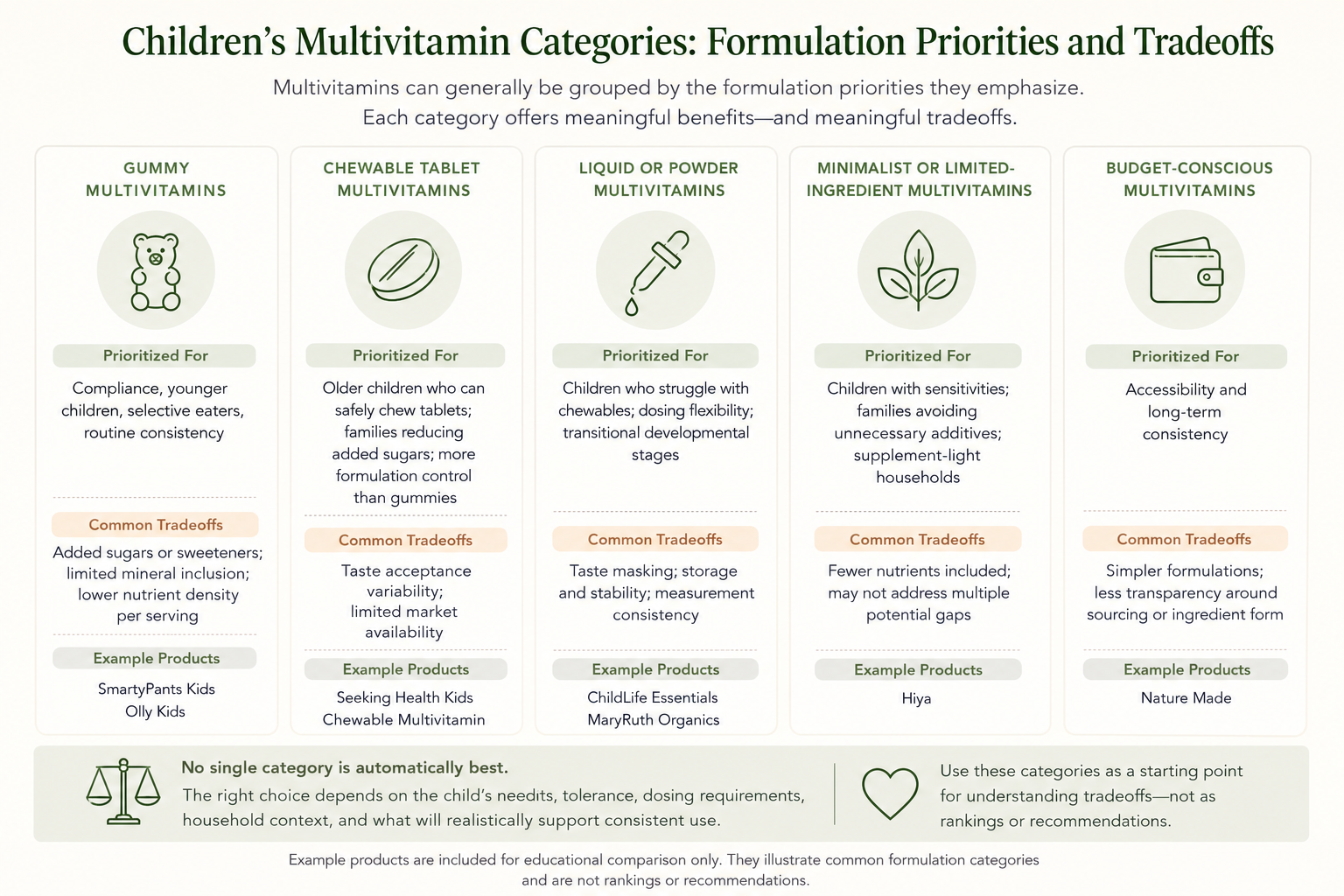
A category is a starting point, not a verdict.
Gummy, chewable, liquid, minimalist, and budget-conscious formulas reflect different formulation priorities. The goal is not to rank the category, but to understand which tradeoffs matter for a specific child and household.
Step Three: Compare Formulation Quality, Not Just Ingredients
Ingredient lists alone rarely tell the full story.
More informative questions include: Are key nutrients present at meaningful levels? Are ingredient forms chosen for tolerability and absorption? Are additions purposeful or primarily marketing-driven?
A shorter, well-designed formulation may be more appropriate than a longer list with minimal doses.
What Looks Impressive, and What Usually Matters More
Answer 6 questions and get a personalized starting point — not a product recommendation, a framework built around your family’s actual situation.
Take the Quiz →Why Different Supplement Categories Are Evaluated Differently
Not all supplement categories are evaluated in the same way. Multivitamins are typically designed to provide broad nutritional coverage and are often used consistently over time. Other supplement categories, such as probiotics or individual minerals, tend to be more situational and purpose-driven.
This difference affects how formulation quality, dose, and delivery are weighed. A framework that works well for comparing multivitamins may need to be applied differently when evaluating supplements intended for more targeted use. This distinction becomes important as families move beyond multivitamins and begin considering other supplement categories.
Step Four: Consider Dose and Safety Together
Children's multivitamins are often conservatively dosed by design, reflecting safety-first principles.
Dosage and ingredient form play a significant role in how a multivitamin functions in the body, which is why they are explored in more detail in How Dosage and Form Matter More Than Ingredient Lists.
For children, more is not automatically better.
A conservative dose can reflect appropriate safety-first formulation, especially for nutrients that may accumulate or exceed needs over time.
Step Five: Evaluate Practicality and Consistency
Effectiveness depends on use.
Parents may want to consider how many servings are required, whether the format fits daily routines, taste, texture, and tolerance, and long-term acceptability. Consistency often matters more than complexity.
Before choosing based on the label alone, ask:
Why This Matters for Families
Stand in the vitamin aisle long enough and the pattern becomes obvious. The green packaging. The cartoon sun. The "complete nutrition" promise on every label. Every brand has done just enough to look like every other brand, and the differences that actually matter are buried in the fine print that nobody reads and that brands never volunteer. That is not an accident. The category was designed to be compared by packaging, not by formulation.
That is what makes the aisle so exhausting. You are trying to make a real decision in an environment built to prevent you from making one. Most of the variation between products at the same price point is surface-level. Most of what matters sits in the Supplement Facts panel, not on the front of the bottle.
Understanding how to read the back of the label rather than the front is what makes this decision faster and less stressful. The choices narrow considerably once you know which differences are real and which ones are just design.
The best comparison is the one that reduces pressure, not the one that creates a winner.
For families, a useful comparison should clarify role, formulation, dose, practicality, and tradeoffs. It should not make parents feel that every difference is equally important or that one product is universally best.
Pulling It All Together: A Thoughtful Comparison Framework
The most useful comparison is not between brand A and brand B. It is between what you are actually trying to address and what the product is actually offering. What role is this meant to play? Does the formulation match that role? Is the dose meaningful? Will the child take it consistently? What are you comfortable trading off?
Answer those questions and the aisle gets a lot smaller.
Get the Supplement Decision Framework and the Evaluation Checklist — free, printable, and delivered straight to your inbox.
Get the Free Starter Kit →References and Further Reading
- American Academy of Pediatrics. Where We Stand: Vitamin Supplements for Children.
- National Institutes of Health Office of Dietary Supplements. Fat-Soluble Vitamins; Iron Fact Sheet for Health Professionals.
- Harvard T.H. Chan School of Public Health. Vitamins and Minerals: Supplements for Children.
- National Institutes of Health Office of Dietary Supplements. Omega-3 Fatty Acids; Choline Fact Sheets.
All sources are freely accessible and searchable via Google or Google Scholar.
Content on this site is provided for educational purposes only and does not constitute medical advice. Individual health decisions should be made in consultation with qualified healthcare professionals.
The Evidence-Informed Family Supplement Guide covers this in depth — add your name to the waitlist ahead of launch.
Get evidence-first supplement guidance weekly — join the digest.

Why Dosage and Form Matter More Than Ingredient Lists
Ingredient names don't tell the whole story. Dosage and form shape how a supplement actually behaves — and are often the difference between products that look identical on the front label.
Why the form of a supplement often matters more than the dose printed on the label.
Two magnesium supplements. Same dose on the label. Different price. If the label does not explain what you are paying for, the answer is probably in the form.
But ingredient lists alone rarely tell the full story.¹
For families trying to make careful, responsible choices, how much of an ingredient is used and in what form often matters more than how many ingredients appear on the label.
Many parents are doing their best to navigate this space with limited time and mixed information. Understanding why dosage and form matter can make supplement decisions feel more grounded and less confusing.
Why Ingredient Lists Can Be Misleading
Ingredient lists answer a very basic question: what's included?
They don't explain whether an ingredient is present in a meaningful amount, how well it's absorbed, how it behaves in the body, or whether it's appropriate for the intended user.
Two products can list the same ingredients and still perform very differently.
This is why evaluating supplements requires looking beyond presence alone.
What an Ingredient List Can — and Can't — Tell You
Dosage: When "Some" Isn't Enough
Most ingredients don't work simply because they're present. They work when they're provided at an amount that aligns with how they've been studied or shown to function biologically.²
A supplement may include an ingredient at a dose far below what's been studied, spread small amounts across many ingredients, or prioritize label appeal over functional relevance.
In those cases, the list can look robust while the formulation itself remains underpowered.²
For parents, this matters because more ingredients does not equal more benefit — and sometimes clarity is more helpful than complexity.
Presence is not the same as relevance.
An ingredient may be listed on the label, but the amount provided still needs to be meaningful enough to support the reason it was included.
Why Form Influences How an Ingredient Behaves
Ingredient form refers to the specific chemical or structural version of a nutrient or compound.
The form used can affect absorption, tolerability, stability, and consistency of effect.³
For example, two supplements may contain the same mineral or vitamin but use different forms that behave differently once consumed.
Labels often list the ingredient name without explaining why a particular form was chosen, leaving readers to assume equivalence where there may be meaningful differences.⁴
This is one of the most common reasons supplements don't perform as expected — even when the ingredient list looks promising.³
Interactions Matter More Than Lists
Supplements are not single-ingredient systems. Ingredients interact with one another within a formulation.
Those interactions can enhance absorption, compete for uptake, affect tolerability, or change how consistently an ingredient works.
An ingredient that performs well on its own may behave differently when combined with others, especially at lower doses.
This is another reason ingredient lists, by themselves, provide limited insight.
Before comparing two products by ingredient list alone, ask:
Get the Supplement Decision Framework and the Evaluation Checklist — free, printable, and delivered straight to your inbox.
Get the Free Starter Kit →Practicality is Part of Quality
For families, effectiveness isn't just biological — it's practical.
Dosage and form influence how many capsules, tablets, or gummies are required, whether a product is realistic to use consistently, taste, texture and tolerance, and long-term adherence.
A theoretically "strong" formulation that isn't practical to use regularly may be less helpful than a simpler one that fits into daily life.
Quality includes usability.
How This Fits Into a Thoughtful Evaluation
Looking beyond ingredient lists doesn't require specialized training. It requires shifting the focus from what's included to how the formulation is designed to work.
A more complete evaluation considers ingredient identity, dose, form, transparency, and context and risk.
Ingredient lists are a starting point — not the conclusion.⁴
A shorter label can sometimes be the more thoughtful formulation.
For families, the goal is not to find the longest ingredient list. The goal is to understand whether the product is clearly formulated, reasonably dosed, tolerable, and appropriate for the person who will actually use it.
Why This Matters for Families
When decisions affect children or household routines, the margin for error feels smaller.
Parents don't need perfect formulations or exhaustive knowledge. They need reliable ways to assess whether a product is thoughtfully designed, reasonably dosed, and appropriate for real-world use.
Understanding dosage and form helps families move past surface-level comparisons and toward more confident decisions.
How This Connects to the Broader Framework
This focus on dose and form is part of the broader framework I use when evaluating supplements, which I explain in more detail in How I Evaluate Supplements as a Biomedical Engineer and Quality Professional.
That framework emphasizes how products are designed to function — not just how they're presented.
Answer 6 questions and get a personalized starting point — not a product recommendation, a framework built around your family’s actual situation.
Take the Quiz →References and Further Reading
- National Institutes of Health Office of Dietary Supplements. Dietary Supplement Fact Sheets, 2023.
- National Academies of Sciences, Engineering, and Medicine. Dietary Reference Intakes (DRIs), 2019.
- Heaney RP. Factors influencing the measurement of bioavailability. American Journal of Clinical Nutrition, 2001.
- U.S. Food & Drug Administration. Dietary Supplements: What You Need to Know, 2022.
All sources are publicly accessible via NIH, FDA, or Google Scholar.
Content on this site is provided for educational purposes only and does not constitute medical advice. Individual health decisions should be made in consultation with qualified healthcare professionals.
The Evidence-Informed Family Supplement Guide covers this in depth — add your name to the waitlist ahead of launch.
Get evidence-first supplement guidance weekly — join the digest.

How to Read a Supplement Label (Without Getting Misled)
A practical, structured guide to reading supplement labels — covering what each section tells you, what to look for, and what to be skeptical of.
What the back of the bottle is actually telling you, and what it quietly leaves out.
You pick it up, flip it over, and realize you are not sure what you are looking at.
Supplement labels are designed to look like they contain everything you need. They contain a lot. Whether any of it answers the question you actually came with is a different matter.
That gap between what a label discloses and what a parent actually needs to know is where most supplement confusion lives. The information is not hidden. The context that makes it useful is almost never there.
This is a guide to finding that context, not by becoming an expert, but by knowing which questions the label can answer and which ones it cannot.
What a Supplement Label Is (and What It Is Not)
It is:
- A legally required way to disclose ingredients
- A tool for communicating how a product is positioned
- A snapshot of what is included in the formula
It is not:
- A guarantee of effectiveness
- A summary of supporting evidence
- A substitute for understanding dose, form, or context
Reading a label well means understanding both what it discloses and what it cannot reasonably prove.
What a Supplement Label Can and Cannot Tell You
A supplement label provides useful information, but not the full picture.
Starting With the Supplement Facts Panel
The Supplement Facts panel is often where people spend the least time, even though it contains the most actionable information on the label.
Serving Size
Serving size is easy to overlook. It is also the first thing worth checking before interpreting anything else on the label.
The amounts listed are only meaningful in relation to the serving size. A product may appear to contain a strong amount of an ingredient, but that amount may require two capsules, a full scoop, or multiple gummies per day to reach. What looks like a single clear number can reflect a serving that may not match how the product is likely to be used.
For families, that has practical implications. Will a child take the full serving consistently? With gummies especially, reaching the stated dose can mean consuming several pieces per day, which also adds to daily sugar intake. If the serving is not realistic, the amount on the label may not reflect actual use.
Start here. Then move to the rest of the panel.
Amount Per Serving
The amount per serving tells you how much of an ingredient you are getting based on the stated serving size, not just whether it is present.
This matters because many ingredients have dose-dependent effects. A small amount may look reassuring on the label while still being too low to matter for the intended purpose. More ingredients in a formula does not automatically mean a better product. It can mean lower individual doses spread across a longer list.
At this stage, you do not need to calculate ideal doses for every ingredient. The goal is to determine whether the amount listed seems relevant to the claim being made.
Daily Value (%DV): When It Helps and When It Does Not
The percent Daily Value (%DV) is a familiar reference point, but it is frequently misunderstood.
Daily Values are based on general population estimates. They are not tailored to individual needs, life stages, or specific health goals. For some nutrients, %DV provides a useful frame of reference. For others, it can be overly simplistic, particularly for children, where adult-based reference values may not apply.
Treat %DV as contextual information, not a quality score. It can tell you how a nutrient amount compares to a general reference point. It does not tell you whether that amount is appropriate for your child or relevant to your specific reason for considering the product.
The Supplement Facts panel is useful, but it only becomes meaningful when dose, serving size, and context are considered together.
A number on a label can look precise without answering whether that amount is relevant for the person using the product.
Ingredient Form: Where Labels Can Be Quietly Misleading
Two supplements can list the same ingredient and still perform very differently.
That difference often comes down to ingredient form.
Labels may list a mineral without specifying its salt form, a vitamin without indicating its bioavailable form, or a botanical without disclosing how it was processed. Those details affect how the ingredient behaves in the body.
Ingredient form influences absorption, tolerability, stability, and consistency of effect. It is one of the most common reasons supplements fail to perform as expected, and one of the least obvious things to a reader scanning the label quickly.
Proprietary Blends: What They Do and What They Hide
Proprietary blends group multiple ingredients under a single listed amount. They exist for legitimate reasons: to protect formulations, simplify labels, or allow flexibility in ingredient ratios.
The tradeoff here is transparency.
When ingredients are listed as part of a proprietary blend, the individual amounts within the blend are not disclosed. That makes it difficult to assess whether any specific ingredient is present at a dose likely to matter for the stated purpose. A blend can include ten ingredients while making it difficult to evaluate how much of each one is actually present.
A proprietary blend is not automatically a problem. But it limits what can reasonably be evaluated from the label alone.
The Other Ingredients Section: What Lives Below the Line
Every Supplement Facts panel has two parts. The top lists nutrients with doses and daily values. Below a dividing line sits the Other Ingredients section, a separate list of everything in the product that is not a nutrient. Most people never read it. That is where a significant amount of the information that actually matters for families is quietly stored.
These are excipients, the functional components that make the supplement possible to manufacture, store, and take. Binders hold tablets together. Fillers give capsules volume. Flow agents keep powders from clumping. Coatings make tablets easier to swallow. Flavors and sweeteners make gummies palatable. Colors make the product look appealing. None of these are inherently suspicious. Without them the supplement could not exist in its current form. But they are worth reading for a few specific reasons.
Allergens: By law, major allergens must be declared on supplement labels. What families sometimes miss is that the allergen can be present in an excipient rather than an active ingredient, such as a capsule shell made from shellfish-derived gelatin or a filler that contains soy. The declaration, required by the Food Allergen Labeling and Consumer Protection Act, typically appears as a "Contains:" statement near the Other Ingredients section rather than within the Supplement Facts panel itself. If allergen avoidance is a concern, reading below the nutrient table rather than relying solely on a front-label claim is worth the extra step.
Sugar alcohols: Sorbitol, xylitol, mannitol, and erythritol are common in sugar-free gummies and chewables. At the amounts used in supplements they are unlikely to cause problems for most children, but they can cause digestive discomfort in children who are sensitive to them.
Artificial colors: FD&C dyes appear by name in this section. If avoiding artificial colors is a priority for your family, this is where to check rather than trusting front-label claims.
Natural flavors: This is a catch-all term that does not require disclosure of source ingredients. It is not a red flag on its own, but it is not a fully transparent disclosure either.
The Other Ingredients section is also where most clean and natural marketing is making its real argument. When a brand says "clean," it usually means this list is short, avoids certain excipients, or substitutes alternatives that test better in market research. Whether those substitutions actually change anything about the product's safety or effectiveness is a separate question from whether they change the brand's positioning. Reading this section is one of the fastest ways to understand what a product is actually prioritizing.
Structure and Function Claims: How to Read the Language
Supplement labels often use phrases like "supports immune health," "promotes normal digestive regularity," or "helps maintain energy levels." These are known as structure/function claims, language designed to describe how a product relates to normal bodily processes without crossing into disease-related territory.
This wording is intentionally broad.
Structure/function claims tell you how a product is positioned, not how well it works. They do not tell you whether the product has been shown to meaningfully improve an outcome for a specific person, at a specific dose, in a specific context. Two products can make nearly identical claims while differing significantly in their formulas, doses, and evidence base. Understanding that distinction helps prevent over-interpreting what label language promises.
When you see a claim like "supports immune health" or "promotes digestive balance," ask:
What Labels Often Do Not Tell You
Even a well-designed label leaves out important information: bioavailability data, stability over time, population-specific considerations for children versus adults, and how ingredients interact within the entirety of the formulation.
The absence of this information does not automatically mean a product is of poor quality. It does mean that what the label shows is genuinely incomplete, and that assuming otherwise is a common source of misplaced confidence.
Labels are a starting point, not a conclusion.
Get the Supplement Decision Framework and the Evaluation Checklist — free, printable, and delivered straight to your inbox.
Get the Free Starter Kit →Using the Label as One Part of a Bigger Decision
Reading a supplement label well is not about finding a perfect product. It is about using the information available to ask better questions.
A thoughtful evaluation considers ingredient identity, dose, form, transparency, third-party certifications, context, and risk. The label supports that process. It does not replace it.
A label is not the decision. It is the first layer of the decision.
Use the label to identify what deserves a closer look: serving size, dose, ingredient form, transparency, and whether the claim matches the evidence available.
Why This Matters for Families
When you are making decisions for yourself, imperfect information can feel manageable. When you are making decisions for a child, uncertainty carries more weight.
Most parents are not reading supplement labels because they want to become experts in formulation science. They are reading them because they are trying to answer a specific set of questions: Is this necessary? Is it appropriate for my child? Is it likely to help with the reason I am considering it? Is it worth adding to our routine?
Those are the right questions. Learning to read a label more deliberately does not resolve every uncertainty, but it makes it clearer what the label can and cannot actually tell you. That's a better starting point than taking the claims at face value.
How This Fits With What Comes Next
In future articles, this label-reading framework gets applied to specific supplements commonly used by families, so the ingredient choices, formulation decisions, and claims involved can be evaluated in practical terms.
This approach is part of a broader evaluation framework described in more detail in How I Evaluate Supplements as a Biomedical Engineer and Quality Professional.
The label is where those conversations must start. Knowing what it can and cannot tell you makes every subsequent decision more grounded.
Answer 6 questions and get a personalized starting point — not a product recommendation, a framework built around your family’s actual situation.
Take the Quiz →Content on this site is provided for educational purposes only and does not constitute medical advice. Individual health decisions should be made in consultation with qualified healthcare professionals.
The Evidence-Informed Family Supplement Guide covers this in depth — Add your name to the waitlist ahead of launch.
Get evidence-first supplement guidance weekly — join the digest.