Comparing Children’s Multivitamins: What to Actually Look at
What actually separates children's multivitamins from each other.
Comparing children's multivitamins is harder than it should be because they are designed to look more similar than they actually are.
This article is not about identifying a single "best" children's multivitamin. There is not one. Instead, it explains how to compare options thoughtfully, using an evidence-informed framework that considers safety, formulation quality, practicality, and real-world tradeoffs.
How Pediatric Nutrition Guidance Is Used Here
In the United States, pediatric nutrition guidance generally emphasizes adequacy and safety, not optimization. The priority is ensuring children receive sufficient essential nutrients while avoiding unnecessary excess, particularly for nutrients that can accumulate over time.
Organizations like the American Academy of Pediatrics (AAP) generally state that healthy children with a well-balanced diet do not need a daily multivitamin, emphasizing a food-first approach because most nutrients are best obtained from a varied diet.¹ In some cases, such as selective eating, limited dietary variety, or specific health circumstances, targeted supplementation may be appropriate, but routine multivitamin use is not universally recommended.
This perspective helps explain why children's multivitamins are often conservatively dosed, why "more" is not always better, and why formulations tend to focus on a limited set of nutrients.
Children's multivitamin comparisons should start with proportion, not optimization.
For most families, the question is not which product provides the most. It is whether a product offers appropriate support without creating unnecessary excess, complexity, or unrealistic expectations.
Step One: Clarify the Role of a Multivitamin
Before comparing products, it helps to clarify why a multivitamin is being considered.
For many families, children's multivitamins are used to support selective or inconsistent eating, provide reassurance during growth phases, and supplement, not replace, a generally balanced diet. They are not designed to correct diagnosed deficiencies or substitute for medical care. Keeping expectations realistic helps narrow choices and reduces pressure to find a perfect product.
Before comparing products, clarify the role:
Key Vitamins and Minerals Commonly Emphasized in Children's Multivitamins
Pediatric guidance and formulation practices tend to emphasize a core group of nutrients that appear consistently across children's multivitamins.³ These nutrients are included not because every child is deficient, but because they are broadly relevant during growth, more likely to vary in children's diets, and appropriate for conservative, routine supplementation.
Vitamins A, C, D, and E
These vitamins support vision, immune function, bone development, and cellular protection. Because vitamins A and E are fat-soluble, doses in children's multivitamins are typically conservative.² Vitamins C and D are included at modest levels intended for routine support rather than therapeutic correction.
Iron
Iron inclusion varies widely. Some children's multivitamins include it; many intentionally do not.² This reflects both its importance during growth and the need for caution, as excess iron is not appropriate for all children.
Zinc
Often included due to its role in growth and immune function. Zinc is easier to formulate than larger minerals, though still typically dosed conservatively.
Iodine
Included in some formulations, particularly those designed to complement diets that may limit iodized salt or dairy.
Vitamin B6, B12, and Folate
These B vitamins support energy metabolism, nervous system function, and development. Vitamin B6 is typically included at conservative levels, reflecting both its importance and the recognition that excessive intake is unnecessary. Vitamin B12 and folate are included due to their relevance across dietary patterns and roles in cellular development.
A note on what is often missing: Minerals such as magnesium or potassium are frequently absent or present only in small amounts due to formulation constraints. Their absence is usually intentional, not an oversight.
Nutrients Often Discussed Separately: Omega-3 Fatty Acids and Choline
Some nutrients important for development are often discussed alongside multivitamins but are not consistently included.
Omega-3s, particularly DHA, play a role in brain and visual development. They are rarely included in meaningful amounts in multivitamins due to dose size, stability, and taste considerations.⁴ For this reason, omega-3s are commonly provided as separate products rather than bundled into a multivitamin.
Choline supports cell membrane integrity and brain development, yet it is frequently absent or present only in trace amounts in children's multivitamins. This reflects formulation bulk and taste constraints rather than lack of relevance.
Their absence does not automatically indicate poor quality.⁴
Common Nutrient Patterns in Children's Multivitamins
| Nutrient or Category | Why It Appears | What to Watch For | Common Interpretation |
|---|---|---|---|
| Vitamins A, C, D, and E | Broadly relevant to growth, immune function, bone health, and cellular protection | Fat-soluble vitamins such as A and E are usually dosed conservatively | Presence is common, but dose and safety context still matter |
| Iron | Relevant during growth, but needs vary widely | Not all children need supplemental iron; excess is not appropriate for everyone | Absence is not automatically a weakness; inclusion should be intentional |
| Zinc and iodine | Related to growth, immune function, and dietary pattern considerations | Doses are typically conservative; relevance depends on diet and context | Useful to evaluate, but not a reason to assume superiority |
| B vitamins and folate | Support metabolism, nervous system function, and cellular development | Forms and doses may vary across products | Common in multivitamins, but more is not automatically better |
| Magnesium and potassium | Often limited by formulation bulk and serving size constraints | Frequently absent or present in small amounts | Absence is often a formulation reality, not necessarily poor quality |
| Omega-3s and choline | Relevant to development but difficult to include meaningfully in many multivitamins | Often better evaluated separately due to dose, taste, and stability constraints | Absence does not automatically indicate poor quality |
This table is not a recommendation list. It is a way to interpret common formulation patterns so product comparisons stay grounded in purpose, dose, and context.
Step Two: Understand the Main Product Categories
Children's multivitamins fall into a small number of practical formulation categories, each reflecting different priorities and limitations. Understanding these categories makes brand-level comparisons more meaningful.
Category 1: Gummy Multivitamins
Often prioritized for younger children, selective eaters, and routine consistency. Common tradeoffs include added sugars or sweeteners, limited mineral inclusion, and lower nutrient density per serving. Gummies are designed primarily for acceptance, which makes them practical for some families but structurally limited. Example products: SmartyPants Kids; Olly Kids.
Category 2: Chewable Tablet Multivitamins
Often prioritized for older children who can safely chew tablets, families reducing added sugars, and parents seeking more formulation control than gummies allow. Common tradeoffs include taste acceptance variability and limited market availability. True chewable tablet multivitamins for children are relatively limited. Example product: Seeking Health Kids Chewable Multivitamin.
Category 3: Liquid or Powder Multivitamins
Often prioritized for children who struggle with chewables, families needing dosing flexibility, and transitional developmental stages. Common tradeoffs include taste masking challenges, storage and stability considerations, and measurement consistency. Example products: ChildLife Essentials; MaryRuth Organics.
Category 4: Minimalist / Limited-Ingredient Multivitamins
Often prioritized for children with sensitivities, families avoiding unnecessary additives, and supplement-light households. Common tradeoffs include fewer nutrients included and the possibility that the product may not address multiple potential gaps. Example product: Hiya.
Category 5: Budget-Conscious Multivitamins
Often prioritized for accessibility and long-term consistency. Common tradeoffs include simpler formulations and less transparency around sourcing or ingredient form. Example product: Nature Made.
Example products are included for educational comparison only. They illustrate common formulation categories and are not rankings or recommendations. Any product mentions are selected based on formulation characteristics, not sponsorship.
Children's Multivitamin Categories: Common Priorities and Tradeoffs
| Category | Often Prioritized For | Common Tradeoffs | Example Products |
|---|---|---|---|
| Gummy multivitamins | Compliance, younger children, selective eaters, routine consistency | Added sugars or sweeteners; limited mineral inclusion; lower nutrient density per serving | SmartyPants Kids; Olly Kids |
| Chewable tablet multivitamins | Older children who can safely chew tablets; families reducing added sugars; more formulation control than gummies | Taste acceptance variability; limited market availability | Seeking Health Kids Chewable Multivitamin |
| Liquid or powder multivitamins | Children who struggle with chewables; dosing flexibility; transitional developmental stages | Taste masking; storage and stability; measurement consistency | ChildLife Essentials; MaryRuth Organics |
| Minimalist or limited-ingredient multivitamins | Children with sensitivities; families avoiding unnecessary additives; supplement-light households | Fewer nutrients included; may not address multiple potential gaps | Hiya |
| Budget-conscious multivitamins | Accessibility and long-term consistency | Simpler formulations; less transparency around sourcing or ingredient form | Nature Made |
Example products are included for educational comparison only. They illustrate common formulation categories and are not rankings or recommendations.
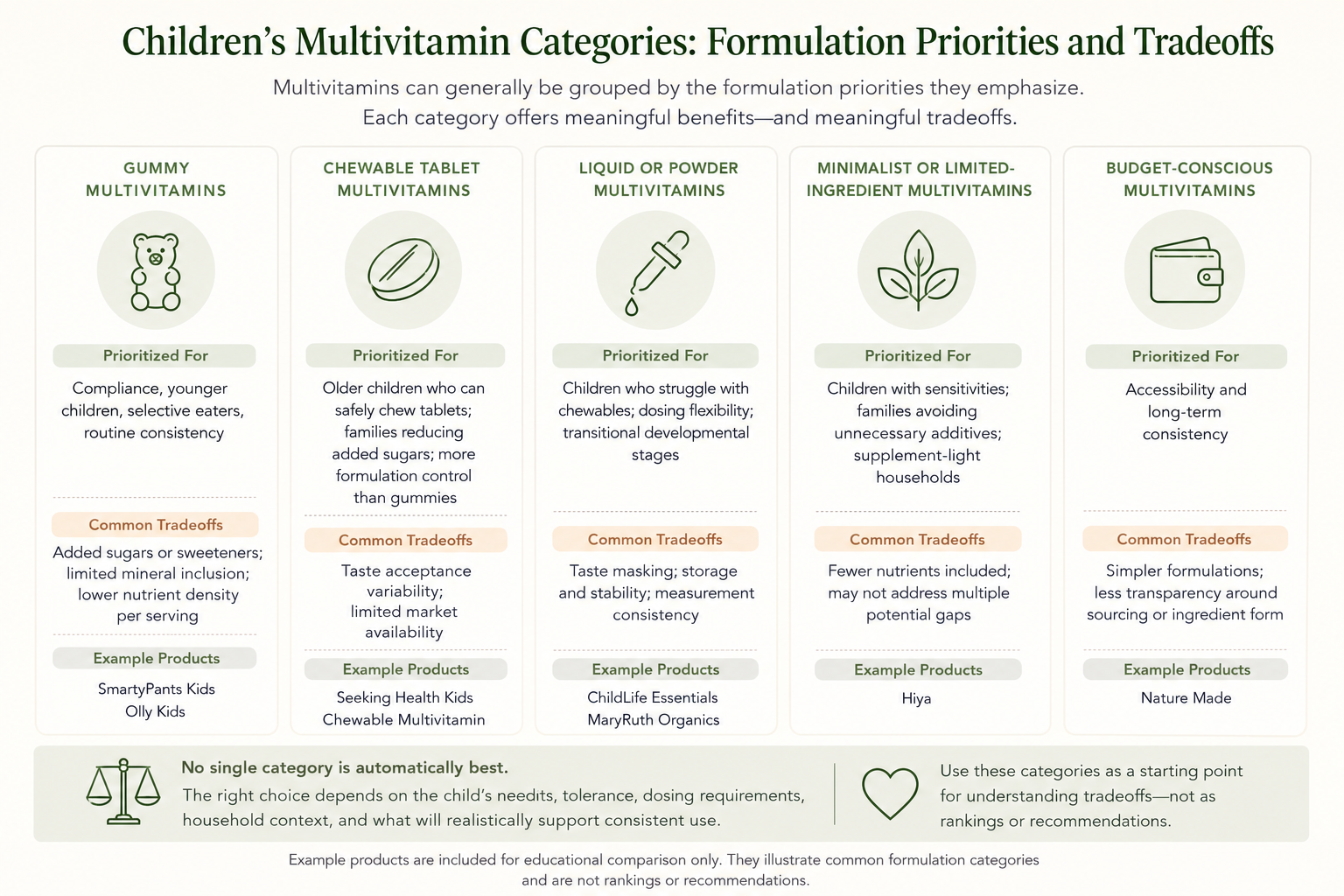
A category is a starting point, not a verdict.
Gummy, chewable, liquid, minimalist, and budget-conscious formulas reflect different formulation priorities. The goal is not to rank the category, but to understand which tradeoffs matter for a specific child and household.
Step Three: Compare Formulation Quality, Not Just Ingredients
Ingredient lists alone rarely tell the full story.
More informative questions include: Are key nutrients present at meaningful levels? Are ingredient forms chosen for tolerability and absorption? Are additions purposeful or primarily marketing-driven?
A shorter, well-designed formulation may be more appropriate than a longer list with minimal doses.
What Looks Impressive, and What Usually Matters More
Answer 6 questions and get a personalized starting point — not a product recommendation, a framework built around your family’s actual situation.
Take the Quiz →Why Different Supplement Categories Are Evaluated Differently
Not all supplement categories are evaluated in the same way. Multivitamins are typically designed to provide broad nutritional coverage and are often used consistently over time. Other supplement categories, such as probiotics or individual minerals, tend to be more situational and purpose-driven.
This difference affects how formulation quality, dose, and delivery are weighed. A framework that works well for comparing multivitamins may need to be applied differently when evaluating supplements intended for more targeted use. This distinction becomes important as families move beyond multivitamins and begin considering other supplement categories.
Step Four: Consider Dose and Safety Together
Children's multivitamins are often conservatively dosed by design, reflecting safety-first principles.
Dosage and ingredient form play a significant role in how a multivitamin functions in the body, which is why they are explored in more detail in How Dosage and Form Matter More Than Ingredient Lists.
For children, more is not automatically better.
A conservative dose can reflect appropriate safety-first formulation, especially for nutrients that may accumulate or exceed needs over time.
Step Five: Evaluate Practicality and Consistency
Effectiveness depends on use.
Parents may want to consider how many servings are required, whether the format fits daily routines, taste, texture, and tolerance, and long-term acceptability. Consistency often matters more than complexity.
Before choosing based on the label alone, ask:
Why This Matters for Families
Stand in the vitamin aisle long enough and the pattern becomes obvious. The green packaging. The cartoon sun. The "complete nutrition" promise on every label. Every brand has done just enough to look like every other brand, and the differences that actually matter are buried in the fine print that nobody reads and that brands never volunteer. That is not an accident. The category was designed to be compared by packaging, not by formulation.
That is what makes the aisle so exhausting. You are trying to make a real decision in an environment built to prevent you from making one. Most of the variation between products at the same price point is surface-level. Most of what matters sits in the Supplement Facts panel, not on the front of the bottle.
Understanding how to read the back of the label rather than the front is what makes this decision faster and less stressful. The choices narrow considerably once you know which differences are real and which ones are just design.
The best comparison is the one that reduces pressure, not the one that creates a winner.
For families, a useful comparison should clarify role, formulation, dose, practicality, and tradeoffs. It should not make parents feel that every difference is equally important or that one product is universally best.
Pulling It All Together: A Thoughtful Comparison Framework
The most useful comparison is not between brand A and brand B. It is between what you are actually trying to address and what the product is actually offering. What role is this meant to play? Does the formulation match that role? Is the dose meaningful? Will the child take it consistently? What are you comfortable trading off?
Answer those questions and the aisle gets a lot smaller.
Get the Supplement Decision Framework and the Evaluation Checklist — free, printable, and delivered straight to your inbox.
Get the Free Starter Kit →References and Further Reading
- American Academy of Pediatrics. Where We Stand: Vitamin Supplements for Children.
- National Institutes of Health Office of Dietary Supplements. Fat-Soluble Vitamins; Iron Fact Sheet for Health Professionals.
- Harvard T.H. Chan School of Public Health. Vitamins and Minerals: Supplements for Children.
- National Institutes of Health Office of Dietary Supplements. Omega-3 Fatty Acids; Choline Fact Sheets.
All sources are freely accessible and searchable via Google or Google Scholar.
Content on this site is provided for educational purposes only and does not constitute medical advice. Individual health decisions should be made in consultation with qualified healthcare professionals.
The Evidence-Informed Family Supplement Guide covers this in depth — add your name to the waitlist ahead of launch.
Get evidence-first supplement guidance weekly — join the digest.