Evidence-first supplement
guidance for families.
Structured, research-informed articles designed to help families evaluate supplement claims, understand product tradeoffs, and make calmer, more consistent decisions.
 Structured evaluation over simplified claims.
Not sure where to begin?
These three articles offer the clearest entry point depending on what you are trying to understand.
All Articles
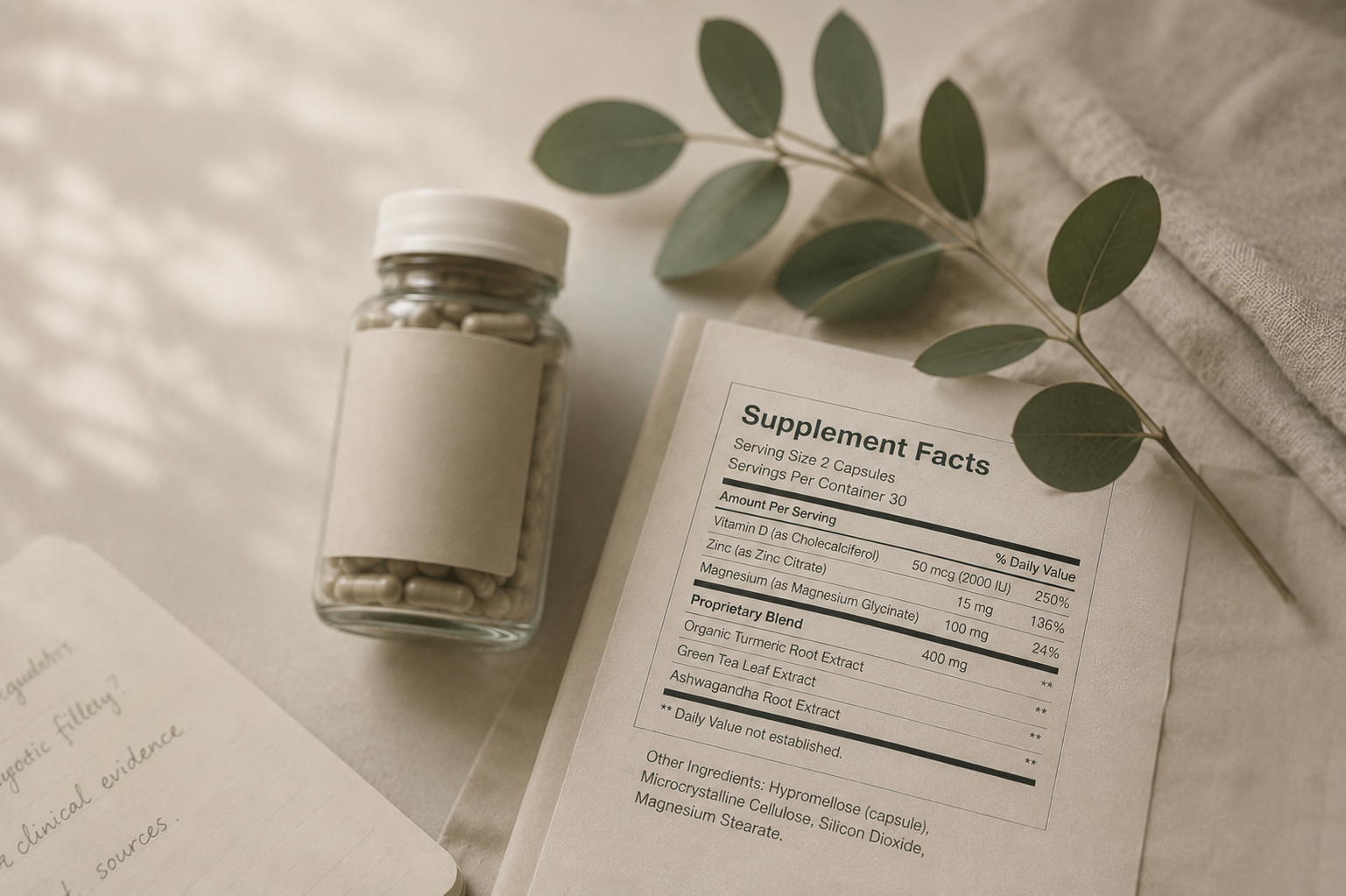
Are “Clean” and “Natural” Supplement Claims Meaningful — or Just Marketing?
"Clean" and "natural" appear on nearly every supplement shelf. This article examines what those terms are actually regulated to mean — and what they leave out.
What those terms actually mean on a supplement label, and why they are not enough.
Clean is not a regulated term. Natural is not a regulated term. Neither of them answers the questions that actually matter before you buy a supplement for your child.
I have worked in this industry for years and I genuinely cannot tell you what "clean" means on a supplement label. Not because I have not looked. Because there is no definition to find. Nobody is checking whether the claim is accurate because there is no standard against which to check it. "Clean" implies there is something dirty to compare it to. Nobody ever explains what that is.
The "natural" argument is its own kind of curious. Echinacea is a flower. Magnesium is a mineral. Vitamin C is an acid. At some point in the supply chain, every supplement ingredient has been extracted, concentrated, processed, or synthesized in some way. "Natural" describes where something started. It does not describe what it became.
The problem is that these words often sound more precise than they are. Unlike regulated drug claims, terms like "clean" and "natural" do not have universally standardized definitions within the supplement industry.¹ As a result, they can create the impression of safety, quality, or effectiveness before those things have been evaluated at all.
These claims may reflect real formulation choices. Some products labeled natural or clean do reflect priorities that matter to families. The issue is that the terms are broad enough to describe very different products, and they do not answer the questions that guide a good supplement decision: what is in the product, why is it included, at what dose, and what evidence supports the intended use.
What "Natural" Usually Means on Supplement Labels
In supplements, "natural" can refer to several different things: the original ingredient source, the way an ingredient was processed, the absence of artificial colors or flavors, or the overall branding style of the product. These meanings are not always consistent, and they are not interchangeable.²
A vitamin may originate from a plant source while still undergoing substantial processing before reaching the finished supplement. A synthetic ingredient may be chemically identical to a naturally occurring version. Natural may describe where an ingredient started. It does not necessarily describe what the finished ingredient does in the body, how it was controlled, or whether the dose fits the intended use.
Natural alone does not reliably predict effectiveness, absorption, safety, manufacturing quality, or suitability for children. A deeper discussion of these distinctions appears in Natural vs. Synthetic Vitamins: What the Evidence Actually Shows.
"Natural" describes a possible origin, not a final quality judgment.
A natural-source ingredient may still be processed, purified, standardized, or combined with other ingredients before it becomes part of the finished supplement.

What "Clean" Usually Signals
"Clean" is even less standardized. In practice, clean-label supplements often emphasize shorter ingredient lists, fewer dyes or flavors, fewer sweeteners or preservatives, and simplified packaging. Some families genuinely prefer these approaches, and in certain situations reducing unnecessary additives or simplifying formulas may improve tolerability.
But when you try to pin down what "clean" actually means, every interpretation falls apart quickly. If it means no additives, that is not possible, because every capsule needs a binder, and the binder is usually something like cornstarch, which is itself natural. If it means allergen-free, that is a medical consideration, not a cleanliness one, and framing allergens as "dirty" confuses two completely different things. If it means no artificial colors, that actually holds up and means something specific. If it means no sugar, sugar is a carbohydrate that exists throughout the natural world, and calling it dirty is a marketing position, not a chemistry one. The definition shifts depending on what the brand is trying to sell.
Silicon dioxide is a useful illustration. It is a mineral compound found in sand, quartz, and most rocks on earth. It is used in supplements as an anti-caking agent to keep powders from clumping. Some clean-label brands flag it as an ingredient to avoid and use rice hull powder instead. Rice hull is the outer shell of rice grain, removed during milling, then collected, dried, and processed into a fine powder before it goes into the capsule. It is doing the same job as silicon dioxide. It went through its own industrial process to get there. The only meaningful difference is that one sounds like a mineral and one sounds like a food. The marketing is built entirely on that association.
Following this logic all the way to its conclusion, the truly clean vitamin C would require someone to stand at a lemon farm and watch the manufacturer squeeze citrus by hand. In reality, the ascorbic acid in a "whole food" vitamin C supplement has been extracted, processed, concentrated, and standardized before it reaches the capsule, regardless of what the front label says. The lemon was involved at some point. The lemon was not squeezed in a clean room.
"Clean" can easily become a broad emotional signal rather than a clearly defined quality standard. Two products may both market themselves as clean while differing substantially in ingredient quality, manufacturing controls, dose alignment, stability testing, and evidence supporting use. A cleaner-looking formula may be preferable in some situations. "Clean" does not tell you whether the product is well designed, well tested, or appropriate for the person taking it.
Why These Claims Feel So Convincing
Terms like "clean" and "natural" work because they connect to something real. Parents want fewer unnecessary ingredients, simpler products, safer-feeling options, and products that appear less heavily processed. Those instincts are understandable, especially when the product is for a child.
Marketing language builds on those instincts by framing products as more pure, more trustworthy, or more aligned with wellness. The problem is not the instinct. The problem is when the label turns that instinct into a conclusion before the product has been evaluated. A product can look clean and still provide unrealistic doses, lack meaningful evidence, or rely heavily on marketing associations. A product without clean-label branding can still have strong manufacturing controls, transparent labeling, and appropriate dosing.
This is one reason evidence-informed evaluation requires looking beyond branding language.
What Matters More Than "Clean" or "Natural"
For families evaluating supplements, several factors are more decision-ready than broad front-label claims. These are the details that reveal whether a product is actually worth considering, regardless of how it is positioned.
What Matters More Than "Clean" or "Natural"
| Evaluation Factor | What to Look For | Why It Matters |
|---|---|---|
| Ingredient transparency | Clear ingredient identity, nutrient form, active amounts, and standardized extracts where relevant | A product is easier to evaluate when the label shows what is included and how much is provided |
| Dose alignment | Amounts that match the age, intended use, and available evidence | A clean-looking label does not tell you whether the dose is appropriate |
| Formulation design | Delivery format, stability, ingredient interactions, tolerability, and practical use | The finished formula matters more than the front-label claim |
| Quality signals | Testing information, manufacturing controls, supplier oversight, and clear quality claims | Important quality factors are often not visible from "clean" or "natural" language alone |
| Evidence supporting use | Research that matches the ingredient, dose, population, and intended outcome | A thoughtful-looking product still needs evidence that supports the specific use |
"Clean" and "natural" can describe preferences or formulation choices. They do not replace the need to evaluate dose, form, transparency, quality signals, and evidence.
Get the Supplement Decision Framework and the Evaluation Checklist — free, printable, and delivered straight to your inbox.
Get the Free Starter Kit →A Practical Way to Think About "Clean" and "Natural" Claims
Rather than treating these labels as proof of quality, or dismissing them entirely, it helps to treat them as starting points rather than conclusions. Ask what the claim is referring to: is it describing the ingredient source, the absence of certain additives, the processing approach, or primarily the brand positioning? Then ask whether that distinction changes the product's function, tolerability, or fit for the intended use.
Some products marketed as clean or natural do reflect formulation priorities that are worth considering. Others rely on those terms because they create strong associations around safety and wellness without adding specific information. The label can be a useful first signal. It is not a substitute for evaluating dose, evidence, quality controls, and product fit.
Why This Matters for Families
Parents are often trying to make careful choices in an environment filled with strong opinions and confident label language. "Clean" and "natural" can quickly become shorthand for safer, healthier, more responsible, or better for children. That association is understandable, especially when the goal is to avoid unnecessary ingredients and choose thoughtfully.
The issue is not the preference. The issue is when the label language creates a sense of confidence that the product has not yet earned. Supplement decisions are usually more specific than broad categories like "clean" or "natural" allow. A product that fits a family's preferences still needs to be evaluated for dose, evidence, quality controls, and intended use.
Pulling It All Together
"Clean" and "natural" are not meaningless terms, but they are often less precise than they appear. Some products using these claims reflect formulation priorities that families may reasonably care about. Others rely on the terms to create broad impressions of safety or quality without providing enough detail to evaluate the product.
The most useful question is not whether the label sounds clean enough. It is whether the product gives enough information to understand what it contains, why it is included, and whether it fits the intended use. A product can align with a family's preferences and still need to be evaluated for dose, evidence, quality controls, and product fit. Starting with the label is reasonable. Stopping there is not.
Answer 6 questions and get a personalized starting point — not a product recommendation, a framework built around your family’s actual situation.
Take the Quiz →References and Further Reading
- National Institutes of Health, Office of Dietary Supplements. Dietary Supplement Fact Sheets.
- U.S. Food & Drug Administration. Dietary Supplements: What You Need to Know.
- Harvard T.H. Chan School of Public Health. The Nutrition Source: Vitamins and Minerals.
- National Center for Complementary and Integrative Health. Using Dietary Supplements Wisely.
- National Academies of Sciences, Engineering, and Medicine. Dietary Reference Intakes: Applications in Dietary Assessment.
All sources are freely accessible or summarized via NIH, FDA, Harvard, or Google Scholar.
Content on this site is provided for educational purposes only and does not constitute medical advice. Individual health decisions should be made in consultation with qualified healthcare professionals.
The Evidence-Informed Family Supplement Guide covers this in depth — add your name to the waitlist ahead of launch.
Get evidence-first supplement guidance weekly — join the digest.