Evidence-first supplement
guidance for families.
Structured, research-informed articles designed to help families evaluate supplement claims, understand product tradeoffs, and make calmer, more consistent decisions.
 Structured evaluation over simplified claims.
Not sure where to begin?
These three articles offer the clearest entry point depending on what you are trying to understand.
All Articles

Does My Child Actually Need A Supplement?
The answer to "does my child need supplements?" is almost never universal. This article offers a risk-based framework for thinking through the question with your child's actual context in mind.
How to think through whether your child actually needs a supplement.
The question most parents are actually asking is not whether children need supplements. It is whether their child, eating the way they eat right now, needs this one.
That question usually comes with a feeling underneath it. Something like: I do not know if my child is getting enough, and if they are not, that is on me. Most parents who end up in the supplement aisle are not looking for optimization. They are looking for reassurance that they have not missed something important.
This article is about how to think through that honestly. Not with a blanket answer, but by naming the variables that actually determine whether supplementation makes sense for a specific child in a specific situation.
Why This Question Is So Hard to Answer
Children are not a single population. Nutrient needs vary by age, growth stage, diet, health status, and environment. As a result, blanket statements about supplementation often fail to reflect real-world variability.
At the same time, supplement marketing tends to focus on reassurance, promising to "fill gaps" or "support immunity," without clearly defining what those gaps are or how often they actually exist.
Understanding whether supplements are needed requires stepping back from product categories and focusing on risk and context.
How This Fits Within an Evidence-First Framework
Pediatric supplementation is not an all-or-nothing question. Supplements are conditional tools, not defaults, and whether they make sense depends on the child, the diet, the specific nutrient, and the reason for considering it. That context is what this article is working through.
What Pediatric Guidance Actually Emphasizes
Mainstream pediatric guidance generally does not recommend routine supplementation for all children.¹ Instead, it emphasizes meeting nutrient needs primarily through food,² identifying specific risk factors for deficiency, and using targeted supplementation when appropriate.³
This does not mean supplements are never useful. It means they are situational, not universal.⁴ Understanding this nuance helps parents avoid both over-supplementation and unnecessary worry.
Dietary Adequacy Comes First
Before considering supplements, it's important to assess whether a child's diet is likely meeting basic nutritional needs. Factors that often support adequacy include a reasonably varied diet, regular intake of fortified staple foods, and consistent growth and development. In these situations, routine supplementation may offer limited benefit.
That said, adequacy is not always easy to assess from the outside, and dietary patterns vary widely between families. How to Read a Supplement Label (Without Getting Misled) can help clarify what label information actually tells you, and what it does not.
When Supplementation May Be Reasonable
There are situations where supplementation is more commonly considered, including selective or restrictive eating patterns, medically indicated dietary limitations, periods of rapid growth, limited sun exposure or geographic factors, and specific life stages or transitions.
In these cases, supplements are typically used to address a defined concern, not as a blanket safeguard. This purpose-first approach mirrors how supplements are evaluated throughout this site.
Risk Factors Matter More Than Averages
Population-level recommendations describe averages. Individual children do not live at the average.⁵ Risk-based evaluation asks different questions: Is there a plausible reason this child might not meet needs through diet alone? Are there signs suggesting a potential gap? Would supplementation meaningfully reduce risk, or simply add complexity?
This approach avoids both unnecessary supplementation and rigid adherence to generalized guidance.
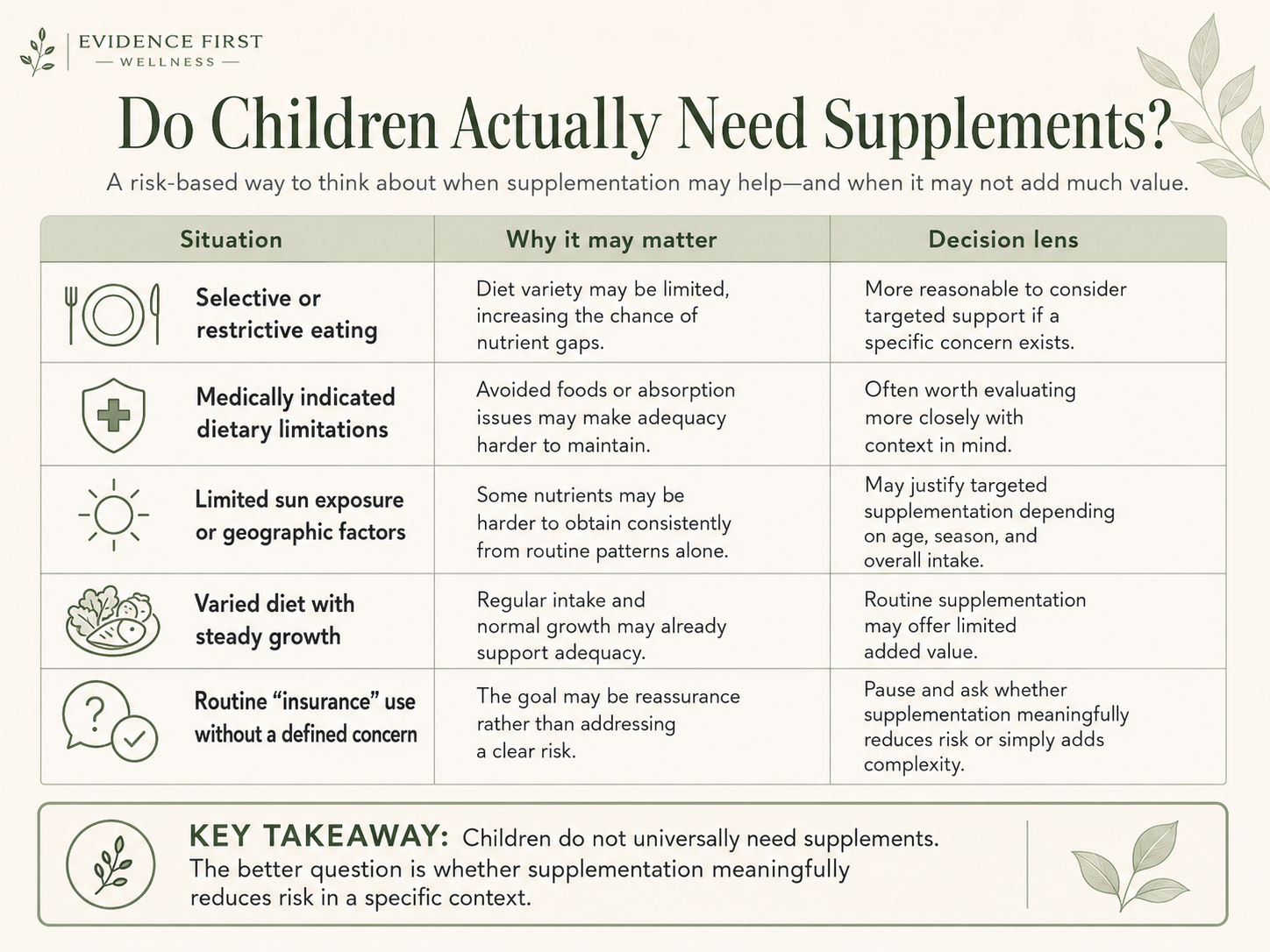
When Supplementation May Be Reasonable vs. When It May Offer Limited Value
| Situation | Why It May Matter | Decision Lens |
|---|---|---|
| Selective or restrictive eating | Limited dietary variety may reduce intake of certain nutrients | Define the specific gap and match the supplement to it |
| Medically indicated dietary limitations | Exclusion of food groups may affect nutrient adequacy | Use targeted supplementation in line with professional guidance |
| Limited sun exposure or geographic factors | Vitamin D synthesis depends on sunlight exposure, which varies significantly | Situational supplementation may be reasonable; dose and form still matter |
| Varied diet with steady growth | Dietary adequacy may already be met through food | Routine supplementation may add limited benefit; evaluate before adding |
| Routine "insurance" use without a defined concern | Motivation is reassurance, not a specific risk | Clarify what is being addressed before continuing; reassess duration |
This table is not a recommendation to supplement or not to supplement. It is a way to match context to decision-making rather than defaulting to either extreme.
Potential Downsides of Routine Supplement Use
While many supplements are well tolerated, routine use without a clear rationale can introduce tradeoffs. These may include unnecessary nutrient exposure, dosing that exceeds needs over time,⁶ reliance on supplements instead of dietary variety, and added ingredients that are not well studied in children.
Recognizing these tradeoffs helps keep decisions proportional rather than fear-driven. For a focused look at long-term use specifically, What Safety Data Exists for Long-Term Supplement Use in Children? examines where the evidence is strong and where meaningful gaps remain.
Answer 6 questions and get a personalized starting point — not a product recommendation, a framework built around your family’s actual situation.
Take the Quiz →Dose, Form, and Duration Still Matter
Even when supplementation is considered reasonable, how a supplement is used matters. Form and dose tend to matter more than ingredient count alone, particularly in pediatric contexts.
Duration also matters. Short-term, targeted supplementation differs meaningfully from long-term routine use. The Frameworks & Decision Tools Hub includes structured tools for thinking through these variables across different supplement categories.
Children Are Not Small Adults
One of the most common pitfalls in supplement decision-making is extrapolating adult practices to children.⁷ Children differ in metabolism, body size and composition, tolerance thresholds, and the available evidence base. Adult research does not automatically apply, and dose assumptions in particular require careful calibration to age and context.
Managing Expectations Around "Insurance" Supplements
Supplements are sometimes used as nutritional "insurance," a way to feel reassured even when dietary intake is uncertain. While this motivation is understandable, insurance framing can obscure important questions: Insurance against what, exactly? For how long? At what dose?
Without clear answers, supplementation can drift from a temporary support into an unexamined routine.
A Practical Way to Think About the Decision
Rather than asking whether children need supplements, a more useful approach is to ask: Is there a specific concern being addressed? Is supplementation likely to meaningfully reduce risk? Are form and dose appropriate for age and use? Is this decision intended to be temporary or ongoing?
This reframing keeps the focus on risk management, not optimization.⁸
Why This Matters for Families
Supplement decisions for children rarely feel theoretical. They happen in the context of a three-year-old who only eats beige food, or a child who has decided they do not like anything green, or a baby transitioning off formula and you are not sure what that changes. The specific situation is always different. The feeling underneath it, that you want to get this right and you are not entirely sure what right looks like, tends to be the same.
That is not a gap in your knowledge. It is the appropriate response to a genuinely complicated category. What helps is not a universal answer but a clearer way to ask the right question for your specific situation.
My own son is on a prescription multivitamin with fluoride, recommended for his age. I still find myself wondering whether the dose accounts for the fact that he is in the 99th percentile for his size, and whether the fluoride amount that was right for the average toddler is the right amount for him. Even when a supplement comes from a pediatrician, the specific questions do not go away. They just come with more professional confidence behind them.
Pulling It All Together
The answer to "does my child need a supplement" is almost never simply yes or no. It is: it depends on the child, the diet, the specific nutrient, and whether supplementation would actually change anything meaningful for the better. Those are answerable questions. They just require more than a product recommendation to work through.
The most useful question is not whether children need supplements. It is whether supplementation meaningfully reduces a real risk for this child, in this situation, at this stage.
If you're weighing a specific supplement for your child, you can submit a question to help guide future Evidence First Wellness content. This isn't medical advice, but reader questions help shape future explanations about evidence, formulation, and common marketing claims.
Get the Supplement Decision Framework and the Evaluation Checklist — free, printable, and delivered straight to your inbox.
Get the Free Starter Kit →References and Further Reading
- American Academy of Pediatrics. Where We Stand: Vitamin Supplements for Children.
- National Institutes of Health, Office of Dietary Supplements. Multivitamin/Mineral Supplements Fact Sheet.
- Centers for Disease Control and Prevention. Nutrition for Children and Adolescents.
- Harvard T.H. Chan School of Public Health. The Nutrition Source: Do Children Need Vitamin Supplements?
- National Academies of Sciences, Engineering, and Medicine. Dietary Reference Intakes (Population-Based Recommendations).
- National Academies of Sciences, Engineering, and Medicine. Tolerable Upper Intake Levels for Vitamins and Minerals.
- National Institutes of Health. Pediatric Research and Age-Specific Dosing Considerations.
- National Academies of Sciences, Engineering, and Medicine. Risk Assessment Framework for Nutrient Intake.
All sources are freely accessible via NIH, FDA, Harvard, or Google Scholar.
Content on this site is provided for educational purposes only and does not constitute medical advice. Individual health decisions should be made in consultation with qualified healthcare professionals.
The Evidence-Informed Family Supplement Guide covers this in depth — add your name to the waitlist ahead of launch.
Get evidence-first supplement guidance weekly — join the digest.