
Evidence-first supplement
guidance for families.
Structured, research-informed articles designed to help families evaluate supplement claims, understand product tradeoffs, and make calmer, more consistent decisions.
 Structured evaluation over simplified claims.
Not sure where to begin?
These three articles offer the clearest entry point depending on what you are trying to understand.
All Articles

Why Children’s Supplements Aren’t Just Smaller Adult Supplements
Adult supplement guidance doesn't translate directly to children. This article explains where the evidence base, dosing context, and safety thresholds actually differ — and why that matters.
Why children's supplements are not just smaller adult supplements.
One of the most common questions about children's supplements is whether you can use an adult version at a lower dose. The answer is almost always no, and the reason is not obvious from the label.
Children are not simply smaller adults.¹ Their physiology, developmental stage, safety margins, and evidence base all influence how supplement decisions are made.
This article is about those differences specifically, because knowing they exist changes how you evaluate almost every supplement decision you make for a child.
Why This Distinction Matters
Many supplement practices originate in adult wellness culture: higher doses, optimization goals, performance framing, and routine long-term use. When these approaches are applied to children without adjustment, several problems can emerge: dosing misalignment, overestimation of need, inappropriate extrapolation of adult research, and unnecessary exposure.
Understanding how pediatric guidance differs helps prevent well-intentioned but mismatched decisions. For a broader look at when supplementation may or may not be appropriate for children, see Do Children Actually Need Supplements?
Children Are Not Smaller Adults
| Decision Area | Pediatric Guidance | Adult Guidance | Why It Matters |
|---|---|---|---|
| Dose | Age-stratified; conservative; calibrated to body mass and development | Often based on population averages; may emphasize higher potency | Pediatric doses do not scale linearly from adult doses |
| Safety margin | Narrower; precaution is emphasized; upper intake levels are age-specific | Wider in most cases; adults may accept voluntary tradeoffs at higher doses | Excess intake in children may reach concerning thresholds more quickly |
| Evidence base | Limited; often extrapolated cautiously from adult data | More extensive; longer-term and larger studies more common | Adult findings do not automatically translate to pediatric safety or efficacy |
| Duration | Typically short-term or purpose-driven; periodic reassessment encouraged | Long-term routines more common; continuation often assumed | Cumulative exposure in children warrants more active monitoring |
| Risk tolerance | Lower; threshold for justification is higher | Higher; adults may voluntarily accept greater uncertainty | Pediatric decisions operate under a different ethical framework |
| Marketing framing | Reassurance-based: immunity, growth, brain development | Enhancement-based: energy, performance, anti-aging | Marketing language in both categories often exceeds what evidence supports |
Pediatric supplementation follows different safety thresholds, evidence standards, and risk tolerance than adult guidance. The table above reflects principles, not absolute rules. Individual context always matters.
1. Differences in Physiological Scale and Metabolism
Children differ from adults in body mass, metabolic rate, organ maturity, and nutrient storage capacity. These differences influence how nutrients are absorbed, distributed, metabolized, and excreted.²
Higher doses that are tolerated in adults may not scale proportionally in children. Safety margins can narrow more quickly, especially with ongoing use. This is why pediatric dosing is typically conservative and age-stratified.
2. Differences in Developmental Sensitivity
Children undergo rapid growth and neurological development. Certain nutrients are critical during specific windows, but excess intake can also carry greater implications during development.³
This dual sensitivity, where adequacy matters but excess also matters, shapes pediatric guidance. Adult supplementation often prioritizes optimization or enhancement. Pediatric guidance prioritizes safety, sufficiency, and stability.
3. Differences in Evidence Base
A significant portion of supplement research is conducted in adults.⁴ Pediatric data is often limited in duration, narrower in scope, ethically constrained, and extrapolated cautiously. Adult findings do not automatically translate to children.⁵
The limits of extrapolating adult data are examined in more depth in How to Interpret Supplement Research Without Getting Misled.
4. Differences in Risk Tolerance
Adult supplementation decisions often involve voluntary tradeoffs. Adults may choose higher doses based on personal goals or risk tolerance. Pediatric decisions operate under a different ethical framework. Risk tolerance is typically lower, and precaution is emphasized.⁶
This does not mean pediatric supplementation is discouraged. It means the threshold for justification is higher.
Answer 6 questions and get a personalized starting point — not a product recommendation, a framework built around your family’s actual situation.
Take the Quiz →5. Differences in Duration Expectations
Adults may adopt long-term supplementation routines. In children, prolonged use is often approached more cautiously. Because duration influences cumulative exposure, pediatric supplementation decisions benefit from periodic reassessment, a principle explored further in What Safety Data Exists for Long-Term Supplement Use in Children?⁷
Duration is part of the safety equation, not an afterthought.
6. Differences in Dosing Philosophy
Adult supplements frequently emphasize potency and higher intake. Pediatric guidance typically emphasizes meeting established requirements, avoiding excessive intake, and minimizing unnecessary complexity.⁹
This difference reflects a shift from optimization thinking to adequacy thinking, recognizing that higher intake does not automatically improve outcomes, and may narrow safety margins over time. This is examined in detail in When "More Is Better" Becomes Risky in Supplement Use.⁸
7. Differences in Marketing Framing
Children's supplements are often marketed through reassurance: "immune support," "brain development," "growth support." Adult supplements are frequently marketed through enhancement: "energy," "performance," "anti-aging."
Understanding this distinction helps families identify when language is persuasive rather than informational.¹⁰ For a practical way to read label language more critically, see How to Read a Supplement Label (Without Getting Misled).
A Practical Way to Apply This Distinction
Rather than applying adult supplementation habits to children, families can ask: Is this practice based on pediatric guidance or adult wellness trends? Does the dose reflect age-specific recommendations? Is this short-term support or indefinite use? Is there a clear reason for supplementation?
Why This Matters for Families
The "it works for me, so why not for my child" logic is one of the most common ways families end up with dosing that was never designed for a child's body. I have heard this in almost every supplement conversation I have with other parents. Someone found a magnesium supplement that helps them sleep and wants to give their toddler a smaller amount for the same reason. Someone takes a high-dose vitamin D because they were told they were deficient and assumes their child probably is too. The instinct to share what works is a loving one.
The problem is that what works for an adult body, processed by adult organs at an adult dose, is a completely different equation than what is appropriate for a child who is still building those systems. Smaller person does not mean smaller version of the same thing. It means different thresholds, different evidence, different safety margins, and a completely different set of questions.
Pulling It All Together
Pediatric supplement guidance differs from adult recommendations in physiology, evidence base, safety thresholds, and risk tolerance. Children are not smaller versions of adult consumers. Their supplementation decisions require context, restraint, and periodic reassessment.
The most useful question is not "What do adults take?" but: What is appropriate for this child, at this stage, and for this reason?
Get the Supplement Decision Framework and the Evaluation Checklist — free, printable, and delivered straight to your inbox.
Get the Free Starter Kit →References and Further Reading
- American Academy of Pediatrics. Pediatric Nutrition Handbook.
- Kearns GL et al. Developmental Pharmacology: Drug Disposition, Action, and Therapy in Infants and Children. New England Journal of Medicine.
- Georgieff MK. Nutrition and the Developing Brain: Nutrient Priorities and Measurement. American Journal of Clinical Nutrition.
- U.S. Department of Health and Human Services. Ethical Considerations in Pediatric Clinical Research.
- Ioannidis JPA. Why Most Clinical Research Is Not Useful. PLOS Medicine.
- American Academy of Pediatrics Committee on Bioethics. Ethical Conduct of Clinical Research in Children.
- National Academies of Sciences, Engineering, and Medicine. Dietary Reference Intakes: Tolerable Upper Intake Levels.
- Institute of Medicine. Dietary Reference Intakes: Applications in Dietary Assessment.
- National Institutes of Health, Office of Dietary Supplements. Dietary Supplement Fact Sheets.
- U.S. Food & Drug Administration. Dietary Supplements: What You Need to Know.
All sources are freely accessible or summarized via NIH, FDA, Harvard, or Google Scholar.
Content on this site is provided for educational purposes only and does not constitute medical advice. Individual health decisions should be made in consultation with qualified healthcare professionals.
The Evidence-Informed Family Supplement Guide covers this in depth — add your name to the waitlist ahead of launch.
Get evidence-first supplement guidance weekly — join the digest.


Does My Child Actually Need A Supplement?
The answer to "does my child need supplements?" is almost never universal. This article offers a risk-based framework for thinking through the question with your child's actual context in mind.
How to think through whether your child actually needs a supplement.
The question most parents are actually asking is not whether children need supplements. It is whether their child, eating the way they eat right now, needs this one.
That question usually comes with a feeling underneath it. Something like: I do not know if my child is getting enough, and if they are not, that is on me. Most parents who end up in the supplement aisle are not looking for optimization. They are looking for reassurance that they have not missed something important.
This article is about how to think through that honestly. Not with a blanket answer, but by naming the variables that actually determine whether supplementation makes sense for a specific child in a specific situation.
Why This Question Is So Hard to Answer
Children are not a single population. Nutrient needs vary by age, growth stage, diet, health status, and environment. As a result, blanket statements about supplementation often fail to reflect real-world variability.
At the same time, supplement marketing tends to focus on reassurance, promising to "fill gaps" or "support immunity," without clearly defining what those gaps are or how often they actually exist.
Understanding whether supplements are needed requires stepping back from product categories and focusing on risk and context.
How This Fits Within an Evidence-First Framework
Pediatric supplementation is not an all-or-nothing question. Supplements are conditional tools, not defaults, and whether they make sense depends on the child, the diet, the specific nutrient, and the reason for considering it. That context is what this article is working through.
What Pediatric Guidance Actually Emphasizes
Mainstream pediatric guidance generally does not recommend routine supplementation for all children.¹ Instead, it emphasizes meeting nutrient needs primarily through food,² identifying specific risk factors for deficiency, and using targeted supplementation when appropriate.³
This does not mean supplements are never useful. It means they are situational, not universal.⁴ Understanding this nuance helps parents avoid both over-supplementation and unnecessary worry.
Dietary Adequacy Comes First
Before considering supplements, it's important to assess whether a child's diet is likely meeting basic nutritional needs. Factors that often support adequacy include a reasonably varied diet, regular intake of fortified staple foods, and consistent growth and development. In these situations, routine supplementation may offer limited benefit.
That said, adequacy is not always easy to assess from the outside, and dietary patterns vary widely between families. How to Read a Supplement Label (Without Getting Misled) can help clarify what label information actually tells you, and what it does not.
When Supplementation May Be Reasonable
There are situations where supplementation is more commonly considered, including selective or restrictive eating patterns, medically indicated dietary limitations, periods of rapid growth, limited sun exposure or geographic factors, and specific life stages or transitions.
In these cases, supplements are typically used to address a defined concern, not as a blanket safeguard. This purpose-first approach mirrors how supplements are evaluated throughout this site.
Risk Factors Matter More Than Averages
Population-level recommendations describe averages. Individual children do not live at the average.⁵ Risk-based evaluation asks different questions: Is there a plausible reason this child might not meet needs through diet alone? Are there signs suggesting a potential gap? Would supplementation meaningfully reduce risk, or simply add complexity?
This approach avoids both unnecessary supplementation and rigid adherence to generalized guidance.
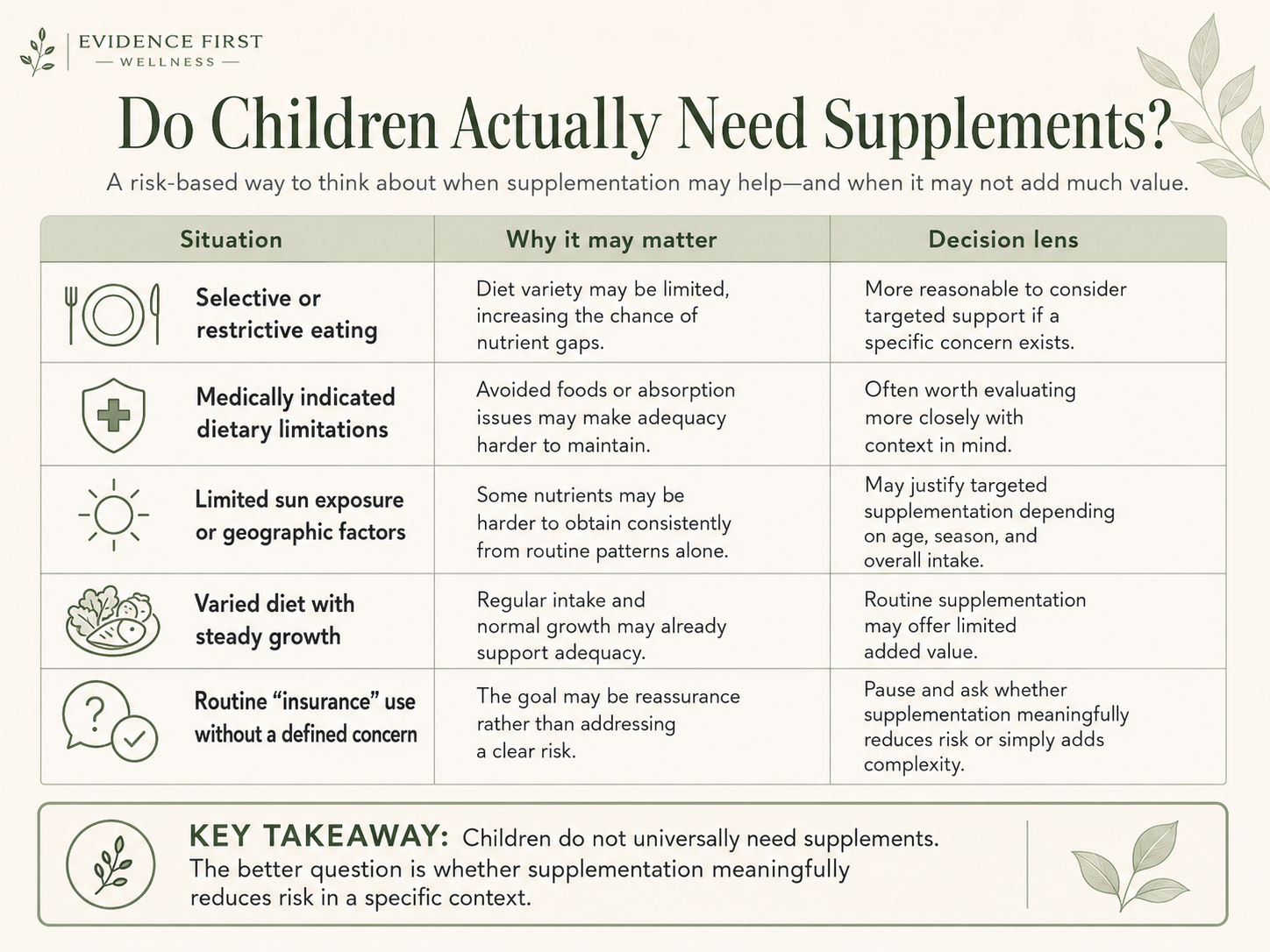
When Supplementation May Be Reasonable vs. When It May Offer Limited Value
| Situation | Why It May Matter | Decision Lens |
|---|---|---|
| Selective or restrictive eating | Limited dietary variety may reduce intake of certain nutrients | Define the specific gap and match the supplement to it |
| Medically indicated dietary limitations | Exclusion of food groups may affect nutrient adequacy | Use targeted supplementation in line with professional guidance |
| Limited sun exposure or geographic factors | Vitamin D synthesis depends on sunlight exposure, which varies significantly | Situational supplementation may be reasonable; dose and form still matter |
| Varied diet with steady growth | Dietary adequacy may already be met through food | Routine supplementation may add limited benefit; evaluate before adding |
| Routine "insurance" use without a defined concern | Motivation is reassurance, not a specific risk | Clarify what is being addressed before continuing; reassess duration |
This table is not a recommendation to supplement or not to supplement. It is a way to match context to decision-making rather than defaulting to either extreme.
Potential Downsides of Routine Supplement Use
While many supplements are well tolerated, routine use without a clear rationale can introduce tradeoffs. These may include unnecessary nutrient exposure, dosing that exceeds needs over time,⁶ reliance on supplements instead of dietary variety, and added ingredients that are not well studied in children.
Recognizing these tradeoffs helps keep decisions proportional rather than fear-driven. For a focused look at long-term use specifically, What Safety Data Exists for Long-Term Supplement Use in Children? examines where the evidence is strong and where meaningful gaps remain.
Answer 6 questions and get a personalized starting point — not a product recommendation, a framework built around your family’s actual situation.
Take the Quiz →Dose, Form, and Duration Still Matter
Even when supplementation is considered reasonable, how a supplement is used matters. Form and dose tend to matter more than ingredient count alone, particularly in pediatric contexts.
Duration also matters. Short-term, targeted supplementation differs meaningfully from long-term routine use. The Frameworks & Decision Tools Hub includes structured tools for thinking through these variables across different supplement categories.
Children Are Not Small Adults
One of the most common pitfalls in supplement decision-making is extrapolating adult practices to children.⁷ Children differ in metabolism, body size and composition, tolerance thresholds, and the available evidence base. Adult research does not automatically apply, and dose assumptions in particular require careful calibration to age and context.
Managing Expectations Around "Insurance" Supplements
Supplements are sometimes used as nutritional "insurance," a way to feel reassured even when dietary intake is uncertain. While this motivation is understandable, insurance framing can obscure important questions: Insurance against what, exactly? For how long? At what dose?
Without clear answers, supplementation can drift from a temporary support into an unexamined routine.
A Practical Way to Think About the Decision
Rather than asking whether children need supplements, a more useful approach is to ask: Is there a specific concern being addressed? Is supplementation likely to meaningfully reduce risk? Are form and dose appropriate for age and use? Is this decision intended to be temporary or ongoing?
This reframing keeps the focus on risk management, not optimization.⁸
Why This Matters for Families
Supplement decisions for children rarely feel theoretical. They happen in the context of a three-year-old who only eats beige food, or a child who has decided they do not like anything green, or a baby transitioning off formula and you are not sure what that changes. The specific situation is always different. The feeling underneath it, that you want to get this right and you are not entirely sure what right looks like, tends to be the same.
That is not a gap in your knowledge. It is the appropriate response to a genuinely complicated category. What helps is not a universal answer but a clearer way to ask the right question for your specific situation.
My own son is on a prescription multivitamin with fluoride, recommended for his age. I still find myself wondering whether the dose accounts for the fact that he is in the 99th percentile for his size, and whether the fluoride amount that was right for the average toddler is the right amount for him. Even when a supplement comes from a pediatrician, the specific questions do not go away. They just come with more professional confidence behind them.
Pulling It All Together
The answer to "does my child need a supplement" is almost never simply yes or no. It is: it depends on the child, the diet, the specific nutrient, and whether supplementation would actually change anything meaningful for the better. Those are answerable questions. They just require more than a product recommendation to work through.
The most useful question is not whether children need supplements. It is whether supplementation meaningfully reduces a real risk for this child, in this situation, at this stage.
If you're weighing a specific supplement for your child, you can submit a question to help guide future Evidence First Wellness content. This isn't medical advice, but reader questions help shape future explanations about evidence, formulation, and common marketing claims.
Get the Supplement Decision Framework and the Evaluation Checklist — free, printable, and delivered straight to your inbox.
Get the Free Starter Kit →References and Further Reading
- American Academy of Pediatrics. Where We Stand: Vitamin Supplements for Children.
- National Institutes of Health, Office of Dietary Supplements. Multivitamin/Mineral Supplements Fact Sheet.
- Centers for Disease Control and Prevention. Nutrition for Children and Adolescents.
- Harvard T.H. Chan School of Public Health. The Nutrition Source: Do Children Need Vitamin Supplements?
- National Academies of Sciences, Engineering, and Medicine. Dietary Reference Intakes (Population-Based Recommendations).
- National Academies of Sciences, Engineering, and Medicine. Tolerable Upper Intake Levels for Vitamins and Minerals.
- National Institutes of Health. Pediatric Research and Age-Specific Dosing Considerations.
- National Academies of Sciences, Engineering, and Medicine. Risk Assessment Framework for Nutrient Intake.
All sources are freely accessible via NIH, FDA, Harvard, or Google Scholar.
Content on this site is provided for educational purposes only and does not constitute medical advice. Individual health decisions should be made in consultation with qualified healthcare professionals.
The Evidence-Informed Family Supplement Guide covers this in depth — add your name to the waitlist ahead of launch.
Get evidence-first supplement guidance weekly — join the digest.

How to Choose a Children’s Multivitamin
A structured evaluation guide for choosing a children's multivitamin — covering formulation quality, dosage appropriateness, and what the front label doesn't tell you.
How to choose a children's multivitamin using criteria that actually matter.
Most parents who buy a children's multivitamin choose based on brand recognition, a flavor their child will accept, and the certification seal in the corner. There is a better set of criteria.
This article is not about finding the "best" children's multivitamin. It is about understanding how to evaluate options thoughtfully, using a framework that prioritizes safety, evidence, and real-world practicality.
Start With the Purpose, Not the Product
Before comparing brands or ingredients, it helps to clarify why a multivitamin is being considered.
For many children, multivitamins are used to fill potential nutritional gaps, support periods of selective eating, or provide reassurance during growth phases. They are not meant to replace a balanced diet or compensate for systemic nutritional concerns.¹ Keeping expectations realistic helps narrow choices and avoids unnecessary complexity.
Before comparing children's multivitamins, ask:
More Ingredients Are Not Always Better
Children's multivitamins often list long arrays of vitamins, minerals, botanicals, and extras. While this can look comprehensive, it does not necessarily translate to effectiveness.²
Important questions include: Are the included nutrients relevant for children? Are the doses appropriate for age and developmental stage? Are certain ingredients included primarily for marketing appeal?
A shorter ingredient list, when thoughtfully designed, can be more appropriate than an expansive one.² Ingredient lists are often used as marketing shortcuts, which is why understanding how labels present information is as important as the ingredients themselves.
What a Long Ingredient List Suggests, and What It Does Not Prove
Pay Attention to Dosage and Form
Dosage and ingredient form play a significant role in how a supplement functions and how it is tolerated.³
For children's multivitamins, this affects absorption, tolerability, and ease of consistent use.
Some products rely on very small amounts of many nutrients, while others focus on fewer nutrients at more meaningful levels. Neither approach is inherently right or wrong, but understanding the tradeoff helps parents choose intentionally.³
A children's multivitamin is only as useful as its dose, form, and fit.
The goal is not to find the longest label. It is to understand whether the nutrients included are relevant, reasonably dosed, tolerable, and practical for the child who will actually use them.
Consider Delivery Method and Practicality
Children's supplements come in many forms: gummies, chewables, liquids, and capsules or tablets. Each has implications beyond preference.
Factors to consider include sugar content and sweeteners, choking risk, taste and texture, and how many servings are required daily. A supplement that fits easily into daily routines is more likely to be used consistently, which matters more than theoretical perfection.
Children's Multivitamin Formats: Common Tradeoffs
| Format | Common Strengths | Common Tradeoffs | Best Fit |
|---|---|---|---|
| Gummies | Palatable; easy to build into routines; often accepted by children | Sweeteners; lower dosing flexibility; formulation and stability constraints | When acceptance and consistency are the main barriers |
| Chewables | Familiar format; may allow more flexibility than gummies; no swallowing required | Taste and texture can be issues; still may include sweeteners or flavors | When a child can tolerate chewing but capsules are not realistic |
| Liquids | Adjustable dosing; useful for younger children or swallowing difficulty | Taste, measuring accuracy, preservatives, and stability may matter | When dose adjustment or swallowing difficulty is the primary concern |
| Capsules / Tablets | More formulation flexibility; often easier to dose precisely; fewer taste constraints | Not practical for many children; swallowing difficulty may reduce adherence | When dosing precision and ingredient density matter more than palatability |
Be Thoughtful About Added Ingredients
Some children's multivitamins include additional ingredients such as probiotics, herbs, or "immune blends." These additions may sound appealing, but they often raise more questions than they answer.
Extra ingredients are not inherently problematic, but they should be included with intention and transparency.
When a children's multivitamin includes extras, ask:
Safety, Transparency, and Quality Signals
While parents are not expected to audit manufacturing facilities, certain signals can help indicate whether a product is thoughtfully made.
When information feels vague or overly promotional, it is reasonable to pause and reassess.⁴
Signals That Support Confidence, and Reasons to Pause
Answer 6 questions and get a personalized starting point — not a product recommendation, a framework built around your family’s actual situation.
Take the Quiz →A Practical Way to Compare Options
Rather than trying to evaluate everything at once, it can help to narrow choices using a few consistent questions.
Use these questions to keep the focus on function rather than marketing:
If You Are Choosing a Multivitamin Right Now
If you are actively comparing options, it can help to simplify the decision: prioritize meaningful dose over long ingredient lists, look for appropriate forms rather than just presence on the label, and be cautious with products that include many added ingredients without clear purpose. Choose a format your child will consistently take.
No product will be perfect across every dimension. But using a consistent framework makes it easier to choose something that is appropriate, practical, and aligned with your goals. Most families do not need to get this perfect. Just more intentional.
When the Right Formulation Does Not Exist as a Single Product
Sometimes the multivitamin that fits the need on paper does not exist in the format the child will actually take, or the one that comes in the right format is missing a nutrient that matters. When that happens, the better move is usually a simple targeted stack rather than settling for a product that almost fits.
That might mean a basic multivitamin covering the core vitamins plus a separate vitamin D. Or a multivitamin without iron paired with an iron supplement recommended by a pediatrician. It is more intentional than it sounds, and it is more honest than expecting one gummy to do everything.
The supplement industry tried to commercialize exactly this idea through personalized subscription services that bundled individual nutrients based on questionnaires, delivered monthly at a significant markup. The business model required customers to believe the customization was worth the premium. Most eventually figured out they could walk into a store and buy the same nutrients individually for a fraction of the cost. The services that survived had to rely on heavily discounted introductory offers just to keep people from doing the math. That is not a knock on the idea of targeted supplementation. It is a pretty clear signal that convenience has a price ceiling and most families found it quickly.
The middle path is simpler: know which gaps you are actually trying to address, use the least complicated product that addresses them, and resist the pull toward turning the kitchen counter into a supplement aisle. Precision is useful. Complexity for its own sake is not.
Why This Matters for Families
I will be honest about something. I have worked in this industry. I know the QA systems, the manufacturing floors, the gap that can exist between what a label says and what the process actually delivers. When I am standing in that aisle, I sometimes reach for a brand I know from the inside because I know what their standards look like. And sometimes I put it back for exactly the same reason. That knowledge does not make the decision easier. If anything, it makes me more careful about what I look for on the label, because I know how easy it is for a product to look good without being good.
For families who have not spent years inside a manufacturing facility, the label is what you have. Understanding how to read it, what the signals mean, and which differences actually matter is what makes the aisle less overwhelming and the decision less arbitrary.
The best choice is usually the one that fits the actual need clearly.
For families, a thoughtful children's multivitamin choice is not about finding the most complete label. It is about choosing a product with a clear purpose, reasonable dosing, practical format, and fewer unnecessary distractions.
Get the Supplement Decision Framework and the Evaluation Checklist — free, printable, and delivered straight to your inbox.
Get the Free Starter Kit →References & Further Reading
- National Institutes of Health Office of Dietary Supplements. Multivitamins and Dietary Supplements for Children.
- Harvard T.H. Chan School of Public Health. Vitamins and Minerals: Supplements and Children.
- National Institutes of Health Office of Dietary Supplements. Dietary Supplement Fact Sheets.
- U.S. Food & Drug Administration. Dietary Supplements: What You Need to Know.
All sources are publicly accessible and easily found via Google or Google Scholar.
Content on this site is provided for educational purposes only and does not constitute medical advice. Individual health decisions should be made in consultation with qualified healthcare professionals.
The Evidence-Informed Family Supplement Guide covers this in depth — add your name to the waitlist ahead of launch.
Get evidence-first supplement guidance weekly — join the digest.